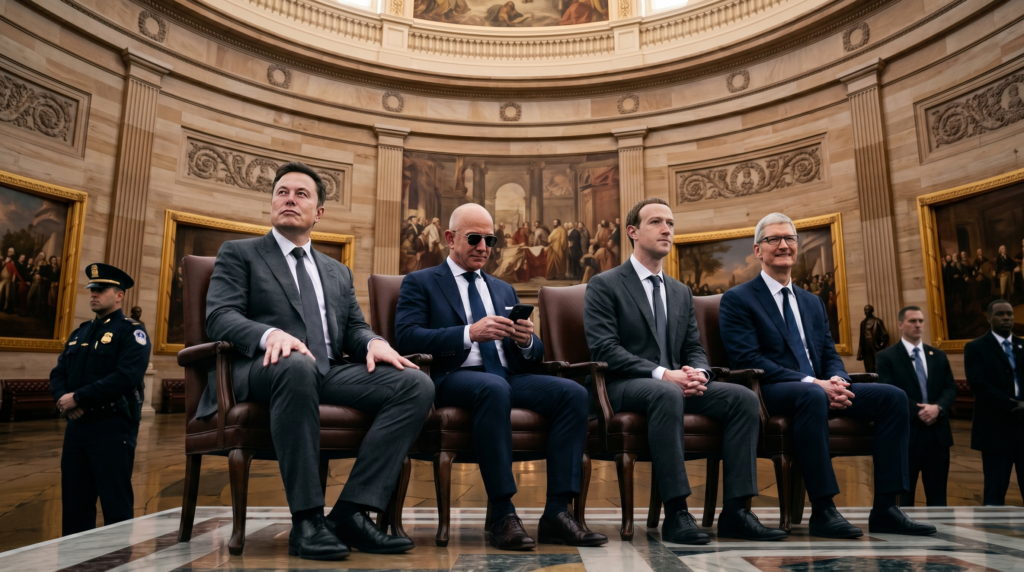
Billionaires influence markets through four primary mechanisms: concentrated equity ownership that moves prices when positions are disclosed or changed; public statements and social media that shift retail sentiment rapidly; activist investment pressure that forces corporate strategy changes; and political and regulatory access that shapes the rules within which markets operate.
Elon Musk posted four words about Dogecoin in 2021 and the price jumped 50% within hours. That is not coincidence, that is market influence at its most visible, and it is the least interesting version of how billionaire wealth actually moves financial markets.
The mechanisms that operate daily, quietly, structurally, without a single tweet are far more consequential. And understanding them is not academic. It is the difference between making investment decisions based on the actual forces shaping prices and making them based on information that arrived too late to be useful.
This is the real breakdown.
Why Concentrated Ownership Is the First and Biggest Lever
When a single individual owns 5%, 10%, or 20% of a publicly traded company, they are not simply an investor. They are a price-setting force.
Mandatory SEC disclosure rules require investors crossing the 5% threshold to file 13D or 13G forms. The moment that filing is public, the market reacts, typically pushing the price up, because the market reads large-stake ownership as a signal that the investor believes the stock is undervalued.
Warren Buffett’s Berkshire Hathaway positions follow this pattern with extraordinary consistency. When Berkshire discloses a new holding in its 13F filing, analysts and retail investors buy before the position is fully built. The price appreciation that follows is partly self-fulfilling, created by the market’s reaction to the disclosure rather than by any change in the underlying business.
Disclosure Timing Advantage
Most quarterly 13F filings are released 45 days after the end of the quarter. By the time the public sees what Buffett, Ackman, or Druckenmiller owned, the position was built months earlier, at lower prices.
Critical Rule: By the time a billionaire’s position appears in a 13F filing, the easy money is already made. Public disclosure is the exit signal for sophisticated traders, not the entry signal for retail investors.
The 13D filing is the most powerful single disclosure in public markets. It signals that a large investor has crossed 5% and intends to engage with management. Companies receiving 13D filings from activist investors historically see average price moves of 7–8% in the following week.
Interesting Article: What Companies Actually Control the Global Economy
Public Statements and the Social Media Multiplier
The direct statement mechanism is newer in form but ancient in function. When a billionaire investor publicly praises or attacks a company, a currency, or a commodity, the price moves. The question is by how much and in which direction.
The mechanism runs through two channels simultaneously. First, direct retail reaction, individual investors who follow the billionaire’s public commentary buy or sell based on the statement. Second, institutional reaction, funds recalibrate their risk models based on whether the statement signals that a major market participant is changing their position.
Crypto Case Study
Bitcoin’s price history from 2020 to 2022 shows the Musk effect with uncomfortable clarity. His February 2021 announcement that Tesla had purchased $1.5 billion in Bitcoin was followed by a 20% price increase in 24 hours. His May 2021 tweet suggesting Tesla might sell its holdings preceded a 30% drop over the following weeks.
Activist investing is the most operationally direct form of billionaire market influence, and the most studied.
Critical Warning: Social media market influence creates asymmetric risk for retail investors. The billionaire making the statement typically has a large existing position, they benefit from the price move in either direction. Retail investors who react to the statement are buying or selling after the information has already been priced in by faster-moving institutional capital.
This is not market manipulation in every case, it is the structural consequence of information asymmetry. The person with the largest position also has the largest microphone.
Activist Investing as a Direct Price Creation Mechanism
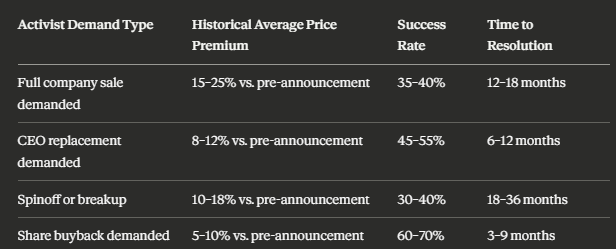
When an investor like Carl Icahn, Bill Ackman, or Dan Loeb takes a significant stake in a company and publicly demands strategic changes, a spinoff, a buyback, a management change, a sale of the company, the market reacts not just to the current price signal but to the probability-weighted expected value of the demanded outcome.
The buyback demand has the highest success rate for a specific reason: it requires the least structural change to the company while immediately returning capital to shareholders, making it the path of least resistance for boards facing activist pressure.
Why Tracking Billionaire Moves Often Goes Wrong
Most retail investors who try to “follow the smart money” make predictable mistakes that erode rather than build returns.
The lag problem is fatal in fast markets. 13F data is 45 days old. In a volatile quarter, a position that looked attractive when the billionaire built it may have already moved 20–30% by the time the public sees the disclosure. Buying after the disclosure means buying someone else’s intended exit.
Context collapse creates false signals. A 13F filing shows position sizes but not conviction levels, hedging strategies, or the specific thesis behind the trade. Buffett’s Berkshire buying airline stocks in 2016 looked like a strong signal, he sold them all at a loss in 2020. The filing showed the trade. It didn’t show the reasoning or the exit plan.
Avoid Doing This
- Focus on 13D filings rather than 13F, they’re more recent and signal active engagement
- Cross-reference disclosed positions with the investor’s publicly stated investment thesis
- Use 13F data as a market structure map, not a trade signal, understanding what major players own tells you where selling pressure will come if sentiment shifts
Billionaire Signal Stack for Proprietary Framework
Think of billionaire market influence as a stack of signal types, ordered by how much time-advantage you have to act on them.
Level 1 — Structural Position: The billionaire builds a position over months. The market doesn’t know. Zero time advantage for outsiders.
Level 2 — Regulatory Disclosure: 13D filed within 10 days of crossing 5%. Small time advantage, you see it quickly, but so does every algorithm.
Level 3 — Public Statement: Tweet, interview, or conference comment. No time advantage, algorithms trade faster than human readers.
Level 4 — Media Narrative: Journalists report on the position or statement. Negative time advantage, you’re reading yesterday’s move.
The only level where a retail investor can develop a genuine edge is Level 2, monitoring SEC EDGAR for real-time 13D filings, not waiting for financial media to summarize them. This is entirely public information. Most retail investors simply don’t know where to look.
Within the Upcoming 24 Hours, Try This:
- Set up a free SEC EDGAR alert for 13D filings in your sectors of interest. You will see activist moves the same day they are disclosed, before most financial media covers them.
- Build a watchlist of 5 billionaire investors whose investment thesis is publicly documented (Buffett, Ackman, Druckenmiller, Burry, Tepper) and track their 13F changes quarter over quarter as a market structure map rather than a trade signal.
- Audit your existing holdings for positions that are heavily owned by one or two large investors, these positions carry concentration risk that will materialize as selling pressure if that investor exits, regardless of the underlying business quality.
You Need to Keep This in Mind
- Billionaire market influence operates through four mechanisms: equity ownership disclosure, public statements, activist investment pressure, and regulatory/political access.
- 13F filings are 45 days old, they are market structure maps, not trade signals.
- 13D filings are the highest-value real-time signal available from public regulatory data.
- The “follow the billionaire” strategy fails retail investors who act on information they received too late.
- Monitoring SEC EDGAR directly for 13D filings gives any investor access to the same regulatory disclosure data that professional analysts use.
Also Read: How Much Power Do Billionaires Really Have in 2026?
Final Verdict
The market influence of billionaires in 2026 is more powerful, more diverse, and more systematically exploited than at any previous point, because information infrastructure now allows concentrated wealth to move faster through social channels than regulatory frameworks were designed to anticipate.
The winners are investors who understand the signal stack and work upstream of public disclosure. The losers are the ones who read about a billionaire’s position in a news article and buy at the price the article’s publication has already set.
FAQs – Frequently Asked Questions
Yes, if they manage over $100M (Form 13F), own more than 5% of a company (Form 13D/G), or are corporate insiders (Form 4).
Generally yes, provided the statement is truthful and they aren’t trading on material non-public information.
They buy large stakes in companies and publicly push for strategic changes, profiting when the stock price rises in anticipation of those changes.
They use private derivatives like total return swaps, collar options, and forward contracts to reduce risk without triggering public sale disclosures.
It is a quarterly SEC report of a fund’s equity holdings used by investors to track institutional trends, though it has a 45-day reporting lag.
While his tweets caused massive price swings, no market manipulation charges have been successfully prosecuted due to the high legal bar of proving an intent to deceive.
While billionaires represent a tiny fraction of the population, the top 1% of US wealth holders overall own roughly 50–55% of all stocks and mutual funds.
Carl Icahn, Bill Ackman, and Warren Buffett reliably move prices through their SEC filings, while Elon Musk generates some of the largest single-day moves via social media.

UK-based journalist covering UAE entrepreneurship, executive branding, and leadership growth across global business ecosystems.