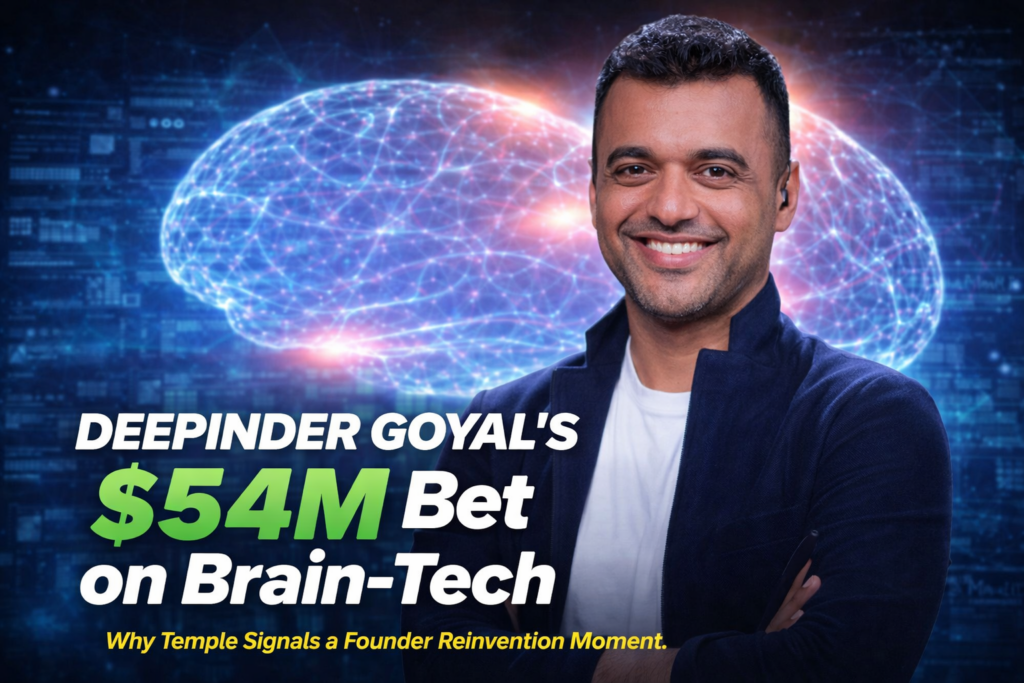
When Deepinder Goyal stepped down earlier this year as CEO of Zomato — now operating under parent entity Eternal — many assumed the Indian entrepreneur would pivot into investing quietly.
Instead, he has returned with something far more ambitious: a $54 million friends-and-family raise for Temple, a brain-monitoring wearable startup targeting elite performance athletes.
According to regulatory filings reviewed by TechCrunch, Temple closed the round at a post-money valuation of approximately $190 million. Goyal is leading the funding round himself, joined by investors including Steadview Capital, Peak XV Partners (formerly Sequoia India), InfoEdge Ventures, Dharana Capital, and a cohort of India’s most prominent founders.
Notably, over 30 employees participated at the same valuation — signaling internal conviction in the product’s future.
But this isn’t just another wearable startup story.
It’s a founder reinvention play.
From Food Delivery to Brain Monitoring
Goyal built Zomato into one of India’s largest consumer technology companies after co-founding it in 2008. Under his leadership, Zomato expanded aggressively, acquiring Uber Eats India in 2020 and grocery platform Blinkit (formerly Grofers) in a $568 million deal in 2022.
In January 2026, Goyal handed CEO duties to Albinder Dhindsa, head of Blinkit, marking the end of nearly two decades of operational leadership.
Temple represents the clearest articulation of what he previously described as a move toward “higher-risk exploration and experimentation.”
The device Temple is building is reportedly designed to sit on the wearer’s temple and continuously track cerebral blood flow — a metric not typically captured by mainstream wearables like Whoop, Oura, or Garmin.
If successful, the device could push wearables beyond heart rate and sleep tracking into neurological performance monitoring.
That’s a far more complex — and controversial — frontier.
The Brain Is the Last Performance Frontier
Elite sports performance is already saturated with biometric data. Recovery scores, HRV tracking, glucose monitoring — these are mature categories.
But cerebral blood flow monitoring ventures into brain-computer interface territory — an area increasingly explored by companies like Neuralink and other neurotechnology firms.
Temple, according to Goyal’s public comments, aims to measure neurological metrics existing devices cannot.
If validated scientifically, this could unlock:
- Enhanced cognitive recovery tracking
- Real-time fatigue detection
- Concussion or micro-impact monitoring
- Neural focus optimization
However, brain-signal measurement is notoriously difficult. Signal noise, motion interference, and calibration challenges have limited consumer-scale neuro-wearables historically.
Temple will need to demonstrate not just innovation — but reproducibility and regulatory viability.
The Founder Pivot: From Scale to Speculation
Temple is part of a broader pattern in Goyal’s recent portfolio.
In October 2025, he committed $25 million of his own capital into Continue Research, a longevity-focused venture exploring lifespan extension. He is also linked to aviation startup LAT Aerospace, which recently expanded into defense technologies.
This shift suggests a deliberate move away from hyper-growth consumer marketplaces toward frontier science and performance technology.
For founders exiting large-scale platforms, this pivot is becoming common:
- Move from operational scale
- To deep tech speculation
- Backed by personal capital
It signals a maturing founder class in India — one willing to reinvest gains into high-risk R&D sectors rather than incremental SaaS plays.
Why Temple Is a High-Risk, High-Reward Play
The wearables market remains competitive and heavily funded. According to reports cited by CB Insights, the global wearable technology market continues to expand, but differentiation has narrowed.
Temple must answer three questions:
- Can it measure cerebral blood flow accurately in real-world athletic environments?
- Will elite athletes adopt neuro-monitoring as part of training?
- Can it expand beyond niche performance markets into broader health tech?
Without clear clinical validation, the company risks becoming a speculative hardware experiment.
With validation, it could redefine performance tracking.
Emerging Market for Neurotechnology Wearables
Consumer wearable technology has evolved rapidly over the past decade. Early devices primarily counted steps and estimated calories burned. Modern wearables now measure heart rate variability (HRV), blood oxygen saturation (SpO2), sleep quality, stress levels, skin temperature, ECG readings, and even glucose trends through companion technologies.
The next frontier appears to be neurological monitoring.
Researchers and technology companies increasingly believe that understanding brain activity and cerebral health could provide deeper insights into cognitive performance, fatigue, recovery, and overall human optimization. If accurate, continuous brain monitoring becomes commercially viable, it could transform not only elite sports but also healthcare, workplace productivity, rehabilitation, and scientific research.
Temple is entering this market at a time when demand for personalized health data continues to grow worldwide. However, unlike traditional fitness metrics, neurological measurements require significantly higher scientific precision and validation before earning widespread trust among consumers, medical professionals, and regulatory authorities.
Scientific Validation Will Be the Ultimate Test
Unlike consumer fitness metrics that provide general wellness insights, measurements related to cerebral blood flow have potential clinical implications.
That raises the standard considerably.
To gain long-term credibility, Temple will likely need to demonstrate:
- Independent clinical validation through peer-reviewed research.
- Consistent measurement accuracy across different users and environments.
- Regulatory compliance in markets where neurological monitoring devices require approval.
- Clear evidence that its data produces actionable insights beyond existing wearable technologies.
- Strong data privacy and cybersecurity protections for highly sensitive biometric information.
Without rigorous validation, even groundbreaking hardware may struggle to achieve mainstream adoption.
Conversely, successful validation could position Temple among the pioneers of consumer neurotechnology.
Opportunities and Challenges Ahead
Temple enters one of the most technically demanding segments of wearable technology.
Several opportunities could accelerate its growth:
- Rising investment in sports science and athlete performance optimization.
- Growing public interest in preventive health and biohacking technologies.
- Expanding demand for AI-powered personalized health insights.
- Increasing adoption of wearable devices across professional sports organizations.
At the same time, meaningful challenges remain.
The company must overcome engineering complexity, educate consumers about neurological biomarkers, navigate evolving healthcare regulations, compete against established wearable brands, and justify premium pricing through measurable performance improvements.
Because neurotechnology remains an emerging category, commercialization timelines may be longer than those of conventional consumer electronics.
Industry Perspective
The broader wearable technology industry is gradually shifting from passive health tracking toward predictive and intelligent health management.
Artificial intelligence plays a central role in this transformation.
Rather than simply collecting biometric data, modern platforms increasingly analyze multiple physiological signals simultaneously to identify patterns, forecast health risks, optimize recovery, and deliver personalized recommendations.
If Temple successfully combines reliable neurological measurements with advanced AI analytics, it could help create a new category of cognitive performance technology.
However, sustained success will depend less on marketing claims and more on scientific evidence, real-world performance, and user trust.
Editorial Analysis
After reviewing publicly available information regarding Temple, Deepinder Goyal’s investment strategy, and current developments within the wearable technology industry, one observation becomes clear: this venture represents a significantly different entrepreneurial challenge from building a consumer internet platform.
Food delivery businesses primarily compete through logistics, network effects, and operational efficiency.
Neurotechnology companies compete through scientific credibility, engineering precision, regulatory compliance, and long-term research.
This transition reflects an increasingly common trend among successful technology founders who redirect their experience and capital toward solving technically complex problems with potentially long development cycles.
Temple’s success will therefore depend not only on product innovation but also on its ability to establish credibility within both the scientific and medical communities.
Our Assessment
Based on currently available information, Temple possesses several advantages that distinguish it from many early-stage hardware startups.
First, the company benefits from founder-led funding and support from experienced investors with long-term investment horizons.
Second, employee participation in the funding round suggests meaningful internal confidence in the company’s vision and execution.
Third, the product targets an emerging category where meaningful technological breakthroughs remain possible.
Nevertheless, investors and industry observers should recognize that brain-monitoring wearables remain significantly more complex than conventional fitness devices.
Scientific reproducibility, regulatory approval, hardware reliability, and market adoption will ultimately determine whether Temple evolves into a category-defining platform or remains a niche performance technology.
Final Thoughts
Deepinder Goyal’s $54 million investment in Temple marks more than a founder’s next entrepreneurial chapter. It reflects a broader shift within India’s startup ecosystem toward deep technology, frontier science, and long-term innovation.
As artificial intelligence, wearable computing, and neuroscience continue to converge, companies capable of delivering reliable neurological insights could unlock entirely new approaches to human performance and preventive healthcare.
Yet the path forward will not be defined by ambitious vision alone.
Scientific validation, regulatory compliance, user trust, and measurable outcomes will ultimately determine whether neurotechnology becomes the next major evolution of wearable devices.
Temple’s journey is still in its early stages, but its focus on brain health rather than conventional fitness metrics makes it one of the more intriguing startups to watch as the global health technology market continues to evolve.
Frequently Asked Questions (FAQs)
Temple is a brain-monitoring wearable technology startup founded by Deepinder Goyal. The company is developing a wearable device designed to continuously measure cerebral blood flow and provide neurological performance insights, particularly for elite athletes.
Temple has raised $54 million in a friends-and-family funding round led by Deepinder Goyal at a reported post-money valuation of approximately $190 million.
The funding round includes participation from Deepinder Goyal, Steadview Capital, Peak XV Partners, InfoEdge Ventures, Dharana Capital, several prominent Indian founders, and more than 30 company employees.
Most traditional wearables monitor physiological metrics such as heart rate, sleep, activity levels, and blood oxygen. Temple aims to monitor cerebral blood flow, potentially providing deeper insights into cognitive performance, fatigue, recovery, and neurological health.
Cerebral blood flow is closely associated with brain function and cognitive performance. Researchers continue to study how changes in blood flow relate to mental fatigue, recovery, attention, concussion assessment, and overall neurological health.
Temple must demonstrate scientific accuracy, validate its technology through clinical research, obtain regulatory approvals where required, protect sensitive biometric data, and convince athletes and consumers that neurological monitoring provides meaningful benefits beyond existing wearable technologies.
AI can analyze complex biometric signals, identify patterns across multiple physiological measurements, generate personalized recommendations, detect anomalies, and improve the interpretation of neurological data collected by wearable devices.
Deepinder Goyal’s decision to lead Temple’s funding round signals a strategic shift from consumer internet businesses toward deep technology and frontier healthcare innovation. It also reflects growing investor interest in neuroscience, AI-powered health technologies, and next-generation wearable devices that extend beyond traditional fitness tracking.

Dwayne Paschke is a seasoned content strategist and AI automation specialist with over nine years of experience at the intersection of journalism and digital innovation. A versatile force in the media landscape, Dwayne has built a reputation as an expert content writer and investigative journalist, contributing high-impact pieces to various reputable news websites.