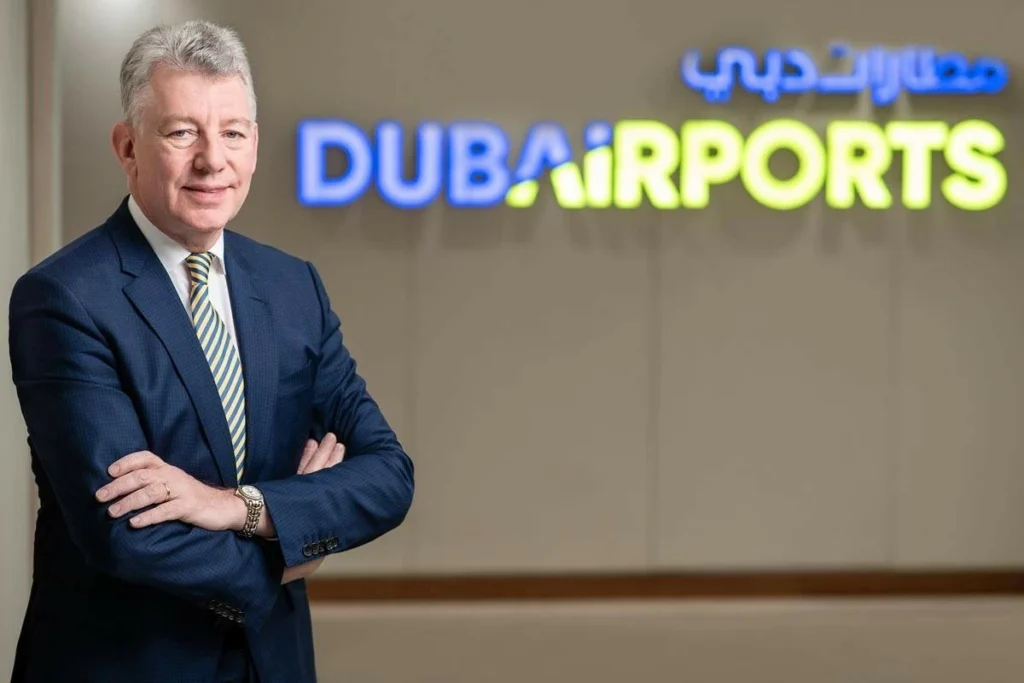
Paul Griffiths is the CEO of Dubai Airports, the company operating Dubai International Airport (DXB) and Al Maktoum International Airport (DWC). He has held the role since October 2007, making him one of the longest-serving airport chief executives in the world. The reason he is being discussed is that Dubai Airports has just revised its 2026 passenger forecast down to around 70 million, while confirming a Dh55 billion expansion of DWC.
Dubai’s aviation sector has spent 2026, mostly in the headlines for reasons nobody at Dubai Airports would have chosen. Regional conflict grounded flights, missile alerts sent staff into shelters, and a 100-million-passenger target quietly slipped a year down the calendar. Through all this, one name keeps appearing in the briefings: Paul Griffiths.
Who Is Paul Griffiths?
Griffiths is a British aviation executive who has run Dubai Airports since October 2007, overseeing both DXB, the busiest airport in the world for international passengers, and DWC, the mega-airport being built to eventually replace it. He was appointed the operator’s first-ever CEO, and nearly nineteen years later he remains in the chair, which is unusual longevity in an industry where airport chiefs typically move on after five or six years.
Paul Griffith’s Career Before Dubai Airports
Griffiths did not follow the usual route into airport management. He entered the travel industry in 1977, and by the mid-1980s was working in Hong Kong as marketing manager for the then-startup carrier Dragonair. He later returned to the UK and set up a software company building information management systems for airlines, one of which was contracted to Virgin Atlantic.
In 2004 he moved into airport operations proper, joining BAA and becoming managing director of London Gatwick Airport, at the time the UK’s second-busiest airport. Three years later, Dubai came calling, and in October 2007 Griffiths became the founding CEO of the newly formed Dubai Airports. The combination is unusual for an airport boss: software and data systems, airline commercial strategy under Branson, and then hands-on airport operations at Gatwick, all before he ever set foot in Dubai in a professional capacity.
What Does Paul Griffiths Do at Dubai Airports?
As Dubai Airports CEO, Griffiths is responsible for running and developing both DXB and DWC, which together make up the emirate’s entire commercial airport system. That covers day-to-day operations, capacity planning, infrastructure investment, and coordination with the airlines that depend on the airports, chiefly Emirates and flydubai, along with more than fifty other international carriers.
A large part of his current job is long-range planning rather than daily operations. Griffiths has to decide how DXB’s remaining runway and terminal capacity gets allocated as it approaches its physical limit, while simultaneously overseeing the construction of DWC, a project on a scale few airport executives ever get to manage. He also acts as the public face of Dubai Airports, briefing journalists and industry bodies on traffic figures, expansion timelines, and, this year, on how the operator coped with a regional conflict that disrupted flights for weeks.
Paul Griffiths and the Growth of Dubai Aviation
Griffiths’ tenure has coincided with Dubai’s transformation into a genuine global aviation hub. A year after joining, he oversaw the launch of Terminal 3 at DXB in October 2008, followed by the opening of Concourse A in January 2013, the world’s first purpose-built A380 facility, and Concourse D in February 2016. In between, he opened Dubai World Central in June 2010, giving the emirate a second commercial airport for the first time.
In his leadership, DXB overtook London Heathrow to become the world’s busiest airport for international passengers, a position it has held for roughly twelve years. In 2025, DXB handled a record 95.2 million passengers, the highest annual international traffic figure ever recorded by an airport. It also passed one billion cumulative passengers in 2018, a milestone Griffiths marked with Emirates Group chairman Sheikh Ahmed bin Saeed Al Maktoum, whom he has called a mentor.
Why Paul Griffiths Is in the News Now
Paul Griffiths has been unusually visible in the press over the past few weeks, largely because Dubai Airports has had a difficult year to explain. The Iran war and the resulting closure of Gulf airspace disrupted operations for nearly two months in early 2026, and DXB’s passenger numbers fell sharply as a result: 31.5 million in the first half of 2026, down from 46 million in the same period a year earlier.
On September 10, Griffiths told Reuters that Dubai Airports now expects to finish 2026 with around 70 million passengers, well short of the roughly 100 million originally targeted, though he added that the 100 million milestone could still be reached by the end of 2027. He also disclosed that DXB was hit with 111 separate ballistic missile alerts during the conflict, telling Fortune that infrastructure damage was slight but that the crisis “tested the resilience and professionalism of our people.”
The recovery, though, has been steady. Traffic climbed from a low of 2.5 million passengers in March to 6.3 million in July, a 26 percent month-on-month jump, and capacity has recovered to roughly 84 percent of pre-war levels, with passenger numbers back to about 78 percent. “We’ve been 12 years as No 1, and I’m not going to lose that crown to anyone else,” he told The National in late August, referring to DXB’s status as the world’s busiest international hub.
What Is Paul Griffiths Saying About Al Maktoum International?
Even while managing DXB’s recovery, Griffiths has kept the DWC expansion on schedule. Dubai Airports plans to award another Dh55 billion in construction contracts by the end of 2026, on top of Dh13 billion already under construction. The project has also logged 10 million work hours, with around 17,000 concrete piles driven and 45 million cubic metres of earth moved.
On September 11, Griffiths confirmed that DWC’s second runway is scheduled to open by the end of 2027, calling it “the next major milestone for DWC.” The first phase of the expanded airport, offering capacity for 150 million passengers, is expected to open in the early 2030’s
Flydubai is expected to move five or six aircraft from DXB to DWC as early as 2027, starting a gradual, multi-year transition. Griffiths compared the move to Hong Kong’s airport relocation, but on a much larger scale. Once DWC reaches its planned 150-million-passenger capacity, all DXB operations are expected to transfer there.
DXB vs DWC At a Glance
| Dubai International (DXB) | Al Maktoum International (DWC) | |
| Status | Operating, the world’s busiest international hub. | Under expansion. |
| 2025/2026 traffic | 95.2 million (2025 record); ~70 million forecast for 2026. | Limited commercial passenger operations currently. |
| Maximum capacity | Approximately 114–115 million by 2031. | Up to 260 million once fully built. |
| Runways (current/planned) | Existing operational runways. | Second runway due 2027; five runways at completion. |
| Key milestone | Reached maximum practical capacity around 2031. | The first phase (150 million capacity) expected early 2030s; full completion around 2032. |
| First airline to relocate | — | Flydubai, from as early as 2027 |
Paul Griffiths’ Role in Dubai’s Aviation Future
The reason Griffiths keeps returning to DWC in every interview is capacity math. He has said publicly that DXB will reach its practical ceiling of roughly 114 to 115 million passengers a year by around 2031, with demand projected to climb to about 124 million by 2032, a figure DXB physically cannot handle alone. That is why the full transition of DXB’s operations to DWC is now pencilled in for 2032, once DWC’s first phase is complete.
What Is Paul Griffiths Known For?
Within the aviation industry, Griffiths is known chiefly for two things: turning DXB into the world’s busiest international airport and holding that position for over a decade, and for now leading the construction of what is intended to become the world’s largest airport at DWC.
He is also recognised for an unconventional route into the industry, moving from airline software development through a long stint at Virgin Group under Richard Branson before arriving in airport management. Outside aviation, he is a trained musician and a vice president of the Royal College of Organists, a detail that occasionally surfaces in profiles but has little bearing on his day job running Dubai’s airports.
To Sum Up
Paul Griffiths has spent nearly nineteen years building Dubai Airports into the operator of the world’s busiest international airport, and he is now managing that airport through the most disruptive year of his tenure while simultaneously pushing forward a Dh55 billion expansion of its eventual successor. Paul matters because the decisions he is making now, on runway construction, airline relocation, and recovery timelines, will determine how many people can fly in and out of Dubai for the next two decades.
Frequently Asked Questions – FAQs
Paul Griffiths is the CEO of Dubai Airports, overseeing Dubai International Airport (DXB) and Al Maktoum International Airport (DWC). He has held the role since October 2007.
Paul Griffiths has been CEO of Dubai Airports since October 2007, making him the operator’s first and, so far, only chief executive.
Nearly nineteen years as of September 2026, having joined in October 2007. That makes him one of the longest-serving airport CEOs anywhere in the world.
Paul Griffiths is known for overseeing DXB’s growth, including the launch of Terminal 3 and Dubai World Central. He now leads the major expansion of Al Maktoum International.
He is leading DWC’s expansion, including a Dh55 billion construction programme and a second runway due in 2027.
Because he controls the pace and shape of Dubai’s entire airport capacity, decisions that directly affect the emirate’s tourism, trade, and global connectivity for decades to come.

UK-based journalist covering UAE entrepreneurship, executive branding, and leadership growth across global business ecosystems.