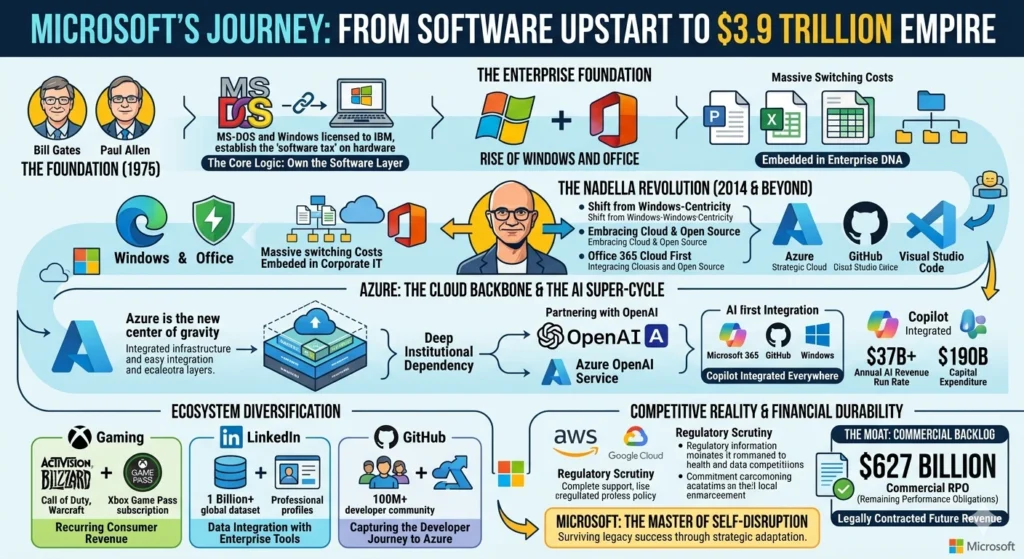
Microsoft emerged as a digital age pioneer when Bill Gates and Paul Allen founded the software upstart in 1975, according to Microsoft’s website. In the early 2010s, a certain narrative about Microsoft had become conventional wisdom in technology circles. The company had missed mobile. It had missed social. Its Windows and Office franchises were aging. The enterprise was loyal but the enterprise was slowly changing. Microsoft was, in this telling, the IBM of its generation, a former titan managing a long, dignified decline.
That assessment was wrong. And the fact that it was wrong so completely, and that the reassessment required such a fundamental revision of how people thought about the company, makes Microsoft’s trajectory perhaps the most instructive story in the history of technology business.
That level of product diversification has earned Microsoft a staggering $3.9 trillion market cap, second only to NVIDIA, per CompaniesMarketCap. It’s bigger than Apple, Alphabet, Amazon and Meta. Microsoft is worth three times more than Tesla.
What Microsoft built over the decade that followed that conventional wisdom isn’t just a recovery. It’s a genuinely stronger position than the company held at its 1990s peak, distributed across more sectors, with more durable competitive moats, and with a strategic positioning in AI that may define the next era of computing.
How Microsoft Got Here from the Foundation
Bill Gates’ original insight was not primarily technical. It was structural.
IBM needed an operating system for its personal computer. Gates didn’t write one — he acquired QDOS from a small Seattle company, had it adapted into MS-DOS, and licensed it to IBM in a deal that gave Microsoft the right to license the same operating system to other hardware manufacturers. IBM, which made its money on hardware, didn’t consider this consequential.
It was, in retrospect, the most consequential licensing agreement in technology history. When IBM-compatible PC hardware proliferated and MS-DOS, then Windows, came installed on all of it, Microsoft established the core logic of its empire: own the software layer through which users access computing, and tax the entire hardware industry indirectly.
Windows as a platform created the Office productivity suite as an ecosystem. Office became the primary productivity environment for hundreds of millions of workers globally, not because it was always the best product but because switching costs were enormous once documents, workflows, and organizational knowledge were embedded in its format. The ability to open a .doc file became a business necessity that entrenched Microsoft’s position across organizations regardless of what alternatives emerged.
The antitrust battles of the late 1990s and early 2000s constrained Microsoft’s ability to use its operating system monopoly as leverage for adjacent markets, but they didn’t dismantle the enterprise foundation. That foundation deeply embedded in corporate and government IT infrastructure was what gave the company its strategic runway when the reinvention came.
From Windows Empire to Cloud Empire with the Help of Nadella
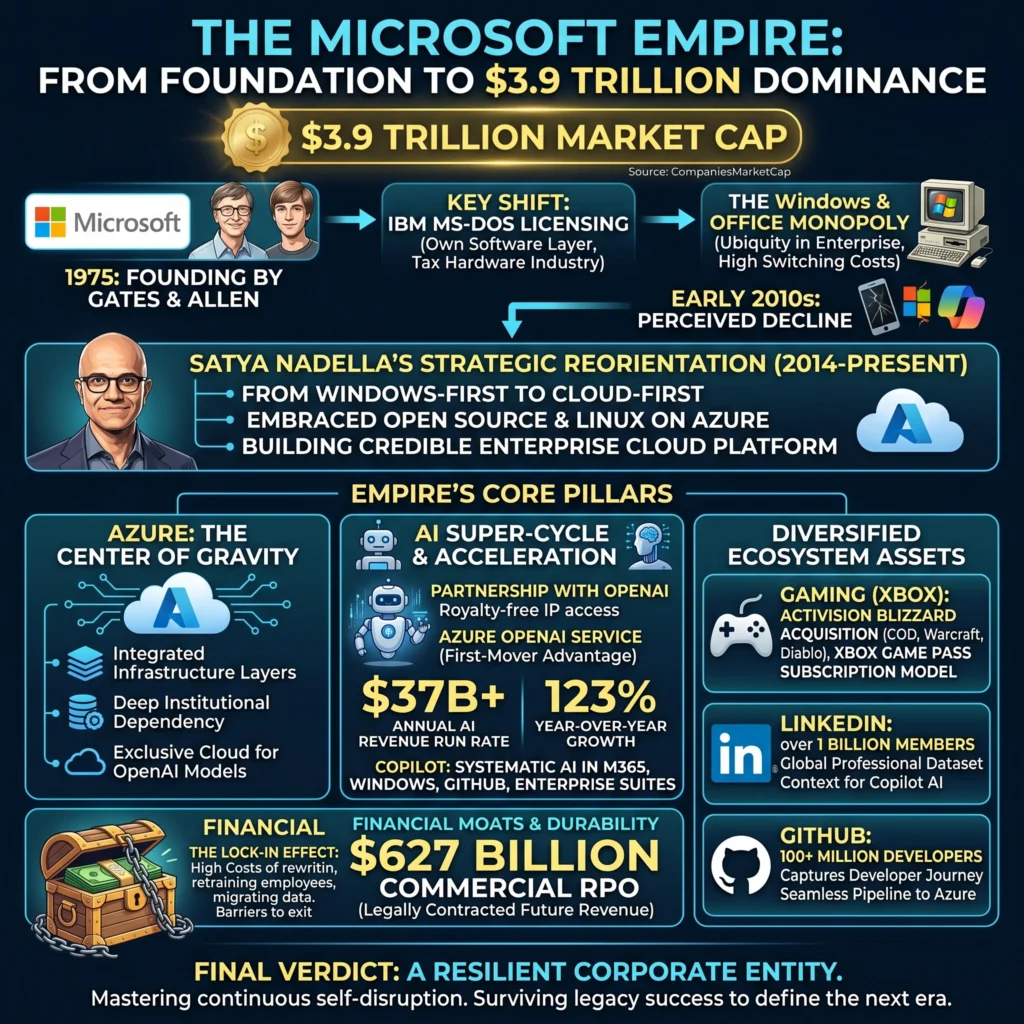
When Satya Nadella became CEO in February 2014, he inherited a company that was profitable but strategically disoriented. The Windows revenue model was under pressure from the mobile shift. The company’s cloud efforts, Azure had launched in 2010 were running well behind AWS. Bing had failed to significantly challenge Google Search. The acquisition of Nokia’s handset division had been a strategic error of embarrassing proportions.
Nadella’s transformation was not a single dramatic gesture. It was a sustained reorientation of strategic priorities that took years to fully manifest in the financials.
The core strategic decision was to stop treating Windows as the center of gravity. Microsoft had organized itself, its priorities, its product decisions, its partnership logic around protecting and extending Windows. Nadella’s insight was that the center of gravity in enterprise computing was shifting to cloud services, and that Microsoft needed to compete in that environment on merit, not through operating system leverage.
This meant making genuine commitments to building Azure into a credible enterprise cloud platform. It meant embracing Linux and open source, Microsoft had historically treated open source as an existential threat, and running Linux on Azure. It meant making Office 365 genuinely good as a cloud product rather than protecting the on-premise license revenue model. It meant rebuilding the company’s developer relations through significant investments in GitHub (acquired 2018), Visual Studio Code, and the broader developer tools ecosystem.
The cultural dimension of the transformation is often discussed Nadella’s emphasis on “growth mindset,” on learning and collaboration rather than internal competition, but the cultural change was downstream of the strategic clarity. When the strategic direction is clear and demonstrably working, organizational culture follows more readily than the reverse.
Azure’s Contribution for The Infrastructure of Microsoft Empire
Azure is the center of gravity for Microsoft’s current competitive position and the element of the empire most people outside technology circles underestimate.
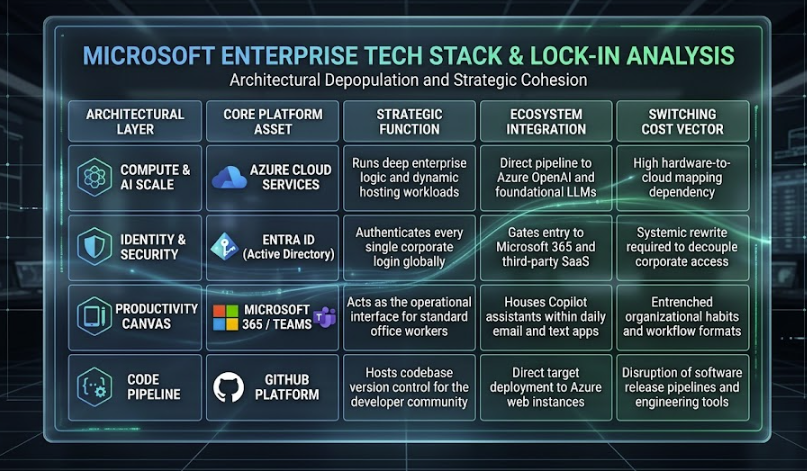
The cloud computing landscape has crystallized into a massive, fiercely contested infrastructure market. To understand Microsoft’s position, we can look at how the core layers of its cloud ecosystem interlock to form an inescapable corporate environment.
The Enterprise Cloud Stack Profile
The modern technology empire does not rely on isolated software sales; it functions through integrated infrastructure layers that secure deep institutional dependency
The Mechanics of the AI Super-Cycle
Azure’s strategic importance extends far beyond its direct computing revenue. In 2026, it positions Microsoft in the artificial intelligence era in a way that is architecturally uncomparable. The partnership with OpenAI, fortified by unprecedented capital infusions and an amended long-term agreement giving Microsoft royalty-free IP access is not simply a financial stake. It is a structural integration.
Azure functions as the exclusive cloud infrastructure on which OpenAI’s models are trained and run. This integration manifests in the Azure OpenAI Service, which serves as the enterprise-facing deployment platform for GPT models, giving Microsoft a first-mover advantage in embedding AI capabilities across its entire software portfolio
Financially, this strategy has triggered an explosive expansion. Microsoft’s annual AI revenue run rate has surged past $37 billion, growing at 123% year-over-year. To feed this insatiable compute demand, Microsoft has raised its capital expenditure guidance toward an unprecedented $190 billion, dedicating nearly two-thirds of that capital to high-performance silicon, graphics processing units (GPUs), and custom data center buildouts.
Copilot, the AI assistant systematically baked into Microsoft 365, Windows, GitHub, and its enterprise resource suites, is the surface expression of this strategy. Because Microsoft already owns the desktop and cloud distribution channels, every pre-existing enterprise seat represents an instant cross-sell opportunity for AI services, creating a monetization ramp that pure software competitors cannot replicate.
Skype
Before the COVID-19 pandemic helped make Zoom the world’s dominant videoconferencing platform, Skype was the leading name in online voice and video calling. Launched in 2003, Skype pioneered internet-based communication and played a major role in popularizing video chat for both personal and business use.
In 2011, Microsoft acquired Skype for $8.5 billion, bringing its more than 160 million active users into the company’s ecosystem. Despite growing competition from platforms such as Zoom, Skype remained widely used for years, and many users did not realize it was owned by Microsoft.
Skype retained its distinct brand identity until May 2025, when Microsoft officially began retiring the service and encouraging users to transition to Microsoft Teams. While the Skype application itself has been phased out, some voice-over-IP (VoIP) services and communication systems continue to rely on technology and infrastructure that originated from Skype, often without users being aware of it.
Gaming, LinkedIn, and Ecosystem Diversification
Microsoft’s empire extends beyond enterprise software and cloud infrastructure into consumer and professional network assets that create massive strategic optionality.
Xbox and the broader gaming division represent a genuine consumer platform bet. The acquisition of Activision Blizzard, one of the largest acquisitions in the history of the technology industry, completed after a protracted global regulatory battle gave Microsoft control of iconic franchises including Call of Duty, Warcraft, and Diablo.
This dramatically expanded the content library available through Xbox Game Pass, Microsoft’s subscription gaming service. The platform logic here mirrors the cloud: own the recurring subscription relationship with a massive, sticky audience, and continuously upsell the content and ancillary services attached to it.
LinkedIn remains an incredibly valuable asset from a data standpoint. Having grown to over one billion members, it represents an incomparable global dataset of professional identity, real-time employment histories, corporate hierarchy charting, and skill taxonomy. This data integrates naturally with Microsoft’s enterprise offerings, providing the structural context required for Copilot AI assistants to understand organizational workflows and professional relationship maps.
GitHub, anchoring over 100 million developers, completes the circle. By owning the environment where software is written, reviewed, and collaborated upon, Microsoft captures the developer journey at its absolute inception point. An engineer writing code inside GitHub, assisted by GitHub Copilot, is fundamentally biased toward deploying that code directly onto Azure instances, creating a seamless, friction-free pipeline from code creation to infrastructure monetization.
The Competitive Reality in 2026
Despite its unprecedented scale, Microsoft’s current competitive position faces real friction at its structural boundaries.
Amazon Web Services (AWS) remains the absolute scale leader in global cloud infrastructure market share at roughly 28%, maintaining a deep-seated dominance among early-stage startups and cloud-native tech companies. While Azure has consistently outpaced AWS in percentage growth terms due to its intense AI workload capture, the absolute dollar-revenue additions keep both hyperscalers locked in a brutal war of attrition. Concurrently, Alphabet’s Google Cloud has emerged as a hyper-growth competitor, leveraging its data analytics and custom TPU hardware to expand its footprint.
In the AI arena, the OpenAI partnership brings clear dependency risks alongside its first-mover advantages. OpenAI’s long-term commercial ambitions and Microsoft’s corporate governance goals are aligned but not identical. The broader competitive horizon includes Google DeepMind, Anthropic, and Meta AI, all of whose open-source and proprietary models present highly competitive alternatives for enterprise CIOs who are increasingly reluctant to depend on a single AI model supplier.
Furthermore, this immense scale has brought intense regulatory scrutiny. Antitrust regulators across North America, Europe, and Asia continuously monitor Microsoft’s multi-layered bundling practices, multi-billion-dollar acquisition strategies, and exclusive cloud partnerships.
The compression of Microsoft Cloud’s gross margins to 68% reflects the heavy capital toll required to maintain this technological lead. Yet, none of these systemic pressures undermine the core integrity of the stack. They are simply the structural boundaries of a tech empire that has mastered the art of continuous self-disruption.
Commercial Backlogs and Lock-In
To truly comprehend the financial durability of this tech empire, one must look past quarterly earnings and examine the underlying plumbing of corporate IT procurement: Commercial Remaining Performance Obligations (RPO). Microsoft’s commercial RPO has swollen to a staggering $627 billion. This number represents legally contracted future revenue from enterprises that have signed multi-year commitments to run their operations on Microsoft’s cloud stack.
This backlog provides a level of earnings quality and revenue visibility that insulates Microsoft from normal economic downturns. When a Fortune 500 corporation signs a five-year, $100 million commitment for Azure and Microsoft 365, that revenue is mathematically locked in.
The software isn’t just an application; it is woven into the regulatory compliance, data retention, and security protocols of the client company. A major enterprise cannot simply decide to drop Microsoft for a cheaper alternative on a whim, the cost of rewriting millions of lines of proprietary code, retraining thousands of employees, and migrating petabytes of historical corporate data out of the Azure cloud creates a functional economic barrier to exit.
Final Verdict
Microsoft is arguably the most resilient corporate entity in business history because it has mastered the rarest feat in technology: surviving its own legacy success. Most tech giants are single-generation organisms that peak during a specific computing wave (PC, mobile, search, social) and spend the subsequent decades managing a slow, nostalgic decline. Microsoft is currently riding its third discrete wave of absolute industry relevance (OS → Cloud → Infrastructure AI).
FAQs – Frequently Asked Questions
Microsoft shifted its core focus from protecting the Windows operating system monopoly to scaling Azure cloud infrastructure and migrating its legacy office software into a cloud-based subscription model.
Remaining Performance Obligations represent contracted future revenue from long-term enterprise agreements, currently exceeding $627 billion, giving Microsoft immense, multi-year financial visibility.
No. Microsoft is a major financial investor and infrastructure partner with non-voting equity stakes, holding royalty-free rights to embed OpenAI’s IP within its own commercial platforms.
It anchors Microsoft within the global developer community, creating a direct pipeline where code written on GitHub is easily deployed onto Azure cloud infrastructure.
No. AWS remains the global market share leader in cloud infrastructure, though Azure is closing the gap via rapid enterprise adoption and AI workload scaling.
It brings massive content franchises to Xbox Game Pass, applying the exact same recurring corporate subscription logic to the global consumer gaming market.
The massive capital expenditure required to buy advanced AI processors, build out next-generation hyper-scale data centers, and power energy-intensive AI computation models.
Practically speaking, no. The integration of identity verification, data security, compliance tracking, and daily software tools creates high technical switching costs that deter migration.

Dwayne Paschke is a seasoned content strategist and AI automation specialist with over nine years of experience at the intersection of journalism and digital innovation. A versatile force in the media landscape, Dwayne has built a reputation as an expert content writer and investigative journalist, contributing high-impact pieces to various reputable news websites.