Swedish freight technology company Einride has secured an oversubscribed $113 million PIPE (private investment in public equity) ahead of its planned public listing in 2026 — a move that says less about hype and more about strategic endurance.
The company confirmed the raise as part of its merger with Legato Merger Corp., the special purpose acquisition company (SPAC) that will take Einride public on the New York Stock Exchange in the first half of 2026.
The new funding exceeds Einride’s original $100 million PIPE target and brings total transaction-linked capital to approximately $213 million, including previously announced crossover financing. If Legato’s trust proceeds hold, gross transaction proceeds could reach roughly $333 million before redemptions and expenses.
But beyond the numbers lies a more interesting story: resilience in a sector that has tested founder credibility.
From Futuristic Pods to Real Fleets
Founded in 2016 by Robert Falck, Einride differentiated itself early by developing electric freight trucks and autonomous “pods” with no cabin for a human driver — a radical rethinking of freight architecture.
Unlike competitors who retrofitted autonomy into traditional truck cabins, Einride designed from scratch for a software-first, electrified future.
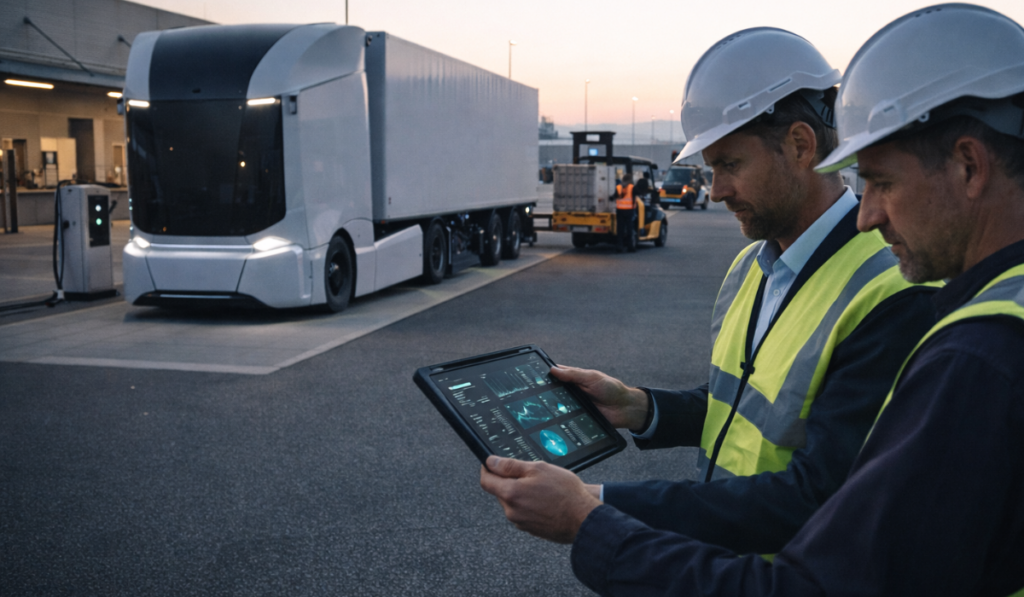
Today, the company operates approximately 200 heavy-duty electric trucks across Europe, North America and the UAE. Customers include PepsiCo, Heineken, Carlsberg Sweden and DP World — signaling real commercial traction beyond pilot hype.
Autonomous pod deployments remain limited but notable, including trials with Apotea in Sweden and GE Appliances in the United States.
This hybrid strategy — electrification today, autonomy tomorrow — may prove to be the company’s most strategic decision.
Valuation Reset, Not Retreat
Einride’s SPAC transaction values the company at a pre-money valuation of $1.35 billion, down from the earlier $1.8 billion target. In 2021’s exuberant climate, such a reset might have been perceived as weakness.
In 2025, it signals realism.
The autonomous vehicle sector has seen dramatic recalibrations since the 2020–2021 SPAC boom. Companies like Aurora Innovation went public at multibillion-dollar valuations before scaling back expectations. Others, including Kodiak Robotics, also pursued SPAC routes as public capital markets tightened.
According to data from Crunchbase News, investor appetite has shifted toward companies with visible commercial deployment rather than purely developmental roadmaps.
Einride’s ability to secure an oversubscribed PIPE in this environment suggests investors see execution — not just vision.
Leadership in Capital Discipline
Robert Falck’s leadership style has remained notably understated compared to some autonomous-tech peers.
Rather than positioning autonomy as an immediate replacement for drivers, Einride has focused on building revenue through electric fleets, charging infrastructure, and freight management software.
The PIPE includes participation from new and existing investors, including Stockholm-based EQT Ventures and a U.S.-based global asset manager — reinforcing institutional confidence.
The capital will fund technology development, international expansion and scaled autonomous deployments in North America, Europe and the Middle East.
But the real challenge lies ahead: public market scrutiny.
Bigger Innovation Trend
Einride sits at the intersection of three macro shifts:
- Freight electrification
- Autonomous logistics
- AI-driven supply chain optimization
As sustainability mandates tighten globally and corporations commit to net-zero targets, electrified freight fleets are becoming operational imperatives rather than PR exercises.
At the same time, labor shortages in trucking across Europe and North America create structural pressure toward automation.
Governments are also investing heavily in smart logistics infrastructure, particularly in regions like the UAE, which has positioned itself as a mobility innovation hub.
The autonomous freight race is no longer about futuristic prototypes — it’s about economic viability.
Why This Founder Matters for 2026
In 2026, the companies that survive the autonomous reset will be those that built real revenue before promising autonomy at scale.
Falck’s approach — deploying electric fleets now while methodically advancing autonomy — may prove more sustainable than competitors who bet everything on rapid driverless rollout.
The $113 million PIPE is not just bridge financing. It is a vote of confidence that disciplined execution can still attract capital in a sector where hype has cooled.
If Einride can convert SPAC capital into scaled commercial operations — especially in North America and the Middle East — it could become one of the few autonomous logistics players to emerge stronger from the post-valuation-reset era.
The freight industry rarely makes headlines. But the transformation of how goods move may define the next decade of industrial innovation.
And Einride is placing a measured, electrified bet on that future.
What Einride’s Latest Funding Means for the Autonomous Freight Industry
Einride’s successful PIPE financing comes at a time when autonomous transportation companies are facing increased pressure to prove commercial viability rather than technological ambition. Over the past several years, investors have become significantly more selective, favoring businesses that generate recurring revenue and demonstrate measurable customer adoption instead of relying solely on future autonomous driving capabilities.
This shift represents a broader evolution within the mobility sector. Rather than funding ambitious prototypes, investors increasingly prioritize companies that combine electrification, software, fleet management, and operational efficiency into scalable business models.
Einride appears to fit this emerging investment profile by balancing today’s commercial opportunities with its long-term autonomous vision. Its combination of electric freight operations, charging infrastructure, digital fleet management, and autonomous vehicle development allows the company to diversify revenue while continuing to invest in future technologies.
If this strategy succeeds, Einride could establish itself as one of the few companies capable of bridging the gap between today’s logistics industry and tomorrow’s autonomous freight ecosystem.
AI Implementation in Modern Freight Operations
Artificial intelligence is becoming a critical component of commercial transportation, extending far beyond autonomous driving itself.
Modern logistics platforms increasingly rely on AI to optimize route planning, predict vehicle maintenance, reduce energy consumption, improve fleet utilization, forecast delivery times, and monitor driver safety. These capabilities help logistics providers lower operating costs while improving customer service and sustainability.
For companies like Einride, AI complements electrification rather than replacing it. Intelligent software enables electric fleets to maximize battery efficiency, schedule charging more effectively, and optimize vehicle deployment across increasingly complex supply chains.
As global logistics networks continue digitizing, AI-powered fleet intelligence is expected to become just as valuable as advances in autonomous vehicle hardware.
Risks and Challenges Ahead
Despite its recent funding success, Einride still faces several significant challenges that could influence its long-term growth.
Among the most important are:
- Regulatory approval for autonomous freight vehicles varies significantly across countries and jurisdictions.
- High infrastructure costs remain a barrier to large-scale deployment of electric commercial fleets.
- Competition continues to intensify from established truck manufacturers and autonomous driving technology companies.
- Battery technology improvements and charging infrastructure expansion will remain essential for widespread adoption.
- Public market investors often place greater emphasis on quarterly financial performance than private investors, increasing pressure following a public listing.
Additionally, widespread adoption of fully autonomous freight transportation will depend on continued advances in safety validation, cybersecurity, public acceptance, and insurance frameworks.
These factors mean that commercialization timelines may differ considerably across markets.
Industry Perspective
The autonomous freight industry has matured considerably since the early wave of excitement surrounding self-driving vehicles.
Instead of promising fully driverless transportation in every scenario, many companies now focus on incremental deployment strategies that deliver measurable value today while expanding autonomous capabilities over time.
This measured approach reflects changing customer priorities.
Fleet operators are primarily seeking solutions that reduce operating costs, improve sustainability, increase vehicle utilization, and address persistent driver shortages. Complete vehicle autonomy remains an important long-term objective, but many businesses place greater value on technologies that improve existing operations immediately.
Einride’s strategy aligns closely with this industry evolution by combining commercially available electric fleets with ongoing autonomous technology development rather than waiting for full autonomy before entering the market.
Analysis By Our Editors
After reviewing Einride’s public announcements, investor participation, commercial partnerships, and broader transportation industry trends, the company’s latest funding round appears to represent more than another capital raise.
It reflects growing investor confidence in businesses capable of generating commercial revenue while continuing to innovate in emerging technologies.
Unlike many autonomous vehicle startups that concentrated almost exclusively on future driverless capabilities, Einride has developed multiple complementary business lines, including electric freight operations, fleet management software, charging infrastructure, and autonomous transportation technologies.
This diversified strategy may reduce dependence on any single technological milestone while creating additional opportunities for long-term growth.
However, the company’s public market debut will introduce new expectations regarding revenue growth, profitability, operational efficiency, and execution against ambitious expansion plans.
Exclusive Assessment from Business Perspective
Based on publicly available information and current developments within the transportation sector, Einride appears well positioned within one of the fastest-evolving segments of industrial technology.
Three competitive advantages stand out.
First, the company has demonstrated commercial adoption through partnerships with globally recognized enterprises rather than relying solely on pilot projects.
Second, its integrated business model combines electrification, artificial intelligence, fleet software, and autonomous driving into a unified logistics platform.
Third, management has maintained a relatively disciplined approach to capital deployment, adjusting valuation expectations while continuing to secure institutional investment during a more cautious funding environment.
Nevertheless, long-term success will ultimately depend on execution. Scaling international operations, maintaining technological leadership, expanding charging infrastructure, and navigating evolving regulations will remain critical priorities as the company transitions into public markets.
Final Thoughts
Einride’s oversubscribed $113 million PIPE financing represents an important milestone not only for the company but also for the broader autonomous freight industry.
As logistics providers seek cleaner transportation, greater operational efficiency, and smarter supply chain management, companies capable of integrating electrification, artificial intelligence, and automation into practical commercial solutions are likely to attract increasing attention from both customers and investors.
While fully autonomous trucking remains a long-term objective for much of the industry, today’s market rewards businesses that deliver measurable operational value while steadily advancing future technologies.
Einride’s strategy reflects that reality.
If the company successfully executes its international expansion plans while maintaining disciplined financial management and continued technological innovation, it could emerge as one of the defining infrastructure providers shaping the future of intelligent freight transportation.
The road to fully autonomous logistics may still be measured in years rather than months, but companies building sustainable business models today are likely to lead the industry’s next chapter.
Frequently Asked Questions (FAQs)
Einride is a Swedish freight technology company founded in 2016 that develops electric commercial vehicles, autonomous freight solutions, digital fleet management software, and charging infrastructure for logistics operators worldwide.
Einride secured an oversubscribed $113 million PIPE (Private Investment in Public Equity) financing ahead of its planned public listing through a merger with Legato Merger Corp., strengthening its capital position for global expansion.
Einride was founded by Robert Falck, a Swedish entrepreneur focused on transforming freight transportation through electrification, artificial intelligence, and autonomous vehicle technologies.
Unlike conventional trucking businesses, Einride combines electric heavy-duty vehicles, autonomous driving technology, AI-powered fleet management software, and charging infrastructure into a fully integrated freight ecosystem.
Yes. Einride operates approximately 200 heavy-duty electric trucks across Europe, North America, and the Middle East, serving customers including PepsiCo, Heineken, Carlsberg Sweden, and DP World.
AI helps optimize route planning, fleet scheduling, battery usage, predictive maintenance, energy efficiency, freight allocation, and operational decision-making, improving productivity while lowering transportation costs.
Key challenges include scaling commercial operations, meeting public market expectations, expanding charging infrastructure, complying with evolving autonomous vehicle regulations, and competing against both established truck manufacturers and emerging autonomous technology companies.
Einride represents a new generation of logistics companies combining electrification, AI, autonomous driving, and digital fleet management into a unified platform. Its balanced strategy of generating revenue today while advancing long-term autonomy positions it as a notable player in the evolution of sustainable and intelligent freight transportation.

Dwayne Paschke is a seasoned content strategist and AI automation specialist with over nine years of experience at the intersection of journalism and digital innovation. A versatile force in the media landscape, Dwayne has built a reputation as an expert content writer and investigative journalist, contributing high-impact pieces to various reputable news websites.