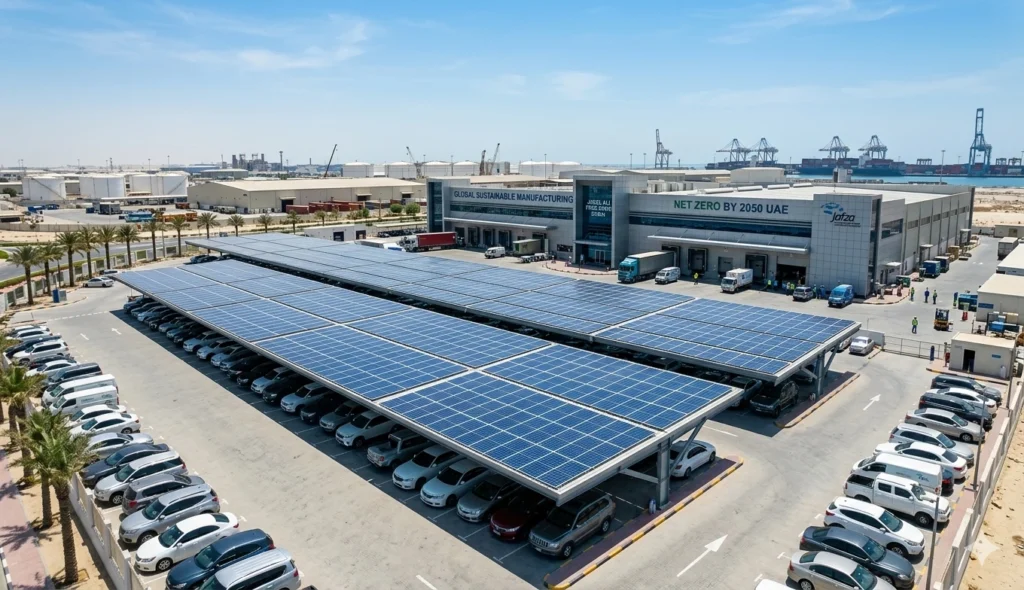
In Dubai’s Jebel Ali Free Zone (JAFZA), a sprawling 11,000-square-meter facility hums with the precision of a Swiss watch. This is the Lipton Jebel Ali factory, a titan of global trade that churns out more than 11 billion tea bags every single year. For decades, the energy required to power such a colossal operation was a fixed, often rising, operational cost. But as of April 2026, the economics of this facility—and the industry surrounding it—have fundamentally shifted.
With the flick of a switch, Lipton commissioned a 580 kilowatt-peak (kWp) solar plant on its car park roof. This isn’t just a PR stunt; it is a calculated strategic move. The plant is projected to generate nearly 1 million kilowatt-hours of clean electricity in its first year, enough to power the production of over 1 billion tea bags. The most striking part? Lipton didn’t pay a single dirham upfront for the hardware.
This is the disruptive world of Yellow Door Energy (YDE). By removing the capital expenditure (capex) barrier, YDE is effectively “democratizing” the energy transition for the Middle East and Africa’s industrial heavyweights. In a region where oil was once the only game in town, a new power structure is emerging—one panel at a time.
If you’re studying disruptive business models in the energy sector, this is the one worth watching.
Yellow Door Energy – Desert Blueprint to Regional Disruptor
Yellow Door Energy was not born in a boardroom of a traditional utility giant. It was founded in 2015 in Dubai, driven by a simple but radical premise: businesses should be able to go green without bleeding cash.
The founder and Group CEO, Jeremy Crane, saw a glaring gap in the market. While residential solar was gaining traction, the “Commercial and Industrial” (C&I) sector was stuck in a CAPEX trap. Companies wanted to reduce their carbon footprint, but few were willing to divert millions from their core business to buy solar panels that would take years to pay off.
The early days were defined by a struggle for credibility. Crane and his team had to convince skeptical CFOs that a “Solar Lease” or Power Purchase Agreement (PPA) was a safe, long-term financial instrument rather than a temporary trend. They weren’t just selling energy; they were selling a new way to think about corporate balance sheets.
This is where things get interesting: the company’s name itself reflects this mission. “Yellow” for the sun, and “Door” for the access they provide to a cleaner future. By 2022, that door had swung wide open, with the company securing over 200 megawatts of solar projects across the region.
Also Read: Saudi Aramco Halts Juaymah LPG Exports, Sending Shockwaves Through Asian Energy Markets
Scaling The YELLOW DOOR ENERGY – The Actis Acquisition and the Multi-Million Dollar Entity
If 2015 was the year of the idea, 2022 was the year of the rocket ship. In July 2022, Actis—a leading global investor in sustainable infrastructure—acquired a controlling stake in Yellow Door Energy.
This wasn’t just a change in ownership; it was a massive injection of institutional muscle. Actis’s goal was clear: scale YDE into the undisputed leader of distributed solar in the Middle East and Africa (MEA), targeting a portfolio exceeding 1 gigawatt (GW).
The funding landscape for YDE is a “Who’s Who” of global finance. Beyond Actis, the company is backed by:
- The International Finance Corporation (IFC): The private sector arm of the World Bank Group.
- Mitsui & Co., Ltd.: A Japanese powerhouse with deep roots in global infrastructure.
- The Arab Energy Fund (TAEF): Formerly known as APICORP, providing regional strategic depth.
With $28 million in early-stage funding eventually giving way to the massive Actis-led buyout, YDE has the “dry powder” needed to finance massive projects that competitors simply cannot touch.
The Crane Philosophy and Leadership
At the helm of this expansion is Jeremy Crane, a leader whose vision blends hardcore engineering logic with a philosophical commitment to the planet. “I believe it is important to consider not just the financial, but also the social and environmental impacts of our business decisions,” Crane has stated. “At the end of the day, I want to leave the Earth in a better place for future generations”.
Under Crane’s leadership, the decision-making process is anchored in “agility”—one of the company’s core values. This allows YDE to enter complex markets like Pakistan or South Africa while maintaining the rigorous standards expected by shareholders like the IFC.
But it isn’t just Crane. The leadership team, including regional directors like Umer Farooq in Pakistan, has successfully navigated the “cluttered and distorted” energy markets of emerging economies by focusing on one thing: the performance guarantee.
How the “Solar Bill” Model is Killing the Utility Monopoly
To understand why Yellow Door Energy is winning, you have to understand the PPA.
How does it really work? Yellow Door Energy acts as the developer, financier, and operator. They design the plant, pay for the panels, handle the construction, and take on all the operational risks. The customer—whether it’s a Lipton factory or a Nestlé bottling plant—simply provides the roof or car park space.
Once the sun hits the panels, the customer pays YDE a monthly “solar bill” based on the electricity generated. This rate is typically 15% to 40% lower than the traditional utility grid price.
The revenue model is elegantly simple:
- Zero Upfront Cost: The customer preserves capital for their core business.
- Performance Risk: If the panels don’t produce, the customer doesn’t pay. YDE is incentivized to keep the technology running at peak efficiency.
- Long-Term Ownership: At the end of the lease term (typically 10-20 years), the ownership of the plant often transfers to the customer for a nominal fee.
For entrepreneurs, there’s a lesson hidden here: solving a customer’s capital constraint is often more valuable than the product itself.
Storage and the Quest for 24/7 Clean Power Using the Hybrid Way
While solar PV (photovoltaic) was the starting point, YDE has evolved far beyond simple rooftop panels. On the global markets, where grid reliability is a constant headache, the company has pivoted to “Solar + Storage”.
By integrating Battery Energy Storage Systems (BESS), YDE can store excess midday sun and discharge it during peak evening hours or during grid outages. This transforms solar from a “nice-to-have” fuel saver into a mission-critical energy security asset.
Beyond BESS, the company’s product suite now includes:
- EV Charging Systems: Helping fleets transition to electric.
- LED Retrofits: Reducing the total load before the solar is even installed.
- Water Treatment and Green Cooling: Tackling the region’s other great resource challenge.
A Mid-2026 Progress Report in Figures
The scale of Yellow Door Energy’s impact is best viewed through the cold, hard lens of its March 31, 2026 metrics:
- 450 Megawatts: Total solar projects in the Middle East and South Africa.
- 1,186 Gigawatt-Hours: Clean energy generated to date.
- 465,000 Metric Tons: Carbon emissions avoided.
- 150 Employees: A lean team managing a massive regional footprint.
While PitchBook lists early funding at $28M, the subsequent Actis buyout and the sheer volume of their operating assets suggest a valuation that places them firmly at the top of the regional CleanTech hierarchy.
Considering the “IFC” Standard for Balancing
No investigative look at an energy giant is complete without examining its accountability. Because the IFC is a major shareholder, YDE must adhere to incredibly strict Environmental and Social Performance Standards.
This means that communities affected by YDE projects have access to the Compliance Advisor Ombudsman (CAO), an independent mechanism that reports directly to the World Bank Group President. While YDE has maintained a strong track record, the existence of these “grievance mechanisms” ensures that the company cannot simply run roughshod over local regulations in its quest for growth. It is a “credibility boost” that few local competitors can match.
The Competitive Hunting Among the Giants
YDE is the leader, but they are not alone. The competitive landscape is heating up as private equity pours into the region. Key rivals include:
- Enviromena International Holdings: A Reading-based player with deep regional roots.
- ZEN Energy: A venture-backed Australian firm looking at international expansion.
- Luminace and Trinity Solar: US-based firms that represent the global standard for what YDE aims to be.
YDE’s strength lies in its “Buy and Build” status date and its ability to offer a “Total Energy Solution” (solar, storage, and efficiency) rather than just a one-off installation.
What’s the Net Zero Horizon? The Future of Yellow Door Energy
The future for YDE is defined by two words: Emerging Economies.
As many countries aim for more than 60% renewable energy by 2030, and the UAE doubles its solar capacity every few years, the tailwinds for YDE are gale-force. We expect to see YDE move deeper into South Africa, where the Parsons Power Park (31 MWp) represents a massive step into one of the continent’s most energy-hungry markets.
The next frontier? Distributed Green Hydrogen. As the Middle East looks to export clean fuel, the small-scale, distributed production of hydrogen powered by YDE’s solar arrays could be the next “turning point” for the company.
Contributing Healthier Lifestyle Has Become the Legacy
Can an energy company really bring “joy”?
When Lipton’s Factory Director, Philip Ayoub, talks about achieving Zero Waste to Landfill and powering a billion tea bags with the sun, he isn’t just talking about electricity; he’s talking about the future of his brand.
Yellow Door Energy is the “silent engine” behind this transformation. They are proving that the transition to a low-carbon economy isn’t just a moral obligation—it is the most profitable decision a modern business can make.
Are you ready to join the transition? Whether you are a factory owner in JAFZA or an investor in London, the lesson is clear: the door to the sun is open, and it’s painted yellow.

Dwayne Paschke is a seasoned content strategist and AI automation specialist with over nine years of experience at the intersection of journalism and digital innovation. A versatile force in the media landscape, Dwayne has built a reputation as an expert content writer and investigative journalist, contributing high-impact pieces to various reputable news websites.