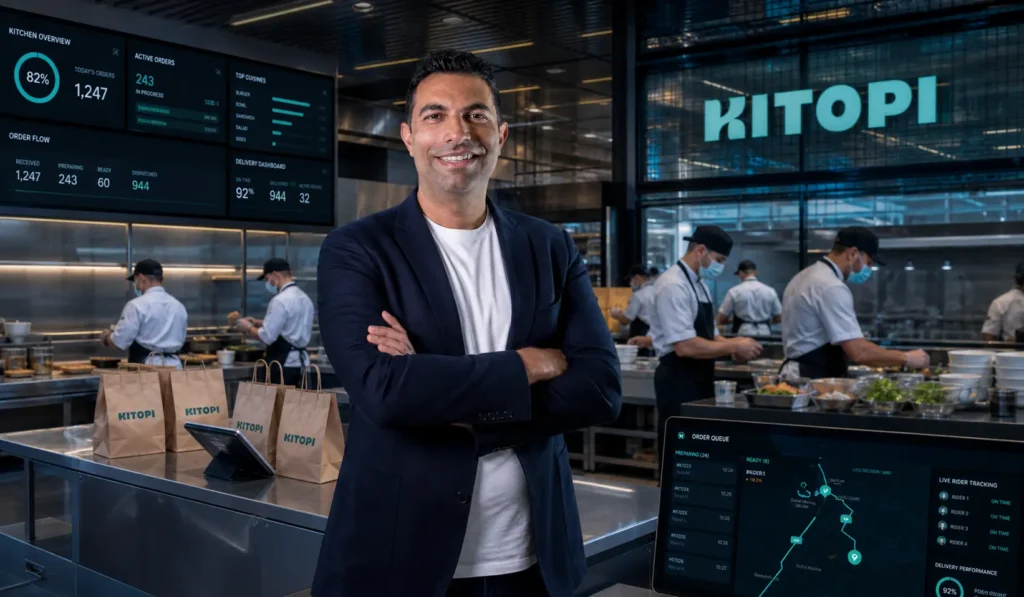
The food and beverage (F&B) industry in the Middle East has undergone a radical transformation over the last decade, transitioning from traditional brick-and-mortar dining to a tech-enabled ecosystem. At the forefront of this shift is Mohamad Ballout, the co-founder and CEO of Kitopi, a company that has redefined the “cloud kitchen” concept into a managed culinary platform. By 2021, Kitopi achieved unicorn status, becoming one of the most successful startups to emerge from Dubai’s thriving tech scene.
For investors and market analysts, Kitopi’s journey offers a blueprint for how regional companies can leverage technology to scale globally. This analysis explores the strategic decisions, technological innovations, and market trends that have propelled Mohamad Ballout and his team to the top of the global F&B sector.
The Academic and Entrepreneurial Roots of Mohamad Ballout’s Business Empire
Mohamad Ballout’s success is built on a strong academic and entrepreneurial foundation. He is often described as a “third culture kid,” having been born and raised in Dubai while originally hailing from Lebanon. This international perspective shaped his early approach to business and global market dynamics.
Ballout pursued his higher education in the United Kingdom, where he focused on quantitative and management disciplines. He earned a Bachelor of Science in Mathematics and Economics from the University of Warwick and later completed a Master of Science in Management at Imperial College London. This combination of analytical rigor and strategic management training provided him with the skills necessary to navigate complex industries like logistics and manufacturing.
Before entering the food tech space, Ballout spent nearly a decade building a successful business in the confectionery sector. In 2007, at the age of 21, he co-founded BMB Group with his brother. Originally starting as an ingredients distributor in a small warehouse in Sharjah, BMB quickly pivoted to manufacturing. Under Ballout’s leadership, BMB became one of the largest ethnic sweets manufacturers in the Middle East, supplying global giants like Walmart, Carrefour, and Starbucks across 32 markets.
For investors, this track record of scaling a manufacturing business into a global player is a key indicator of Ballout’s operational expertise. He eventually sold his shares in BMB to a private equity group in 2016, a decision that gave him the financial freedom to explore his next major venture.
Also Read: Dee Deu and Chalhoub Group Are Leading Enterprise-Level Security Transformation
Kitopi Established a Delivery-First Infrastructure for Modern Food Brands
After exiting BMB Group, Ballout spent time as an angel investor, where he noticed a significant gap in the F&B market. While e-commerce and ride-hailing had been disrupted by technology, the food industry was still operating on models that had remained largely unchanged for a century. Most restaurant brands struggled to scale because the traditional model required significant capital for physical locations, front-of-house staff, and local management.
In January 2018, Ballout partnered with his friends Saman Darkan, Bader Ataya, and Andy Arenas to launch Kitopi. The name “Kitopi” is a portmanteau for “Kitchen Utopia,” reflecting the founders’ vision of a seamless, tech-powered culinary environment.
Unlike a standard cloud kitchen that simply rents out space to restaurants, Kitopi operates as a “managed kitchen as a service”. Kitopi handles the entire supply chain, including ingredient sourcing, cooking the meals, and managing the delivery through third-party aggregators like Uber Eats or Deliveroo. This allows restaurant brands to expand into new cities and countries within weeks without the need for physical construction or local hiring.
This could shape the market in the coming years as more traditional brands move toward a “delivery-first” strategy.
SKOS Is the Technology Backbone Behind Kitopi’s Rapid Expansion
A central driver of Kitopi’s efficiency is its proprietary technology, the Smart Kitchen Operating System (SKOS). While many cloud kitchens rely on manual processes, Kitopi treats its kitchens like fulfillment hubs powered by data science.
The SKOS platform is designed to maximize efficiency through a series of tech-infused strategies:
- Real-Time Operations: The system manages the entire workflow of a kitchen, allowing a single station to orchestrate up to 30 different brands simultaneously.
- Data-Driven Demand Matching: Kitopi uses software to identify “cuisine gaps” in specific hyperlocal areas, ensuring that the brands they launch in a particular kitchen match the local demand.
- Rapid Integration: The technology is so advanced that a new partner brand can have its entire menu ready for delivery on the platform in just two weeks.
To maintain this technological edge, Kitopi operates a dedicated engineering hub in Krakow, Poland. This team includes data mining engineers, DevOps specialists, and solution architects who constantly refine the SKOS to improve delivery speed and food quality. Additionally, the company has established a robotics hub in Odense, Denmark, to explore the future of automated cooking.
Kitopi Reached a $1 Billion Valuation Within Three Years of Its Founding
Kitopi’s growth has been among the fastest in the Middle East. By 2021, only three years after its founding, the company achieved a valuation of over $1 billion, securing its status as a unicorn. This milestone was reached following a $415 million Series C funding round led by SoftBank’s Vision Fund 2. This investment marked the first time a UAE-headquartered company received funding from SoftBank’s prestigious Vision Fund 2.
As of 2026, Kitopi operates in five primary markets: the UAE, Saudi Arabia, Kuwait, Bahrain, and Qatar. The company manages over 200 locations and employs a workforce of more than 5,000 “Kitopians”.
The company’s expansion strategy is focused on high-density urban areas where delivery demand is mature. For example, Kuwait was identified as a critical market due to its high population of tech-savvy residents who adopted online food ordering earlier than most other regions.
Businesses should pay close attention to these changes in consumer behavior as urban density continues to drive the demand for on-demand services.
Its Expansion Strategy Blends Acquisitions With Operational Independence
In recent years, Mohamad Ballout has shifted Kitopi’s strategy toward a multi-brand restaurant model. This involves acquiring successful brands and integrating them into the Kitopi ecosystem to drive higher profitability.
One of the most significant moves in this direction was the acquisition of the AWJ Group. AWJ is the group behind some of the Middle East’s most recognizable dine-in and delivery brands, including Operation Falafel, Catch 22, Awani, and SushiDo. This was one of 18 acquisitions Kitopi executed as it sought to diversify its portfolio.
Ballout’s approach to acquisitions emphasizes “strategic integration” rather than a total overhaul. For large, fast-moving businesses like AWJ, Ballout advocates for maintaining their independence to ensure they can continue to innovate while benefiting from Kitopi’s back-end technology and supply chain.
By owning and operating its own brands, Kitopi can capture more of the value chain. For investors, this shift from being a pure service provider to a brand owner represents a more sustainable, high-margin business model.
Mohamad Ballout’s Leadership Is Helping UAE Startups Gain Global Recognition
The success of Mohamad Ballout and Kitopi has had a “multiplier effect” on the Middle Eastern entrepreneurship landscape. Ballout himself notes that successful exits and unicorn valuations encourage more talent to join startups and more parents to support their children entering the tech sector.
Kitopi serves as a symbol of the UAE’s ability to “export” technology rather than just importing brands from the West. While the Middle East was historically seen as a region that licensed Western concepts, Kitopi has reversed this trend by taking its Dubai-founded technology to international markets like the UK and potentially the US.
Ballout is also committed to “paying it forward” by mentoring the next generation of founders. He has shared insights and best practices with startups as far away as Colombia, helping them avoid the mistakes the Kitopi team made during their early years.
Related Article: Deepinder Goyal’s $54M Bet on Brain-Tech: Why Temple Signals a Founder Reinvention Moment
Kitopi Must Adapt Its Expansion Strategy to Mature Western Market Conditions
Despite its rapid rise, Kitopi faces significant challenges as it scales globally. One of the primary obstacles is the difference in real estate dynamics between the Middle East and Western markets.
In Dubai, a company can often sign a lease and set up operations in a week. However, in cities like New York, the process is far more complex, involving picky landlords, strict regulations, and lease negotiations that can take up to six months. This makes the “rapid expansion” model more difficult to execute in the US compared to the GCC.
Furthermore, there is the ongoing challenge of maintaining brand quality across hundreds of locations. Ballout acknowledges that the “art” of cooking must be converted into a “science” for it to be truly scalable. If a brand relies too heavily on a specific chef’s “magic,” it cannot be easily replicated in a managed kitchen environment.
Managing these operational risks will be crucial for Kitopi’s long-term sustainability as it looks to compete on a global stage.
Kitopi’s Long-Term Vision Includes Robotics, Data, and Customer-Centric Dining
Looking toward the future, Mohamad Ballout sees a shift toward even greater personalization in the food industry. He believes the future of eating will be “on consumer terms,” where menus are tailored to an individual’s specific health goals, budget, and dietary preferences.
Kitopi is already investing in the technologies needed to facilitate this:
- Robotics: The Odense robotics hub suggests that automated food preparation will play a larger role in reducing human error and increasing speed.
- Customer Experience (CX): With global CX centers in Dubai and Amman, Kitopi is using data to understand and predict what customers want before they even order.
- Dine-In Experiences: While Kitopi started as delivery-only, it has begun opening physical dine-in locations in Dubai, recognizing that the “experience” of dining out still holds significant value for consumers.
For long-term investors, Kitopi’s pivot into robotics and high-tech personalization suggests they are building a business designed to last for decades, not just to be sold for a quick profit.
Final Thoughts
Mohamad Ballout has successfully navigated the complexities of the Middle Eastern market to build a global tech leader. By focusing on a “Kitchen Utopia” that combines deep operational expertise with cutting-edge software, Kitopi has solved the scaling problem for dozens of restaurant brands. As the company continues to acquire more brands and expand its technological footprint, it remains a central figure in the evolution of the global F&B industry.
FAQs – Frequently Asked Questions
Kitopi is a managed cloud kitchen platform. It partners with existing restaurant brands to cook and deliver their food. Kitopi manages the entire end-to-end process, including ingredient sourcing, cooking in their specialized kitchens, and coordinating delivery with aggregators.
Kitopi was founded in January 2018 in Dubai by Mohamad Ballout, Saman Darkan, Bader Ataya, and Andy Arenas.
The name stands for “Kitchen Utopia,” which represents the company’s goal of creating a perfect, efficient, and tech-powered environment for food preparation.
Yes. Kitopi reached unicorn status (a valuation of over $1 billion) in July 2021 after a $415 million funding round led by the SoftBank Vision Fund 2.
As of current reports, Kitopi operates locations in the UAE, Saudi Arabia, Kuwait, Bahrain, and Qatar. It also maintains an engineering hub in Poland and customer experience centers in the UAE and Jordan.
SKOS is Kitopi’s in-house software platform. It uses data and technology to manage kitchen operations, maximize efficiency, and ensure that multiple restaurant brands can be cooked in the same facility without errors.
Yes. While Kitopi started by partnering with external brands, it has since acquired several brands, including those under the AWJ Group like Operation Falafel and Catch 22, to operate them as part of its multi-brand ecosystem.
Mohamad Ballout is the co-founder and CEO of Kitopi. Before Kitopi, he co-founded BMB Group, a large confectionery manufacturer. He holds a degree in Mathematics and Economics from the University of Warwick and a Master’s in Management from Imperial College London.

Dwayne Paschke is a seasoned content strategist and AI automation specialist with over nine years of experience at the intersection of journalism and digital innovation. A versatile force in the media landscape, Dwayne has built a reputation as an expert content writer and investigative journalist, contributing high-impact pieces to various reputable news websites.