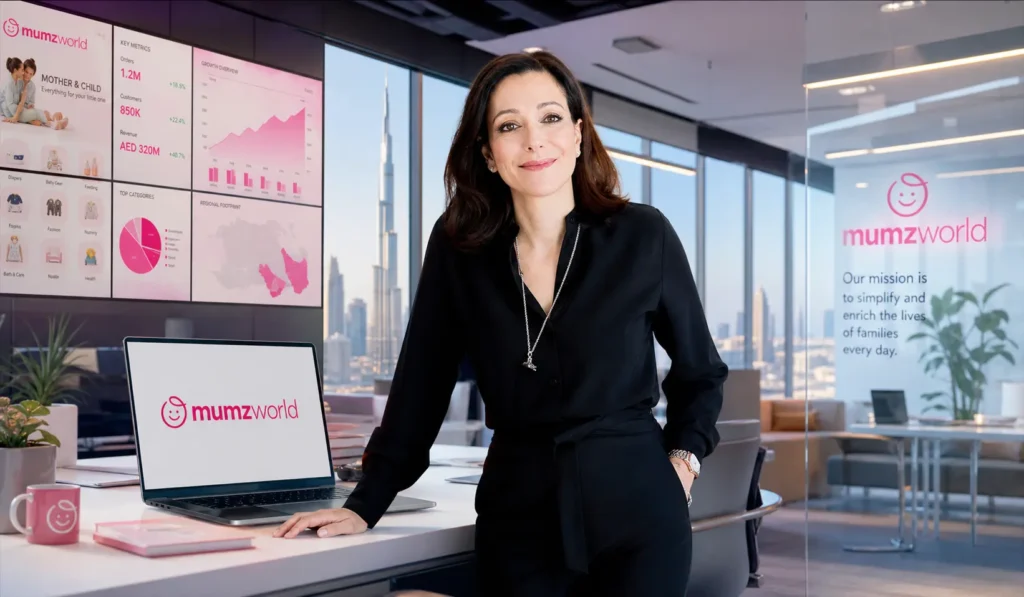
The digital economy in the Middle East has undergone a radical transformation over the past two decades, moving from a nascent stage to a global hub for innovation. At the center of this revolution is Mona Ataya, a Palestinian-Lebanese entrepreneur who built a digital empire dedicated to mothers. Her journey from corporate branding to co-founding Bayt.com and eventually launching Mumzworld provides a masterclass in regional market analysis. This article examines the strategic decisions, market trends, and economic impacts of her leadership on the UAE and the broader MENA region.
Mona Ataya’s Early Business Decisions That Makes Her Entrepreneur
Mona Ataya’s business acumen was forged in the highly competitive environments of multinational giants. She began her career at Procter & Gamble (P&G) in Cincinnati at the age of 20, specializing in the soap sector. She later transitioned to Johnson & Johnson (J&J), where she managed global skincare brands across Europe and the Middle East. This early exposure to global supply chains and consumer behavior proved essential for her future ventures.
In 2000, Ataya made a high-risk strategic decision to leave her stable corporate career in Switzerland to join a startup team. Alongside her brother Rabea Ataya, she co-founded Bayt.com, which would become the leading job search platform in the Arab world. At the time, internet penetration in the region was a mere 2%, and the “dot-com bubble” had just burst. Despite these headwinds, Bayt.com became profitable within its first year, proving that digital solutions could solve regional recruitment inefficiencies.
The success of Bayt.com established Ataya as a pioneer in the Middle Eastern digital ecosystem. It also highlighted the “blue ocean” opportunities available for those willing to navigate a fragmented and underdeveloped market. For investors, this trend of early digital adoption remains a key indicator of long-term regional potential.
The Problem Mumzworld Was Built to Solve in the MENA Region
The concept for Mumzworld was born in 2011 from Ataya’s personal frustrations as a mother of three boys in Dubai. She recognized that the existing retail ecosystem for mothers in the MENA region was significantly underserved. Mothers faced several critical pain points that were not being addressed by traditional brick-and-mortar retailers.
First, access to a diverse choice of quality products was severely limited. Second, regional prices were often 50% to 100% higher than global averages due to a distributor-led economy. Third, there was a complete lack of Arabic-language content and product information. Finally, there was no online community for mothers to share insights and make informed purchase decisions.
Ataya’s realization came at 2:30 AM in a hotel bathroom, where she began drafting the business plan for what she called “the Amazon for moms”. She identified a $1 billion addressable market that was largely ignored by the male-dominated e-commerce players of the time. This gap represented a massive opportunity to provide transparency, choice, and convenience to a high-value consumer segment.
How Mumzworld Expanded Across the Middle East?
The growth of Mumzworld is marked by a series of aggressive expansions and technological pivots.
Also Read: Ayoub Fathi’s Life Journey from Elite Hacker to Chief Information Security Officer of noon
Below is a timeline of the company’s evolution:
- June 2011: Mona Ataya writes the original business plan.
- August 2011: The company is officially incorporated.
- October 2011: Mumzworld launches in beta mode.
- November 2011: The first customer purchase is recorded.
- January 2012: Launch of the fully bilingual Arabic application and website.
- Early 2012: Rapid expansion into Saudi Arabia, followed by other GCC markets.
- 2014: Selected for the Endeavor global network of high-impact entrepreneurs.
- 2018: Closure of a $20 million Series B funding round, the largest for a woman-led e-commerce startup in MENA at that time.
- 2021: Acquisition by Tamer Group, a major Saudi-based healthcare and consumer conglomerate.
This timeline demonstrates a clear trajectory from solving a local problem to becoming a regional dominant force. Businesses should pay close attention to these changes in regional consolidation.
Female Founders Continue to Face Structural Barriers in Venture Capital Markets
Fundraising was one of the most grueling aspects of Ataya’s journey. Globally, women receive less than 2% of venture capital (VC) funding; in the GCC, that number drops to less than 0.8%. Ataya faced numerous rejections and skeptical questions from investors that her male peers rarely encountered.
Some investors asked who would take care of her children while she ran the business. Another investor suggested that only her extended family members would buy from the site, completely ignoring the data on the addressable market. Despite these biases, Ataya stood her ground, eventually raising six rounds of capital from top regional and international institutional investors.
She often emphasizes that she built “stone-hard resilience” during these meetings. Her advice to other entrepreneurs is to focus on fundamentals and unit economics, as it is difficult for investors to ignore a business that is doubling its revenue year after year. For investors, this trend of backing female founders with strong unit economics is worth watching.
How Mona Ataya Built Mumzworld From Scratch in an Underdeveloped E-Commerce Market?
In 2011, the UAE and GCC lacked many of the enablers required for successful e-commerce. Ataya recalls that there were no sophisticated payment gateways, and delivery couriers were often slow and unreliable. In the early days, she even used her own car to make deliveries to ensure customer satisfaction.
To overcome these barriers, Mumzworld had to innovate across the entire supply chain. Since many suppliers did not have ERP (Enterprise Resource Planning) systems to share data, Mumzworld developed its own proprietary systems and shared them with partners. They also negotiated exclusive distribution deals with global brands to ensure a unique product catalog.
Logistics remained one of the toughest hurdles. When couriers laughed at the idea of 5-day delivery for bulky diaper packages, Ataya moved to a variable-pay driver model to speed up the process. Today, Mumzworld offers same-day delivery through its “Yalla” service and 24-hour delivery on over 100,000 products. This relentless focus on the “last mile” is a primary reason for the brand’s high customer loyalty.
Mumzworld Competes Through Deep Market Focus on Mothers and Children
Mumzworld’s success is rooted in its position as a “vertical” specialist in a market dominated by “horizontal” giants like Amazon and Noon. While the larger players sell everything, Mumzworld focuses exclusively on the needs of mothers and children. This specialization allows for a deeper and broader catalog that generalists cannot match.
Key market metrics for Mumzworld include:
- Customer Reach: Over 2.5 million mothers across the Arab world.
- Product Catalog: More than 300,000 products from 6,000 brands.
- Regional Footprint: Ships to over 20 countries in the MENA region.
- Retention: High repurchase rates driven by an “everyday low price” strategy and price match guarantees.
- Exclusivity: Over 25,000 products are exclusive to Mumzworld in the region.
Ataya argues that mothers are risk-averse and information-hungry consumers. By providing content, community, and expert advice, Mumzworld created an “experiential” platform rather than just a transactional one. How can a general retailer compete with a brand that a mother views as a supportive partner in her parenting journey?
Empathetic Leadership and High Standards Define Mona Ataya’s Management Approach
Ataya describes her role as the CEO as being the “conductor of an orchestra”. She believes her primary responsibility is to direct and encourage talented individuals to play the same “beautiful tune” that wows the audience (the customer). This leadership style is centered on empathy, high standards, and constant learning.
Diversity is another core pillar of the company’s DNA. Ataya intentionally built a leadership team where many key positions—including Head of Saudi Operations, Technology, Logistics, and Supply Chain—were held by women and mothers. She found that mothers were often the most efficient employees because they understood the customer psychographics perfectly.
However, she acknowledges that women in leadership still face unique cultural double standards. If a woman is assertive, she may be perceived as aggressive, whereas a man would simply be seen as a strong leader. Ataya has consistently pushed back against these perceptions, maintaining that high standards and sticking to core values are non-negotiable.
Also Read: Mohamed Alabbar Emaar’s Founder Billion-Dollar Vision That Transformed Dubai
How a UAE Startup Exit Changed the Future of Regional E-Commerce?
The impact of Mumzworld extends beyond its financial success; it has played a major role in shaping the regional digital ecosystem. As a board member of the Dubai Chamber of Digital Economy, Ataya has worked with the government to improve supply chain infrastructure and licensing for tech startups.
Furthermore, her role as a UNCTAD eTrade for Women Advocate has allowed her to mentor women entrepreneurs in less developed markets like Lebanon, Jordan, and Morocco. She provides workshops and skill development programs to help women enter the digital economy. This mentorship is critical because, as she notes, “success breeds success”. When women see others succeeding, they gain the courage to start their own ventures.
The acquisition of Mumzworld by Tamer Group in 2021 was a significant moment for the region’s startup history. It proved that “homegrown” brands could achieve successful exits to major regional conglomerates. This could shape the market in the coming months as more traditional businesses look to acquire digital-first companies to modernize their operations.
Why Mona Ataya Believes Work-Life Balance Is a Myth?
One of the most human aspects of Ataya’s story is her candidness about the “myth” of work-life balance. She openly admits that during the first years of building Mumzworld, compromises were constant. She missed school events and felt the judgment of non-working parents who viewed her as a “negligent” parent.
To manage these challenges, she established unbreakable family rituals, such as sacred family dinners and game nights. She emphasizes that she did not seek an “equal” balance but rather a “constantly shifting equilibrium”. Some days the focus was on shareholders, and other days it was entirely on her sons.
Her children, now young adults, have become aspiring entrepreneurs themselves. They witnessed firsthand the sacrifices required to build something of value from scratch. Ataya believes that by standing her ground and living her values, she provided them with a model of commitment and respect for women as equals.
Final Verdict
Mona Ataya’s legacy is not just the creation of the largest online marketplace for mothers in the Middle East, but the paving of a path for future entrepreneurs. She demonstrated that localized, customer-obsessed solutions could outcompete global giants by deeply understanding regional psychographics.
The acquisition by Tamer Group has provided Mumzworld with the “heavy cash injection” required to scale even further and enter new markets like North Africa. While Ataya has stepped down from her operational role, her influence continues through her mentorship and board positions.
As the Middle East continues to invest heavily in its digital future, the story of Mumzworld remains a definitive blueprint for how to build a sustainable, value-driven business in a rapidly evolving market. For anyone looking to understand the intersection of technology, motherhood, and regional business strategy, her journey is essential reading.
FAQs – Frequently Asked Questions
Mumzworld is the leading and largest e-commerce platform in the Middle East dedicated to mother, baby, and child products. It offers over 300,000 products and services to more than 2.5 million mothers across the region.
It was founded in 2011 by Mona Ataya, alongside her brother and a friend, following her earlier success as a co-founder of the job site Bayt.com.
Before Mumzworld, mothers faced high regional prices (often double global rates), limited product choices, a lack of Arabic product information, and no dedicated online community.
Mumzworld is a “vertical” specialist, meaning it focuses deeply on one category. It offers a much wider and more specialized catalog for mothers than general retailers, along with expert content and a community of mothers.
The platform offers free 24-hour delivery on 100,000 products, a price match guarantee on authentic items, a diaper subscription service, and a comprehensive baby registry.
Mumzworld was acquired in 2021 by Tamer Group, a prominent Saudi Arabian conglomerate specializing in healthcare and consumer goods.
While the total amount is not always publicly disclosed, the company raised six rounds of capital, including a landmark $20 million Series B round in 2018.
She serves on the board of the Dubai Chamber of Digital Economy, is an eTrade for Women Advocate for the United Nations (UNCTAD), and holds board positions with Young Arab Leaders and Endeavor.

Dwayne Paschke is a seasoned content strategist and AI automation specialist with over nine years of experience at the intersection of journalism and digital innovation. A versatile force in the media landscape, Dwayne has built a reputation as an expert content writer and investigative journalist, contributing high-impact pieces to various reputable news websites.