Mohamed Alabbar is a central figure in the economic transformation of the United Arab Emirates and the wider Middle East. As the founder of Emaar Properties and the e-commerce platform Noon.com, his decisions have shaped the physical skyline of Dubai and the digital habits of millions of consumers. Today, his focus is shifting toward artificial intelligence (AI) and robotic construction, marking a new chapter in a career defined by high-stakes regional and international investments.
For investors and market analysts, Alabbar’s trajectory provides a blueprint for how local brands can compete with global giants. Whether through the construction of the Burj Khalifa or the launch of a regional competitor to Amazon, his strategy emphasizes speed, local relevance, and a disciplined approach to debt. This article analyzes the history, current operations, and future predictions for the business empire led by Mohamed Alabbar.
Origins of Mohamed Alabbar’s Entrepreneurship
Mohamed Ali Alabbar was born on November 8, 1956, in Dubai. He grew up in the Rashidiya district as the eldest of 12 children. His father was the captain of a traditional trading vessel, or dhow, which provided a modest upbringing centered on hard work and discipline.
In the 1970s, Alabbar received a government scholarship to study in the United States. He attended Seattle University, graduating in 1981 with a degree in Business Administration and Finance. This international exposure is often cited as the foundation for his global business perspective and his later ability to navigate Western financial markets.
How Leadership and Vision Combined to Build Mohamed Alabbar’s Legacy?
Upon returning to the UAE, Alabbar began his career at the Central Bank of the Emirates as a banking manager. His transition into the public sector occurred in 1992 when he was appointed the founding Director General of the Dubai Department of Economic Development (DED). In this role, he worked to modernize Dubai’s economy and improve its global reputation.
A career-defining relationship was formed during this period with Sheikh Mohammed bin Rashid Al Maktoum, the Ruler of Dubai. Alabbar became one of the Ruler’s chief economic advisers, tasked with executing a vision to transform the emirate into a global hub for tourism and services. This partnership provided the political and strategic support necessary for the launch of Emaar Properties in 1997.
Also Read: Dr. Hoda Al Khzaimi – Leading the UAE’s Global Strategy for Cybersecurity and Emerging Technologies
Mega Projects That Transformed Dubai’s Global Reputation Forever
Emaar Properties was founded in 1997 and went public on the Dubai Financial Market in 2000. The company quickly became the primary driver of Dubai’s real estate revolution, focusing on “master-planned communities” rather than isolated buildings.
Several major projects defined Emaar’s early success:
- Downtown Dubai: A 500-acre flagship development that redefined luxury urban living.
- The Dubai Mall: One of the world’s largest shopping and entertainment destinations, attracting millions of visitors annually.
- The Dubai Fountain: A massive choreographed fountain system that serves as a major tourist attraction.
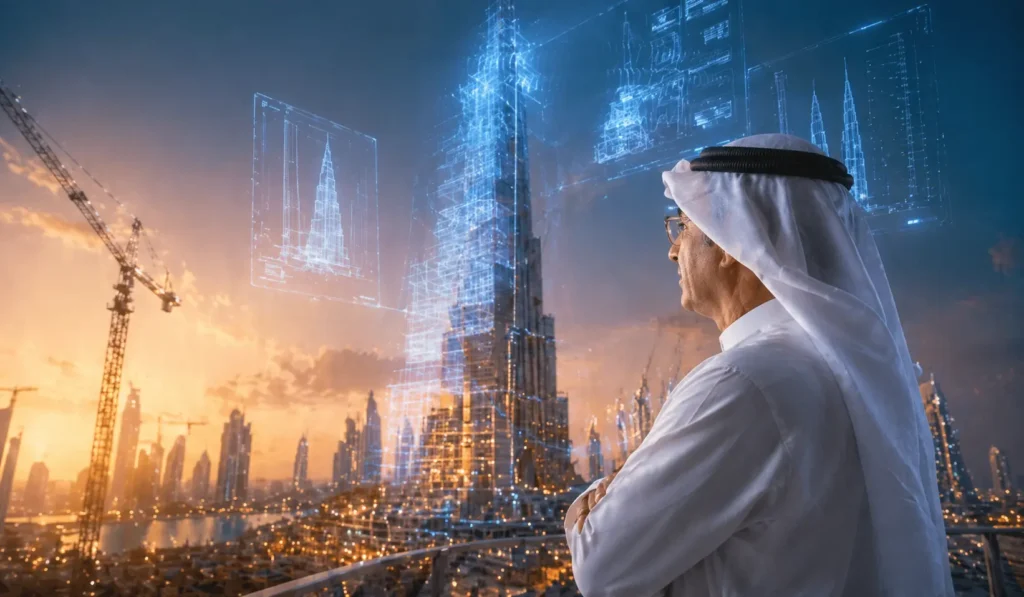
The most significant achievement of Emaar remains the Burj Khalifa, the world’s tallest building. Standing 828 meters tall, the tower opened in 2010 and serves as a global symbol of the UAE’s ambition. While many assume the building is government-owned, it is actually owned by Emaar Properties. Alabbar oversaw every stage of its development, including navigating the 2008 global financial crisis which threatened to halt construction.
Mohamed Alabbar’s Portfolio Reflects a Balanced Multi-Sector Growth Strategy
Alabbar’s business interests extend far beyond real estate and e-commerce. He has built a diversified portfolio that minimizes risk across different sectors:
- Americana Restaurants: Alabbar owns a 33% stake in this publicly traded company, which operates major fast-food franchises like KFC and Pizza Hut across the Middle East.
- Eagle Hills: A private real estate investment firm based in Abu Dhabi, Eagle Hills focuses on large-scale urban regeneration projects in 10 countries, including Egypt, Serbia, Morocco, and Jordan.
- Zand Bank: Alabbar is the chairman of the UAE’s first fully digital bank, catering to both retail and corporate clients.
- Fashion and Retail: Through Alabbar Enterprises, he has held stakes in luxury retailers like YOOX Net-a-Porter and Singapore-based RSH.
This diversified approach allows his group to remain resilient during local market fluctuations. For investors, this trend of multi-sector dominance is worth watching as it mirrors the “zaibatsu” or “chaebol” models seen in East Asia.
Also Read: Sultan Ahmed bin Sulayem Resigns as DP World CEO Following Epstein Allegations
Management Philosophy and the “No Meetings” Rule
Alabbar is known for an unconventional and disciplined management style. He has frequently stated that traditional office meetings are often a waste of time and do not produce results. In September 2024, he implemented a month-long ban on all internal meetings and Zoom calls at his companies to boost productivity.
His financial philosophy is rooted in a strict avoidance of excessive debt. After experiencing a business failure in Singapore in 1997 due to high leverage, he transitioned to a low-debt model. He advises entrepreneurs to avoid borrowing whenever possible, arguing that the global economy is too unstable for high-leverage strategies.
Additionally, Alabbar has expressed mixed feelings about public companies. While Emaar is a highly successful public entity, he has described the pressure of quarterly reporting as “stripping naked in front of the public” every 90 days. He suggests that private ownership offers more freedom for long-term strategic planning.
The $1 Billion Plan to Build an “Arabic-First” Digital Marketplace
In 2016, Alabbar announced the launch of Noon.com, a $1 billion e-commerce joint venture backed by the Saudi Public Investment Fund (PIF) and Kuwait’s MH Alshaya. The platform officially went live in late 2017 with the goal of becoming the “Arabic-first” digital marketplace.
Alabbar’s decision to enter the tech sector was driven by a desire to prevent international players from monopolizing the Middle Eastern digital economy. At the time, online shopping accounted for only 2% of retail in the region, compared to 15% in Western markets. Noon was designed to compete directly with Amazon, which had entered the market by acquiring the regional startup Souq.com.
Today, Noon has expanded its services to include “Noon Food,” a delivery aggregator intended to offer fairer commissions to restaurant owners. Alabbar has publicly criticized the high commissions charged by international aggregators, calling them “daylight robbery” and positioning Noon as a local alternative that supports the regional economy.
Mohamed Alabbar Believes Automation Will Solve Global Housing Challenges
Alabbar is currently championing a shift toward “modular” and robotic construction. During a recent visit to China, he observed technology capable of building a 15-storey building in just 12 days. He is now implementing similar highly automated processes through Eagle Hills in Abu Dhabi.
He predicts that construction must become more sustainable and faster to address global housing shortages. This new model uses prefabrication and robotics, reducing the reliance on traditional concrete and manual labor. Alabbar believes that the first companies to mass-adopt this technology will see a significant drop in costs, which could shape the market in the coming months.
Furthermore, Alabbar is an aggressive adopter of AI in daily operations. He claims to use four different AI tools to assist in decision-making and has even suggested that AI could eventually replace entire departments, such as marketing. He views AI as the greatest opportunity for countries like the UAE to overcome labor shortages and increase efficiency.
How Policy Stability Is Strengthening the UAE’s Global Business Appeal?
Alabbar frequently credits the UAE’s government policies for his ability to scale businesses quickly. He argues that the country “spoils” businessmen with incredible regulations, supportive environments, and a lack of traditional taxes, making it an “autopilot” for wealth creation.
He contrasts this with Western democracies, which he believes are often slowed down by short electoral cycles and “unqualified” leadership. In his view, the UAE’s consistent leadership allows for long-term “construction” and economic growth that is not possible in systems preoccupied with “elections”.
Final Verdict
Mohamed Alabbar’s journey from a modest home on Dubai Creek to the top of the global real estate and digital sectors is a testament to the power of a clear vision and disciplined execution. By diversifying into e-commerce, banking, and food services, he has ensured that his influence extends into every corner of the modern Arab economy.
Businesses should pay close attention to these changes, particularly Alabbar’s pivot toward AI and robotic construction. As he continues to challenge international monopolies and push for regional innovation, his legacy will likely be defined not just by the buildings he has constructed, but by the digital and technological systems he has helped build.
FAQs – Frequently Asked Questions
Mohamed Alabbar is a prominent Emirati businessman and the founder of Emaar Properties, the company behind the Burj Khalifa. He is also the founder of the e-commerce site Noon.com and the chairman of Eagle Hills.
No. Contrary to popular belief, the Burj Khalifa is owned by Emaar Properties, a publicly traded company founded by Alabbar.
Noon.com is a $1 billion e-commerce platform launched in 2017 to serve the Middle East. It was created as a regional alternative to Amazon.
Alabbar believes that most office meetings are unproductive and waste time. He famously banned meetings for an entire month at his companies to prove that productivity would increase.
He is strongly against high leverage. After a significant business failure early in his career, he adopted a model that minimizes borrowing and emphasizes financial discipline.
Alabbar is promoting modular construction where a 15-storey building can be assembled in just 12 days using robots and prefabrication, a technology he discovered in China.
His investments are diversified across real estate (Emaar, Eagle Hills), e-commerce (Noon), digital banking (Zand), and food franchises (Americana Restaurants).
The future focus is on the integration of AI to streamline operations and the use of robotic technology to revolutionize the speed and cost of construction.

Dwayne Paschke is a seasoned content strategist and AI automation specialist with over nine years of experience at the intersection of journalism and digital innovation. A versatile force in the media landscape, Dwayne has built a reputation as an expert content writer and investigative journalist, contributing high-impact pieces to various reputable news websites.