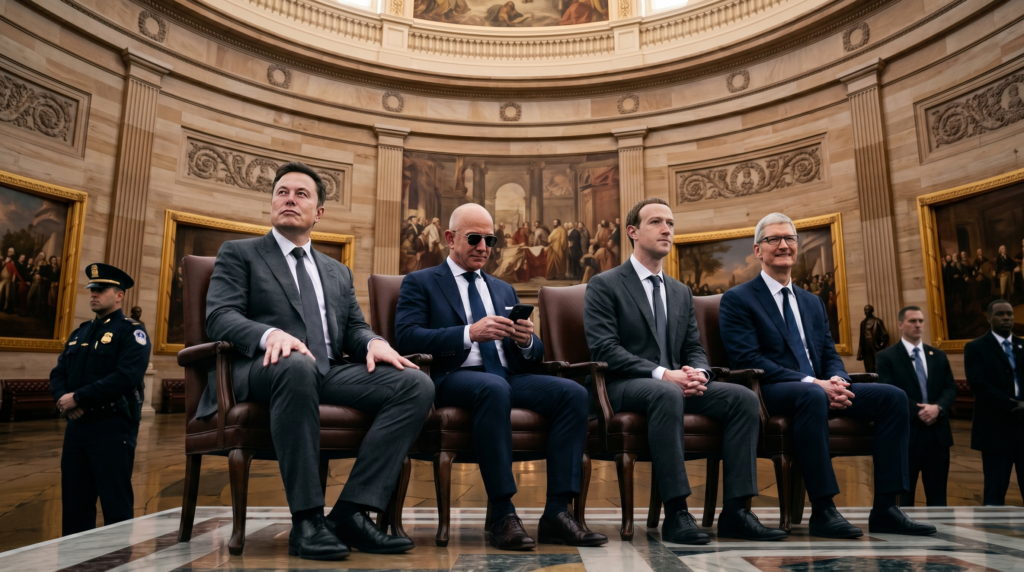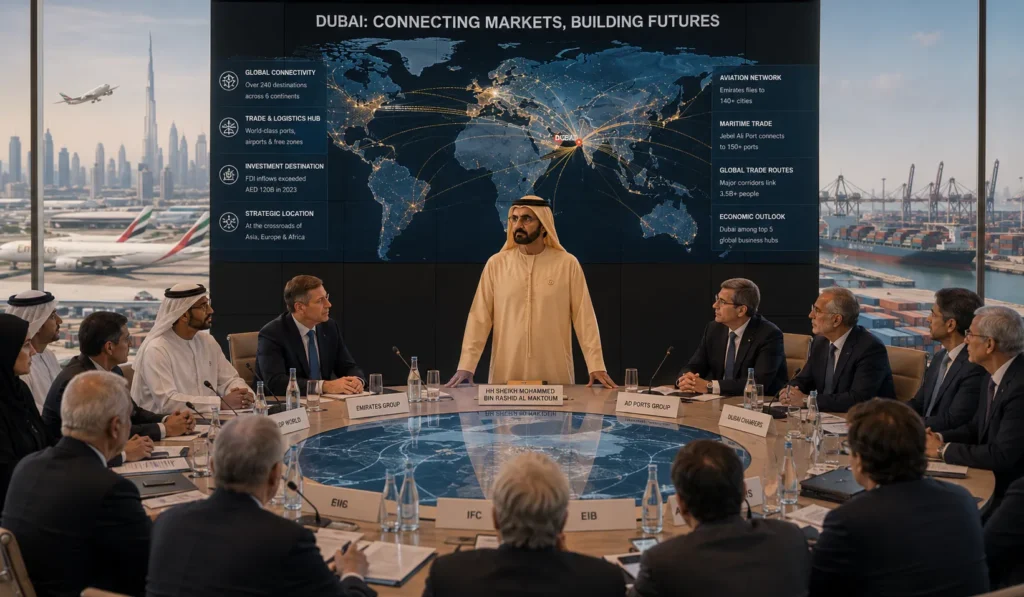

By the time a billionaire makes headlines, the most important decision has already been made, behind closed doors, with no cameras, no press release, and no public vote.
The version of billionaire power the media sells is seductive but incomplete. It’s the yacht photo. The Tesla reveal. The Forbes ranking. What it rarely shows is the actual machinery, how mega-companies decide where to deploy hundreds of billions of dollars, how global CEOs engineer industries from private boardrooms, and how a small class of ultra-wealthy individuals shapes the rules that everyone else has to live by.
This is the story that doesn’t trend. And it’s the one that matters most.
The Scale of Billionaire Wealth Has Reached a Historic Tipping Point
Let’s start with the numbers, because they’ve stopped being abstract.
According to a January 2026 Oxfam report, billionaire wealth surged more than 16% in 2025 alone, rising to $18.3 trillion, three times faster than the previous five-year average. That figure is the highest ever recorded in human history.
The UBS Billionaire Ambitions Report 2025 puts the picture in even sharper relief: 196 self-made billionaires added $386.5 billion to global wealth in a single year. Meanwhile, 91 heirs inherited a record $297.8 billion, a 36% increase over 2024, despite fewer people inheriting overall.
To put it plainly: billionaire wealth has grown 81% since 2020, while nearly half the world’s population still lives in poverty. The gap isn’t just widening, it’s accelerating.
The real story isn’t that billionaires are getting richer. It’s that their wealth is being directly converted into institutional power.
How Mega-Companies Actually Make Billion-Dollar Investment Decisions
The public narrative around major corporate investments tends to focus on announcements, the press conference, the stock bump, the CEO’s confident quote. The actual decision process looks nothing like that.
Inside large corporations, a billion-dollar bet typically passes through multiple filters before it reaches a board vote. Strategic planning teams model scenarios. Finance departments run sensitivity analyses across dozens of variables, currency risk, political risk, supply chain exposure, regulatory environment, competitive response. External advisors are brought in under strict NDAs. In some cases, the decision begins three to five years before any public announcement.
Research from INSEAD Knowledge reveals what CEOs themselves say about high-stakes decisions: a significant number wrestle with balancing intuitive judgment against analytical thinking, with psychological pressure and personal bias frequently cited as real risks. The companies these leaders ran ranged from small enterprises to conglomerates with over €1 billion in annual revenue, and the challenge of decision-making under pressure was consistent across all sizes.
What does this mean in practice? Even the most data-rich CEO is partly making a be, and knows it. The difference between a $1 billion success and a $1 billion catastrophe often comes down to timing, competitive intelligence, and the quality of the team sitting across the table.
Key Insight: At the highest levels of corporate decision-making, the frameworks are rigorous, but the final call is still made by human beings operating under uncertainty, ego, and incomplete information.
The Two-Pizza Rule and Other Billionaire Frameworks
Jeff Bezos, founder and executive chairman of Amazon, the e-commerce and cloud computing giant he built from a Seattle garage into a $2 trillion business, applies a principle he calls the “Two-Pizza Rule”: no meeting should include more people than can be fed with two pizzas. Stanford research backs up the logic, showing that the most productive meetings involve around seven people.
Bezos also pioneered the concept of “disagree and commit,” a documented Amazon leadership principle requiring executives to challenge decisions they disagree with, even when it’s uncomfortable. The goal is to prevent the groupthink that causes large organizations to make expensive mistakes.
Mark Zuckerberg, co-founder and CEO of Meta Platforms, the social technology company that owns Facebook, Instagram, and WhatsApp, famously wears the same grey t-shirt daily. His explanation is precise: “I really want to clear my life to make it so that I have to make as few decisions as possible about anything except how to best serve this community.” Decision fatigue is a documented psychological phenomenon. Eliminating trivial choices is a deliberate cognitive optimization.
Warren Buffett, chairman and CEO of Berkshire Hathaway and widely regarded as the world’s most successful long-term investor, reportedly spends 80% of his working day reading. His investment thesis, buying businesses with durable competitive advantages and holding them indefinitely, requires deep knowledge, not fast reaction. The billionaire “edge” isn’t speed. It’s depth.
Where Billionaires Are Placing Their Bets in 2025 and 2026
Understanding where the world’s richest individuals are moving capital matters because their decisions tend to precede, and shape broader market movements.
The UBS Billionaire Survey 2025 found that nearly half of billionaires (49%) plan to increase exposure to direct private equity investments in 2026, while 37% plan to increase allocations through private equity funds. Private debt is also gaining traction, with one-third of respondents planning to increase exposure as higher interest rates make private credit more attractive.
On public markets, over 40% of billionaires plan to increase exposure to both developed and emerging market equities, with the vast majority planning to maintain current allocations at minimum. Real estate is also back in focus: 43% plan to increase real estate investments, driven by expectations that interest rates in the US and Europe will ease.
Technology sector wealth rose 23.8% in 2025, while industrial wealth recorded the fastest growth at 27.1%, reaching $1.7 trillion. Financial services wealth climbed 17% to $2.3 trillion, boosted by strong markets and a cryptocurrency rebound.
The UBS data underscores a key behavioral pattern: as Jennifer Gabrielli, Head of UBS’s Ultra-High Net Worth solutions group, noted, billionaires consistently invest in “businesses and industries that they’ve run for, if not generations, certainly decades, where they feel like they have a specific edge.” Even after selling original businesses, they deploy capital into familiar territory.
This is the single most important investment lesson billionaires don’t advertise: they don’t diversify into the unknown. They concentrate into what they understand. This is the opposite of the conventional financial advice dispensed to the general public.
The Real Power: Politics, Policy, and the Architecture of Influence
Here is where the media narrative becomes most misleading.
The Forbes profile focuses on the company. The business interview focuses on innovation. Neither adequately covers what is arguably the most significant dimension of billionaire power: the systematic ability to shape the rules under which everyone else competes.
According to The Washington Post’s November 2025 investigation, at least 44 of the 902 US billionaires on the Forbes 2025 list, or their spouses, have been elected or appointed to state or federal office over the past decade, spanning high-level Cabinet positions to advisory board seats. America’s 902 billionaires are collectively worth more than $6.7 trillion.
The top 20 most prolific political donors on the Forbes billionaires list collectively gave nearly $5 billion between 2015 and 2024, spending on everything from state ballot measures to presidential races. The 2024 election cycle saw 150 billionaire families contribute $1.9 billion in support of presidential and congressional candidates, two-and-a-half times the roughly $1 billion spent by individual billionaire donors in 2020.
According to Brookings Institution analysis, billionaire political spending has increased 160-fold since the Supreme Court’s 2010 Citizens United decision. In 2024, lobbying groups spent an all-time high of $4.4 billion on influencing federal policy, with business-related lobbying making up 72% of expenditures versus 16% for public interest groups.
This isn’t a partisan issue. It’s a structural one. The wealthiest individuals in the world now have the financial capacity to shape not only what laws get passed, but what gets discussed, and what doesn’t.
Key Insight: When billionaires own media platforms, fund think tanks, and hold government appointments simultaneously, the line between private interest and public policy dissolves. This is not a conspiracy theory. It is a documented fact.
What the Media Gets Wrong About Billionaire Life
The public imagination of billionaires is built on spectacle: the mega-yacht, the private island, the rocket launch. The reality of how the most effective among them actually operate is significantly less cinematic.
Most high-functioning billionaires treat their lives like a performance optimization problem. Sleep is taken seriously, not as a luxury, but as a cognitive prerequisite. Physical health is managed with the same rigor applied to a portfolio. Time is treated as the single most finite resource, more valuable than capital, because capital can be raised and time cannot.
Many billionaires, contrary to popular assumption, do not retire. The idea that they simply “live off investments” and delegate everything is a myth. As public records and interviews consistently show, figures like Howard Schultz (Starbucks), Larry Ellison (Oracle), and Jan Koum (WhatsApp) built their wealth through prolonged personal involvement, decades of decisions, failures, and recalibration.
What the media consistently underreports is failure. Most billionaires have failed more often than they’ve succeeded, they’ve simply structured their failures to be recoverable and their learning to be accelerating. “Fail fast, fail smart” is not a motivational poster. It is an operational philosophy.
The other underreported dynamic is loneliness and isolation. Several senior executives and former CEOs, speaking to researchers at INSEAD, described the psychological weight of high-stakes decisions made in conditions of radical uncertainty, and the absence of anyone they could fully confide in. Power at the top of an organization is genuinely isolating in ways that don’t photograph well.
The Next Generation of Billionaire Power
The wealth transfer already underway will reshape global power in ways that democratic institutions are not currently equipped to handle.
The UBS report projects that multigenerational billionaires are on track to inherit $6.3 trillion over the next 15 years, up from a previous forecast of $5.2 trillion, because more billionaires have reached age 70 and asset values have risen. In 2025 alone, 91 heirs inherited a record $297.8 billion.
As of 2025, approximately 860 multigenerational billionaires oversee total assets of $4.7 trillion, up from 805 controlling $4.2 trillion in 2024. The number of fourth-generation-and-beyond billionaires grew 10% in a single year.
This is not simply a story about wealth. It’s about the dynastic consolidation of institutional influence, media ownership, political access, corporate control, passing from one generation to the next with minimal democratic accountability.
Investors and policymakers should be paying close attention to this transition. It will determine the ownership structure of critical infrastructure, media ecosystems, and capital markets for the next half century.
Also Read: How the Top 1% Built Their Massive Fortunes From Scratch
The Risks That Don’t Make the Business Press
Billionaire wealth and power are not without vulnerabilities. Several structural risks are building in ways that the financial press undercovers.
Regulatory backlash is accelerating. The concentration of tech ownership, where a handful of individuals simultaneously control platforms that shape political discourse, dominate commercial infrastructure, and influence government has triggered bipartisan concern across multiple jurisdictions. Antitrust enforcement is on the rise in the EU, UK, and increasingly in the United States.
The wealth transfer creates instability. As Oxfam research consistently documents, extreme wealth concentration correlates with weakened institutional trust, increased social fragility, and reduced economic mobility, all of which ultimately create unpredictable environments even for those at the top.
Geopolitical fragmentation is reshaping investment strategy. Billionaires themselves flagged geopolitical risk as a primary concern in the UBS survey, with many increasing gold and alternative asset allocations in response. The era of frictionless global capital movement is under meaningful pressure.
Businesses operating in these environments, whether as suppliers, partners, or competitors to billionaire-backed entities, may need to recalibrate their risk models accordingly.
Final Verdict
The conventional media framing of billionaires as visionary entrepreneurs, eccentric celebrities, or political bogeymen all miss the same thing: the systematic nature of their power.
Billionaire wealth in 2025 stands at $18.3 trillion and growing. Their investment decisions , concentrated in private equity, real estate, and familiar industries, move markets before most analysts notice. Their political spending has increased 160-fold in fifteen years. Their heirs are set to inherit $6.3 trillion in the next fifteen years. And their personal decision-making frameworks, built on cognitive optimization, deep domain concentration, and structured risk, bear almost no resemblance to the image sold in magazine profiles.
What matters for investors, business leaders, and citizens is this: billionaire power is not an abstraction. It manifests in which companies get funded and which don’t. Which regulations pass and which stall. Which narratives reach millions and which remain invisible.
Understanding that machinery, not the mythology around it, is what gives anyone a realistic view of how the global economy actually operates.
Investors monitoring capital flows, businesses navigating competitive landscapes, and policymakers shaping regulatory frameworks should all treat billionaire behavior as a leading indicator, not an afterthought.
FAQs – Frequently Asked Questions
Most billionaires concentrate capital in industries they know deeply, sectors where they’ve operated for decades and believe they have a structural edge. According to UBS research, their top choices for 2026 include direct private equity (49%), private equity funds (37%), real estate (43%), and developed market equities (42%). They rarely diversify into the unknown.
It is thoroughly documented, not exaggerated. At least 44 US billionaires or their spouses have held elected or appointed office in the past decade. The top 100 billionaire families contributed $2.6 billion to the 2024 federal election cycle, one in every six dollars spent. Lobbying by business interests reached a record $4.4 billion in 2024.
The biggest misconception is that billionaires rely primarily on intuition or luck. In reality, the most effective among them apply systematic frameworks to decision-making, minimizing trivial choices to preserve cognitive capacity, investing in areas of deep expertise, and treating failure as data rather than defeat.
According to UBS, multigenerational billionaires are projected to inherit $6.3 trillion over the next 15 years. In 2025 alone, 91 heirs inherited $297.8 billion, a 36% increase over 2024.
Yes, significantly. Between 2015 and 2024, collective billionaire wealth grew 121%, compared to 73% for the MSCI All Country World Index over the same period. The primary driver is concentrated exposure to private equity and direct business ownership, asset classes unavailable to most investors.
Regulatory risk is rising sharply as governments in the EU, US, and UK push antitrust and platform regulation. Geopolitical fragmentation is compressing returns on global investments. And the concentration of wealth itself generates social and political instability that ultimately creates unpredictable operating environments, including for those at the top.
Concentrate on what you understand deeply, think in decades not quarters, and treat failure as an accelerant rather than a verdict. This is the common thread across Buffett, Bezos, and virtually every durable billionaire, and it is the lesson most retail investors never apply.
Daniel Carter covers UAE startups, venture capital, and AI innovation, delivering strategic, investigative reporting on emerging technology ecosystems.