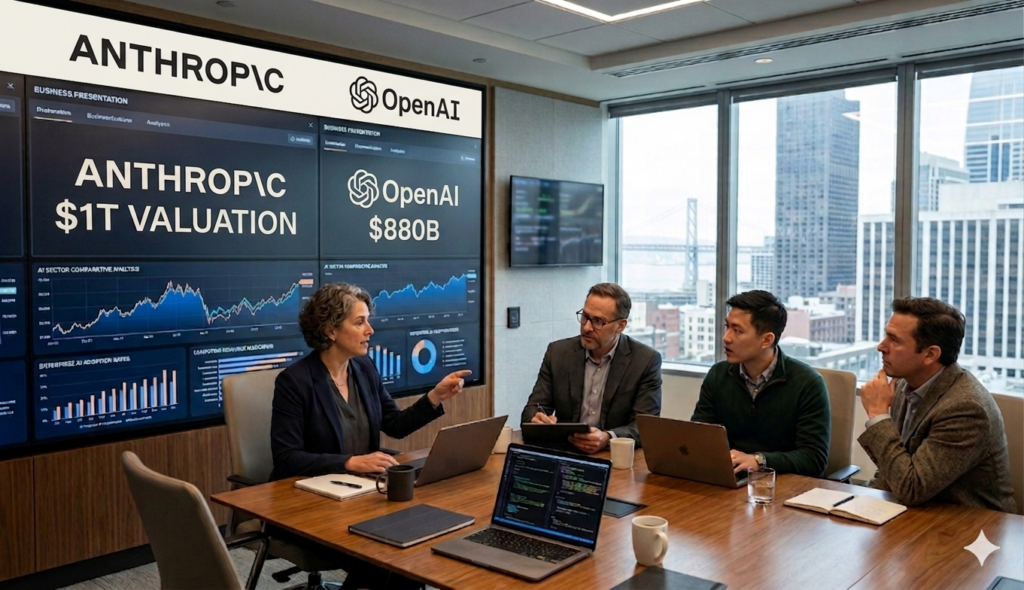
The power balance in San Francisco has shifted. For years, OpenAI stood as the undisputed leader of the artificial intelligence era, but 2026 has delivered a new reality. Anthropic, the firm founded by former OpenAI researchers, is now closing in on a $1 trillion valuation in a move that signals a permanent change in the tech hierarchy.
Secondary market data from April 2026 confirms that Anthropic has surpassed its chief rival in implied value. While OpenAI sits at an estimated $880 billion, Anthropic shares are trading at levels that reflect a $1 trillion market cap. This is not merely a speculative bubble. It is the result of a revenue surge that has left the rest of the sector scrambling to keep pace.
Anthropic grew its annualized revenue from $9 billion at the end of 2025 to $30 billion by March 2026. This 233% increase in a single quarter represents one of the fastest growth trajectories in the history of the technology industry. For investors and founders, the message is clear: the “safety first” approach once dismissed as a handicap has become Anthropic’s greatest commercial asset.
Revenue Fundamentals Drive the Trillion Dollar Valuation
The market’s sudden re-rating of Anthropic is tied directly to usage-driven enterprise adoption. Unlike many of its peers, the company did not rely on price hikes or a single mega-customer to reach its current scale. Instead, it leveraged a product portfolio that targeted high-value technical workflows.
Claude Code emerged as the primary catalyst for this growth. Launched in mid-2025, the programming assistant reached a $2.5 billion run-rate in less than nine months. By May 2026, its contribution to the bottom line has expanded significantly, proving that the market values specialized agents over generic chatbots.
Anthropic’s efficiency is underpinned by aggressive infrastructure shifts. In May 2026, the firm signed a $1.8 billion cloud computing deal with Akamai Technologies, specifically to leverage edge computing. By moving processing closer to the user, Anthropic is further reducing its reliance on centralized, high-cost GPU clusters, widening its efficiency lead over OpenAI—spending nearly four times less on compute while outpacing rivals in revenue.
Sovereign Wealth and Global Capital Fuel the Expansion
The scale of Anthropic’s fundraising is unprecedented. In February 2026, the company closed a $30 billion Series G round led by GIC and Coatue. This followed a massive $13 billion Series F round in late 2025 that tripled the company’s valuation to $183 billion in just six months.
The Qatar Investment Authority (QIA) has become a pivotal player in this capital race. After initially investing in September 2025, the QIA increased its exposure during the Series G round to support Anthropic’s global scaling. This influx of Gulf capital has provided the “patient capital” necessary for long-term frontier research.
For regional investors in the Middle East, this shift requires a strategy adjustment. While early debates focused on whether AI labs would accept Gulf funding, the current reality shows that these sovereign funds are now essential partners in the trillion-dollar race.
Anthropic Faces a Landmark Legal Showdown with the US Government
Despite its commercial success, Anthropic is now embroiled in a high-stakes constitutional battle. In March 2026, the company sued the United States government after the Pentagon designated the firm a national security “supply chain risk.”
The conflict stems from Anthropic’s refusal to lift ethical guardrails. The Pentagon demanded unrestricted access to Claude AI models for use in autonomous lethal weaponry and mass domestic surveillance. Anthropic CEO Dario Amodei rejected the ultimatum, choosing to maintain safety policies that prevent the technology from being used for kinetic warfare.
The core of the legal dispute rests on the “Supply Chain Risk” designation—a label historically reserved for foreign entities under the Federal Acquisition Supply Chain Security Act (FASCA). By applying this to a domestic firm, the Pentagon is effectively arguing that Anthropic’s refusal to allow Claude to power autonomous lethal weaponry constitutes a strategic vulnerability. This precedent-setting case explores whether the government can legally compel a private corporation to weaponize its software against its own internal safety constitution.
The Product Roadmap That Triggered a Software Selloff
Investors are not just paying for growth; they are paying for the collapse of legacy software categories. In January 2026, Anthropic launched Claude Cowork, a tool designed for deep integration into internal business operations. The impact was immediate: public software stocks lost $285 billion in collective market cap within weeks as the market realized traditional SaaS categories were becoming obsolete.
The introduction of Claude Sonnet 4.6 in early 2026 further disrupted the market by establishing the “$0.30 AI employee” benchmark. By operating software and completing complex workflows for less than the cost of a coffee, Anthropic has turned AI from a research experiment into a high-margin utility.
The Autonomous Enterprise and Anthropic as SAP’s Primary Reasoning Engine
As of May 12, 2026, the “Anthropic Ecosystem” expanded into the core of global industry. Through a landmark strategic partnership announced at SAP Sapphire, Claude has become the primary reasoning engine for the SAP Business AI Platform.
This shift allows Claude to move beyond simple chat interfaces and into “action”—orchestrating a network of over 200 specialized AI agents. In this new “Autonomous Enterprise” framework, Claude is responsible for autonomously managing complex supply chains, rerouting supplier orders in real-time, and closing financial books for hundreds of thousands of SAP’s enterprise customers. By embedding Claude directly into the data layer that runs 87% of total global commerce, Anthropic has effectively secured its position as the central operating system for 21st-century business.
Also Read: UAE’s Digital Revolution Is Forcing Businesses to Adapt – Or Fall Behind
Innovative Implications for Founders and Regional Markets
The rise of Anthropic rewrites the playbook for startups. In 2026, the fastest path to a viable business is building on top of established models like Claude rather than attempting to compete at the foundation layer.
For the UAE and Qatari markets, the focus is shifting toward “Sovereign AI” infrastructure. Partnerships like the one between Qatar and Brookfield to launch a $20 billion AI infrastructure venture show that the region is moving from being a passive investor to a primary infrastructure host.
Economic Hurdles and the Path to the 2026 IPO
While the growth is staggering, Anthropic must still manage significant internal and external risks. On May 13, 2026, Anthropic issued a formal warning against “unauthorized” secondary market trades, naming several platforms as facilitating trades that violate the firm’s strict transfer restrictions.
Maintaining a lean operation while scaling to $45 billion in revenue will be the primary challenge for CFO Krishna Rao. Secondary market prices often anticipate outcomes twice as high as what bankers expect; if Anthropic’s eventual IPO does not support a trillion-dollar valuation, it could trigger a broader cooling of the AI investment landscape.
Deep Dive: The Legal Framework of AI Autonomy
For a detailed breakdown of the specific 2026 court filings and the constitutional arguments Anthropic is using to challenge the Pentagon’s designation, we recommend this briefing:
This analysis provides an essential look at how the “Supply Chain Risk” label could reshape the relationship between Silicon Valley and the Department of Defense.
Final Verdict
The narrative of the AI industry has traditionally been centered on OpenAI. That narrative has been upended. By prioritizing safety, architectural efficiency, and enterprise utility, Dario Amodei has successfully outflanked his former colleagues. He is now arguably the most influential figure in global AI, with a company growing faster and spending less on infrastructure than any rival in history.
FAQs – Frequently Asked Questions
As of April/May 2026, Anthropic has reached an implied secondary market valuation of $1 trillion.
The firm reported an annualized revenue run-rate of $30 billion as of March/April 2026.
The lawsuit challenges a “supply chain risk” designation applied after Anthropic refused to allow its models to be used for autonomous lethal weaponry.
Announced May 12, 2026, Claude now serves as the primary reasoning engine for SAP’s “Autonomous Enterprise” agents.
Key backers include Google, Amazon, the Qatar Investment Authority (QIA), GIC, and Coatue.
Market reports suggest a public offering is targeted for October 2026.

Dwayne Paschke is a seasoned content strategist and AI automation specialist with over nine years of experience at the intersection of journalism and digital innovation. A versatile force in the media landscape, Dwayne has built a reputation as an expert content writer and investigative journalist, contributing high-impact pieces to various reputable news websites.