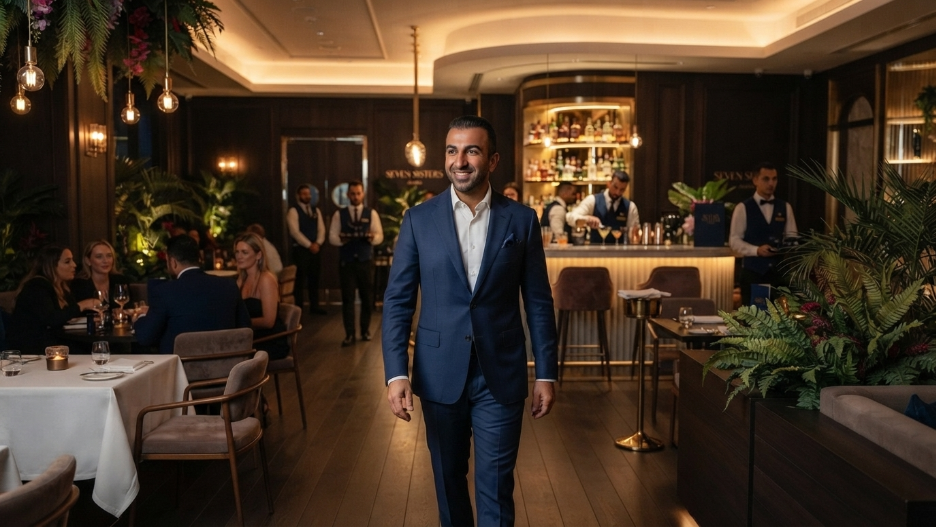
Rabih Fakhreddine is the founder and Group CEO of 7 Management, a Dubai-headquartered entertainment, and hospitality firm behind a few of the Middle East’s most talked-about food companies, and the best nightlife venues. Since the year 2015, he has built a single Beirut theory in a multi-brand portfolio functioning across the UAE, Qatar, Saudi Arabia, Lebanon, and Europe. This guide breaks down his business path, background, leadership strategy, and his journey, his also a lesson for young entrepreneurs to focus on a firm path.
Who is Rabih Fakhreddine?
Rabih Fakhreddine is a Lebanese businessman who has become one of the renowned names in the UAE’s hospitality and entertainment scene. He was born and raised in Lebanon and graduated as a Business Administrator, from the American University of Beirut in 2006, with a keen focus on marketing.
The initial years of his career weren’t satisfying for him. After he graduated, he started working in the FMCG sector at Transmed, which is also the regional distributor for Procter & Gamble, before he moved into a series of managerial positions at British American Tobacco covering the Levant region. That stretch in a well-structured, process-heavy corporate environment provided him a grounding in sales, distribution, and account management that later shaped how he established impressive venues on his own, and achieved his dream.
By his own account, the entrepreneurial itch was always inside him from the early times of his life, when he was looking for growth. He has spoken publicly about always seeing himself running a whole list of diverse restaurants, hotels, and bars instead of climbing a corporate ladder. That vision took its first real shape in Beirut, where he opened a small bar called Faces on Hamra Street as an early, independent venture while still holding down his day job.
Rabih Fakhreddine’s Business Journey
The full-time leap came in 2015. Fakhreddine left corporate life behind and opened Seven Sisters, a music-and-dining venue in Beirut, marking the official start of what would become 7 Management. It was a Rabih Fakhreddine business journey established on doing one concept well, proving it successful, and reinvesting in the next one rather than expanding on borrowed momentum.
From that first venue, growth followed in stages rather than one big jump:
- 2015–2016: Seven Sisters and Antika launched in Beirut, establishing the brand’s identity around music, food, and design-led nightlife.
- 2018: Kahwet Beirut opened, extending the portfolio within Lebanon.
- Post-2018: The company expanded into the UAE, then into Qatar, Saudi Arabia, and parts of Europe, including Greece and Romania.
- 2020s: 7 Management moved into franchise partnerships, bringing established international names into the region alongside its own homegrown concepts.
In practice, this staged approach is what separates a Rabih Fakhreddine success story from a lot of F&B expansion stories that overreach quite quickly. Each latest market entry followed proof of concept somewhere else first, which reduced the operational risk of scaling a hospitality brand across borders with multiple regulatory and consumer environments.
Businesses Founded by Rabih Fakhreddine
7 Management today operates as a group holding firm instead of a single restaurant brand. It launches, designs, and operates entertainment, and hospitality concepts, and increasingly manages franchise rights for brands it didn’t originate.
| Category | Examples |
| Home-grown nightlife & dining brands | Seven Sisters, Antika, February 30, The Theater, Café Beirut, Black Flamingo, B018. DXB |
| Newer concepts | Sayf, Lucia’s, Limonata, Yubi, Lady Bird, Parasol |
| Franchise & partnership brands | Meat the Fish, Em Sherif, Scalini Beirut |
| Street & lifestyle concepts | 25 Jump Street, Dubai’s first licensed street-style concept, operated in partnership with the Dubai World Trade Center |
The Rabih Fakhreddine businesses under the 7 Management umbrella now span Dubai, Riyadh, Beirut, Erbil, and Doha, with a footprint spanning Greece and Romania. The company has also taken on regional franchise rights for established brands like Em Sherif, expanding it into the UAE through a partnership with ADIHH.
This mix of self-built concepts and licensed brands is a deliberate strategy, not an accident. Building homegrown IP gives the group full control and margin on its flagship venues, while franchise partnerships let it move at a great speed into new markets using brand recognition that already exists. A very usual mistake in regional hospitality expansion is choosing one model and sticking to it rigidly; 7 Management runs both at the same time.
Leadership Style That Made Rabih Fakhreddine Successful
Rabih Fakhreddine’s leadership is often known as hands-on, with Fakhreddine himself, rather than being delegated from a distance. He has spoken about staying close to the day-to-day details of every venue rather than treating hospitality as a purely financial rollup exercise.
A few traits define how he runs the business:
- Storytelling over volume. Every venue is established around a concept and a narrative first, with the assumption that guests return for the experience, not just the menu.
- Team empowerment. He has said publicly that real leaders create more leaders, not followers, and that investing in staff pays back in retention and service quality.
- Market-first thinking. In interviews, he’s stressed that customer needs sit at the center of every hospitality decision, from concept design to service standards.
- Operational discipline. Behind the creative ideas is his deep concentration on landlord relationships, partner networks, and repeatable operating structures that let a concept scale without losing what made it work in the first place.
Based on real-world implementation, this mixture of operational rigor, and creative direction is what typically separates hospitality groups that scale from single-location successes that never travel well. If you think of making an attractive restaurant concept that can work in one city and can easily fail in the next city, the operating systems behind it aren’t rebuilt for local conditions, and Fakhreddine’s approach treats that rebuilding as part of the job, not an afterthought.
Major Achievements and Awards
Over the previous decade, Rabih Fakhreddine has received recognition both for brands under 7 management and for individual leadership.
- F&B Heavyweight of the Year, Leaders in F&B Awards (2022)
- F&B Entrepreneur of the Year, Entrepreneur Middle East (2022)
- Forbes Middle East Top 20 List, recognizing leading figures in luxury dining in the Middle East
- Caterer Power List 2025, naming him among the region’s most influential hospitality leaders
- Arabian Business Dubai 100: Most Influential People (2025)
The great founder also works as a board member of the Global Smile Foundation and is an active individual of the Young Presidents’ Organization’s UAE chapter, alongside a trustee role at his alma mater, the American University of Beirut. Precise net worth figures for Fakhreddine haven’t been independently disclosed or verified in public financial reporting, so any particular number circulating online shouldn’t be considered as the confirmed figure.
Lessons Entrepreneurs Can Learn from Rabih Fakhreddine
For business owners looking for business leaders in the UAE as reference points, a few patterns from this journey are worth pulling out directly:
- Corporate experience isn’t wasted time. Years in structured sales roles at Transmed and British American Tobacco established the operational muscle that made later ventures scalable, rather than just creatively ambitious.
- Prove the concept before you multiply it. Seven Sisters launched in one city before the brand expanded regionally. Scaling a hospitality concept before it’s proven locally is a common way founders burn capital.
- Mix owned brands with partnerships. Relying only on home-grown concepts limits speed; relying only on franchises limits margin and differentiation. Running both, as 7 Management does, spreads the risk.
- Build teams that can run without you in the room. A leadership style focused on empowering staff, not just directing them, is what allows a founder to open a fifth venue instead of getting stuck operating the first one.
When NOT to follow this playbook exactly: a staged, city-by-city expansion model works well in F&B and hospitality, where local taste, regulation, and real estate matter enormously. It translates less directly to software or product businesses, where distribution economics work in a different way. The underlying discipline, proving a concept before scaling it, still applies broadly.
What’s Next for Rabih Fakhreddine?
7 Management’s next phase leans further into international growth. Confirmed and announced plans include relocating Seven Sisters to Dubai Creek Resort in partnership with Park Hyatt, opening Lucia’s in both Athens and Baghdad, and bringing Scalini Beirut into the portfolio. The group is also part of a themed restaurant collaboration with chef Joël Robuchon planned for NEOM’s Sindalah Island in Saudi Arabia, alongside a lifestyle collective at Dubai World Trade Center’s One Central.
The broader goal, based on Fakhreddine’s own public comments, is to take home-grown brands built in Beirut and Dubai and position them as genuine international lifestyle destinations, rather than concepts that stay regional by default.
Final Verdict
In all these lists of successful entrepreneurs in the UAE, Fakhreddine becomes prominent less for a single breakout hit and more for a repeatable system: establish a powerful concept, prove it locally, then scale it deliberately over the new markets while mixing owned brands with innovative franchises. For anyone who is gaining knowledge on the hospitality industry in the UAE, his career is a useful case study in what it actually takes to turn one venue into a regional group: patience, operational discipline, and a willingness to rebuild the playbook for each new city rather than copy-paste it.
Frequently Asked Questions – FAQs
Rabih Fakhreddine is a Lebanese businessman and the owner and group CEO of 7 Management, a Dubai-based hospitality and entertainment company operating all over the Middle East and Europe.
He founded and leads 7 Management, whose portfolio consists of brands like Seven Sisters, Antika, February 30, The Theater, Lucia’s, and Sayf, along with franchise partnerships for Em Sherif, Meat the Fish, and Scalini Beirut.
He’s famous for building a multi-brand hospitality and nightlife group from a single Beirut venue in 2015 into a regional business operating in the UAE, Lebanon, Qatar, Saudi Arabia, and Europe.
His work is centered on food and beverage, hospitality, and entertainment, consisting of restaurants, nightlife venues, and lifestyle-driven concepts.
His career highlights the value of corporate experience before becoming a business owner, offering a concept locally before expanding it, and combining owned brands with franchise partnerships to balance growth speed against control.

UK-based journalist covering UAE entrepreneurship, executive branding, and leadership growth across global business ecosystems.