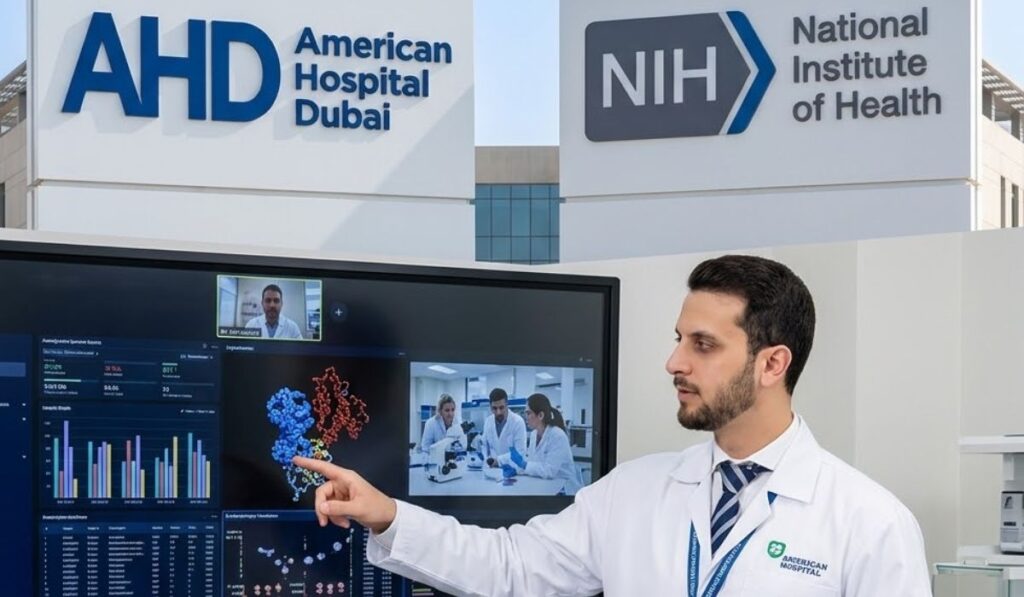
Dubai’s American Hospital Dubai has successfully performed a rare and highly complex surgical procedure to remove and reconstruct a patient’s jaw affected by an uncommon tumor, marking an important milestone in advanced medical care in the UAE.
The operation involved treating an odontogenic myxoma, a rare benign tumor that forms in the jawbone and originates from tissues associated with tooth development.
According to clinical information published by the National Institutes of Health, odontogenic myxoma is an uncommon tumor that can grow aggressively within the jaw and often requires complex surgical management.
The procedure carried out in Dubai required highly specialised surgical expertise and advanced planning technology, making it one of the most sophisticated operations of its kind performed in the country.
Rare Tumor Detected After Routine Examination
The patient, a female who had previously undergone tumor treatment in the United Kingdom in 2000, was initially treated through tumor excision and tissue removal. Years later, during a routine dental check-up, panoramic radiographs revealed unusual changes in the jawbone.
Concerned about the findings, the patient sought further evaluation at American Hospital Dubai, where doctors conducted extensive diagnostic assessments including advanced imaging scans, clinical examinations, and a biopsy.
The tests confirmed the presence of a large recurrent tumor affecting the left mandible, the lower jawbone responsible for essential functions such as chewing, speaking, and facial structure support.
Complex Surgical Plan Developed
Due to the size and progression of the tumor, Dr. Hani Nachawati, Consultant Oral Surgeon and Implantologist at American Hospital Dubai, determined that the most effective treatment would require a hemimandibulectomy.
A hemimandibulectomy is a surgical procedure that removes a portion or half of the mandible, or lower jawbone.
According to the American Association of Oral and Maxillofacial Surgeons, such procedures are typically used to treat severe jaw tumors, infections, trauma, or congenital conditions.
In this particular case, surgeons performed a left hemimandibulectomy while preserving the mandibular condyle, a critical part of the jaw joint that connects the jawbone to the skull through the temporomandibular joint (TMJ).
The preservation of this structure was essential for maintaining jaw movement and facial symmetry.
Advanced 3D Surgical Planning
To ensure maximum precision, the surgical team used 3D CAD/CAM planning technology, allowing doctors to create a detailed virtual surgical plan before entering the operating room.
Such digital surgical planning has become increasingly important in complex reconstructive procedures, enabling surgeons to simulate tumor removal and design the reconstruction process in advance.
According to research published by the National Library of Medicine, computer-assisted surgical planning significantly improves accuracy in maxillofacial reconstruction procedures.
Jaw Reconstruction Using Microvascular Surgery
After removing the affected section of the jaw, surgeons immediately reconstructed the bone using a fibular free flap, a sophisticated microvascular technique widely used in reconstructive surgery.
The fibular free flap involves transferring a segment of bone from the patient’s lower leg (fibula) to replace the removed jawbone. Blood vessels are then carefully reconnected under a microscope to restore blood circulation to the transplanted bone.
This technique helps restore both functional movement and facial structure, enabling patients to regain the ability to chew, speak, and maintain natural facial contours.
Multidisciplinary Surgical Collaboration
The demanding 12-hour surgery was carried out by a multidisciplinary team at American Hospital Dubai, combining expertise from multiple specialties.
The team included Dr. Hani Nachawati, along with ENT surgeon Dr. Roy, and plastic surgeons Dr. Tracia and Dr. Ali, supported by anesthesiology and intensive care specialists.
Such multidisciplinary collaboration is essential for complex head and neck surgeries, where surgeons must coordinate tumor removal, reconstruction, and patient recovery simultaneously.
Successful Recovery and Medical Innovation
Following the procedure, doctors reported that both the surgery and the post-operative recovery proceeded smoothly. The patient achieved strong functional outcomes along with a natural aesthetic appearance.
Medical experts note that procedures of this complexity highlight the growing capabilities of hospitals in the UAE to perform advanced surgical treatments that were once only available in major global medical centers.
American Hospital Dubai has built a strong reputation for treating complex diseases through advanced technology, specialised surgical teams, and multidisciplinary medical care.
The successful treatment of this rare tumor case demonstrates how cutting-edge surgical techniques, combined with detailed digital planning and collaboration among specialists, can significantly improve patient outcomes in complex medical conditions.
As healthcare innovation continues to advance, hospitals in the UAE are increasingly contributing to the development of world-class medical capabilities across the region.
FAQs – Frequently Asked Questions
Dr. Hani Nachawati is a consultant specializing in oral and maxillofacial surgery at American Hospital Dubai. He is experienced in treating complex facial conditions, including jaw tumors, facial trauma, reconstructive surgery, and advanced oral surgical procedures using modern surgical techniques.
The patient was diagnosed with a rare jaw tumor that required complex surgical removal followed by advanced reconstructive procedures. Such tumors can affect the jawbone, surrounding tissues, and facial function, making specialized treatment essential for successful outcomes.
Advanced jaw reconstruction involves restoring the structure and function of the jaw after tumor removal or severe injury. Surgeons may use digital surgical planning, 3D imaging, patient-specific implants, bone grafts, or microvascular free-flap reconstruction to achieve accurate functional and aesthetic results.
Digital surgical planning allows surgeons to create detailed 3D models before the procedure, helping them visualize the anatomy, design personalized reconstruction plans, improve surgical precision, reduce operating time, and enhance patient recovery.
Symptoms of a jaw tumor can include persistent jaw swelling, facial pain, numbness, difficulty chewing, loose teeth, changes in facial appearance, or limited jaw movement. Since symptoms vary depending on the tumor type, early evaluation by a specialist is important for accurate diagnosis and timely treatment.
Complex jaw tumor treatment often requires collaboration between oral and maxillofacial surgeons, radiologists, oncologists, pathologists, anesthesiologists, reconstructive surgeons, and rehabilitation specialists. This multidisciplinary approach helps ensure comprehensive treatment planning, surgical precision, and improved long-term patient outcomes.
Modern reconstructive surgery helps restore jaw function, facial symmetry, speech, chewing ability, and overall quality of life. Personalized reconstruction techniques also reduce complications and support better cosmetic and functional recovery.
American Hospital Dubai is known for offering advanced medical technologies, experienced multidisciplinary teams, and specialized treatment for complex conditions across multiple medical specialties. Its focus on innovation, digital healthcare solutions, and patient-centered care enables it to manage challenging surgical cases using internationally recognized standards.

Dwayne Paschke is a seasoned content strategist and AI automation specialist with over nine years of experience at the intersection of journalism and digital innovation. A versatile force in the media landscape, Dwayne has built a reputation as an expert content writer and investigative journalist, contributing high-impact pieces to various reputable news websites.