The Middle East has officially transitioned from a consumer of global technology to a primary architect of its own digital future. Riyadh-headquartered startup Intella recently secured $12.5 million in an oversubscribed Series A funding round, a move that signals a permanent shift in how localized AI is valued. This investment highlights the urgent demand for “dialect-proof” solutions that can handle the unique linguistic nuances of the Arabic-speaking world.
As Saudi Arabia formally designates 2026 as the “Year of Artificial Intelligence,” Intella’s ascent represents a meritocratic victory for regional innovation. For years, global models were viewed as sufficient; today, the market has realized that generic AI cannot capture the cultural or linguistic specificities required for a truly “Sovereign AI” infrastructure.
Intella Series A Funding and the Shift Toward Institutional Maturity
The funding round was led by Prosus, a global technology powerhouse, alongside heavyweights like 500 Global and Saudi-based Wa’ed Ventures. This latest injection of capital brings Intella’s total funding to approximately $16.9 million.
This is not just another venture check; it is a vote of confidence in the maturity of the MENA tech ecosystem. A significant portion of the investment is earmarked for the research and development of Arabic-first generative models. By prioritizing local R&D, Intella is ensuring that the digital transformation of the Middle East is built on a foundation of local data, rather than being “retrofitted” from Western datasets.
Solving the 25-Dialect Challenge through Architectural Precision
Arabic is the fifth most spoken language globally, yet it remains a “low-resource” language for most Silicon Valley giants. The primary hurdle is that Modern Standard Arabic (MSA)—the version most AI is trained on—is rarely spoken in day-to-day life. Instead, the 400 million speakers in the region utilize over 25 primary dialects that differ significantly in syntax and phonology.
Generic AI models from global tech giants often struggle with these fragmented linguistic patterns. Intella has built its business by addressing this complexity through a deeply localized approach. In the current 2026 landscape, localized AI development has moved from a “niche interest” to a mechanical necessity for any firm operating in the MENA region.
Intella Technology and the 95% Accuracy Benchmark
Intella’s proprietary speech-to-text models have set new global records for Arabic transcription accuracy. The startup’s engine has achieved a 95.73% accuracy rate in real-world environments, outperforming nearly every major cloud provider.
| Model Provider | Reported Arabic Accuracy (Dialectal) |
| Intella AI | 95.73% |
| Microsoft Azure | 66.2% |
| Google Cloud | 62.5% |
| IBM Watson | 59.1% |
This gap isn’t just a technical win; it’s a commercial one. For a call center handling millions of minutes of audio, the difference between 60% and 95% accuracy is the difference between “useless noise” and “actionable intelligence.”
Core Products and the Launch of Ziila Digital Human
The company offers a comprehensive suite of tools designed for high-demand sectors like finance and telecommunications. intellaCX, their flagship analytics tool, transforms unstructured call data into actionable business insights. Simultaneously, intellaVX provides advanced speech-to-text capabilities skilled in over 25 dialects, including advanced noise filtering and multi-speaker identification.
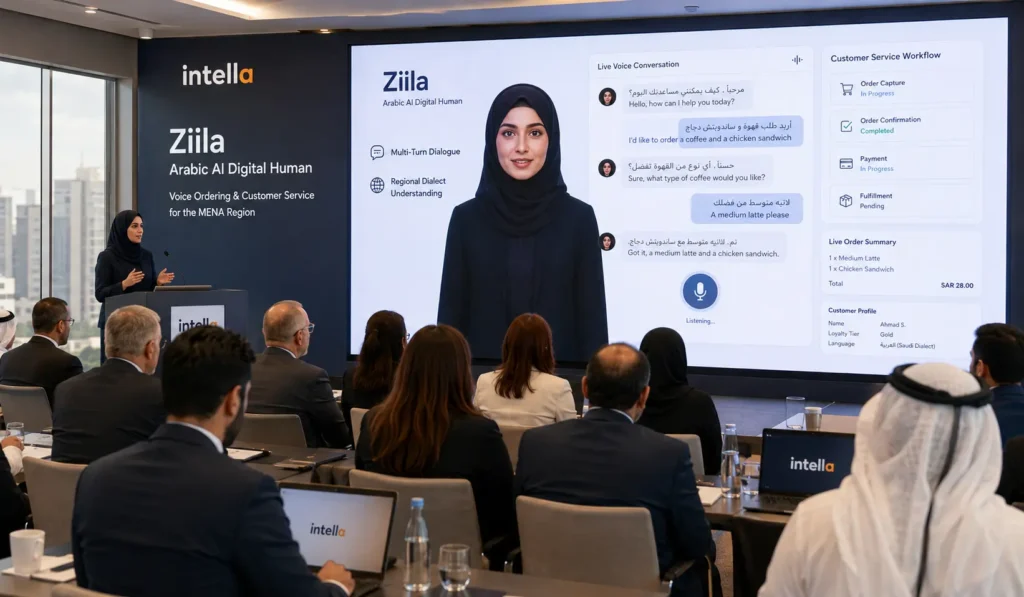
In a landmark 2026 update, Intella unveiled Ziila, an Arabic-born digital human. Unlike generic avatars, Ziila is capable of multi-turn dialogue and contextual understanding of regional slang and cultural nuances. The technology has already been stress-tested through a partnership with Jumia, where it successfully handled voice-ordering for Africa’s largest e-commerce platform.
The Visa Partnership and Banking AI Compliance
A major milestone for Intella is its ongoing collaboration with Visa. The partnership aims to develop “dialect-proof” AI systems specifically for financial institutions. In the 2026 regulatory environment, banks are increasingly required to monitor interactions for compliance and fraud detection.
By using Intella’s engine, Visa is enabling banks to analyze customer interactions in real-time, regardless of the dialect being spoken. This initiative validates the belief that linguistic understanding is the core of financial trust in the Arab world.
Also Read: Sarah Al Amiri and Her Strategy for the UAE Education and Space Technology
MENA Venture Trends and the “Year of AI” Momentum
The MENA region reached a record $3.8 billion in VC investment in 2025, and the momentum into mid-2026 shows no signs of slowing. AI startups have been the primary driver, accounting for a massive share of this capital.
The Kingdom of Saudi Arabia, in particular, is pivoting from oil-dependence to AI infrastructure. With the recent unveiling of the Hexagon Data Center in Riyadh—set to be the world’s largest government-owned facility—local startups like Intella now have the sovereign compute power necessary to train models that rival any in the Global North.
Strategic Expansion into the “Dark Data” Market
Intella is currently projecting 7x growth for 2026, fueled by demand from government agencies and telecommunications operators. The startup is using its Series A capital to scale go-to-market teams in both Egypt and Saudi Arabia.
The strategy is focused on “Dark Data”—the massive amounts of unstructured audio and video that organizations collect but cannot analyze. By transcribing and categorizing this data, Intella is helping regional leaders turn their archives into a strategic asset for Vision 2030 initiatives.
Final Verdict
The legacy of Nour Taher and Omar Mansour’s vision is defined by the refusal to accept “good enough” from global tech providers. Intella has proven that local talent, armed with local data, can outperform the world’s largest companies in their own backyard. As the “Year of AI” continues to unfold in Saudi Arabia, Intella stands as the definitive case study for how regional startups can architect the industrial future of a nation.
FAQs – Frequently Asked Questions
A Riyadh-based AI leader specializing in high-accuracy speech intelligence for over 25 Arabic dialects.
A total of $16.9 million, including a recent $12.5 million Series A.
Global names like Visa and regional giants like Jumia and various Saudi government agencies.
It holds a record 95.73% accuracy rate, significantly higher than global cloud competitors.
An Arabic-born conversational digital human capable of natural, dialect-proficient dialogue.
Riyadh, Saudi Arabia, with secondary operations in Egypt.
A 2026 Saudi government designation emphasizing AI as the core pillar of national development.
Yes, but its primary advantage is transcribing 25+ regional dialects that generic models miss.

Dwayne Paschke is a seasoned content strategist and AI automation specialist with over nine years of experience at the intersection of journalism and digital innovation. A versatile force in the media landscape, Dwayne has built a reputation as an expert content writer and investigative journalist, contributing high-impact pieces to various reputable news websites.