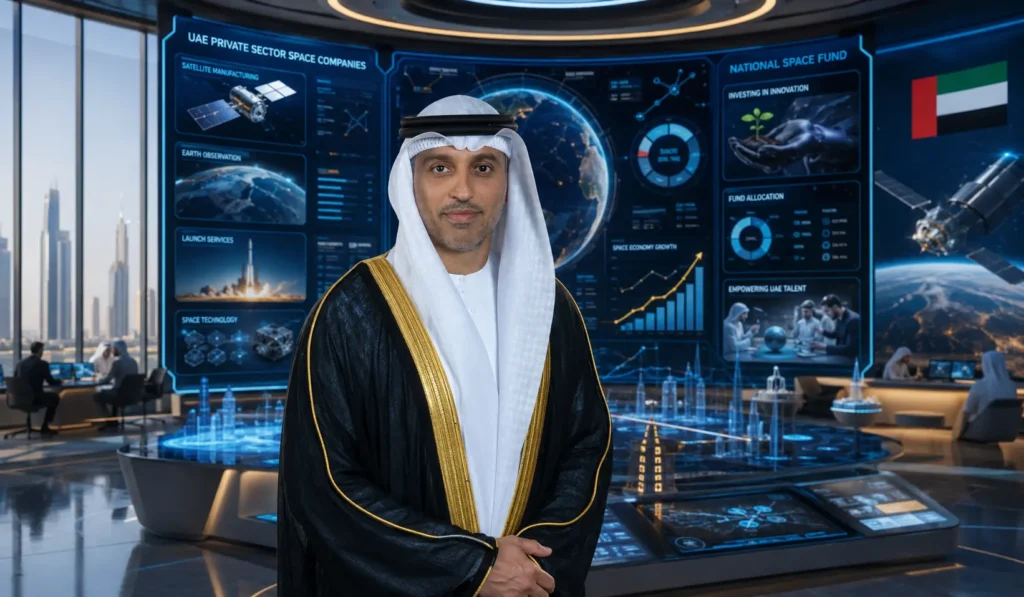
The United Arab Emirates is distributing and dependencies of massive economy, moving away from a traditional oil-based economy toward a future driven by knowledge, innovation, and advanced technology. At the center of this transformation is the national space sector, which has become a key driver for sustainable economic growth and global competitiveness. Leading this ambitious journey is His Excellency Dr. Ahmad Belhoul Al Falasi, the Chairman of the UAE Space Agency and a pivotal figure in the country’s government.
This topic matters right now because the UAE has recently increased its total space sector investment to approximately AED 44 billion (roughly $12 billion). This article explores the growth of the UAE Space Agency, the strategic decisions made by its leadership, and the real-world impact of its interplanetary missions on the national economy. For investors and business leaders, this trend is worth watching closely as the private sector begins to take a dominant role in space-related industries.
Historical Development of the UAE Space Program
The UAE’s interest in the stars is not a recent development but rather a long-standing national ambition that dates back to the 1970s. His Highness Sheikh Zayed bin Sultan Al Nahyan, the founding father of the UAE, met with the NASA Apollo moon landing team nearly five decades ago, sparking a vision for a national space program. This vision eventually led to the creation of major telecommunications entities like Thuraya Communications Company in 1997 and Al Yah Satellite Communications Company (Yahsat) in 2007.
The formalization of this ambition occurred in 2014, when the UAE Space Agency (UAESA) was established under Federal Law by Decree No. 1. The agency was created as a federal body with financial and administrative independence, reporting directly to the Council of Ministers. Its primary mandate was to coordinate, regulate, and lead the national space sector while ensuring its contribution to the national economy. Since its founding, the agency has grown from a regulatory body into a leader of complex deep-space missions.
H.E. Dr. Ahmad Belhoul Al Falasi – A Leadership Journey
His Excellency Dr. Ahmad Belhoul Al Falasi has been the Chairman of the UAE Space Agency since June 2017. Born on November 24, 1977, Dr. Al Falasi’s career is defined by high-level academic achievement and extensive experience in both the private and public sectors. He holds a Ph.D. from Monash University, a Master’s degree from the University of Melbourne, and a Bachelor’s degree in Telecommunications Engineering from Khalifa University.
Before his leadership in the space sector, Dr. Al Falasi held several critical roles, including CEO of Masdar, Executive Director at Dubai Tourism, and Vice President at Mubadala Development Company. He also worked as a consultant for McKinsey & Company. Within the UAE government, his influence is vast; he has served as the Minister of State for Higher Education, the Minister of State for Entrepreneurship and SMEs, and the Minister of Education.
In July 2024, Dr. Al Falasi was appointed as the UAE Minister of Sports. This unique combination of portfolios allows him to oversee the development of human capital through sports and education while simultaneously leading the nation into the space age. He also serves as the Chancellor of the Higher Colleges of Technology (HCT), ensuring that the next generation of Emirati graduates is equipped with the skills required for the labor market and the space industry.
A $40B Space Bet — How the UAE Is Reshaping Its Economy?
The economic impact of the UAE space sector is substantial and growing. Total investments in the field have reached approximately AED 40 billion to AED 44 billion. This capital is not only coming from the government; commercial spending in the space field has surged by 29.51% annually. Furthermore, the overall value of the sector has seen a robust increase of 7.73%.
National companies are playing an increasingly important role, contributing over AED 10.9 billion to the sector’s output, which represents 40.7% of the total. This indicates a healthy ecosystem where private enterprises are thriving alongside government initiatives. Dr. Al Falasi has emphasized that the success of any nation’s space sector depends on the activity of its private sector. To support this, the government established the National Space Fund, valued at AED 3 billion, to finance and facilitate future private space projects.
Private Enterprise Engagement in UAE’s Space Sector Development
In the early stages of the UAE space program, the government bore most of the responsibility and financial risk. However, under the strategic direction of the UAE Space Agency, the private sector—including small and medium enterprises (SMEs)—is now taking on a greater role. Participation of SMEs in major industry events like the Dubai Airshow has doubled in recent years, with their dedicated pavilion area expanding by more than 60%.
Most of these Emirati companies initially focus on space applications that use artificial intelligence and data analytics. These applications provide services such as urban planning, environmental monitoring, and groundwater measurement through the analysis of satellite imagery. As these companies mature, they are beginning to venture into more advanced areas like the production of space components and satellite operations. Businesses should pay close attention to these changes as they represent new opportunities for high-tech manufacturing and software development in the UAE.
Government Support for the UAE Space Industry
To ensure the sustainability of the sector, the UAE government has implemented a comprehensive legislative framework. The National Space Sector Policy and the National Space Sector Strategy provide the overarching goals for the country. A critical piece of legislation is Federal Decree by Law No. (46) of 2023, which regulates space activities and establishes an inspection and oversight regime to ensure compliance.
The UAE Space Agency also launched the Space Economic Zones Program. This initiative aims to establish six specialized zones across the country to serve as accelerators for startups and SMEs. These zones provide economic incentives and initiatives to boost the sector’s growth. Currently, over 180 companies are actively participating in this program, supported by 13 strategic partners.
Also Read: Ahmed Ben Chaibah As The Founder of AquaFun – Entrepreneurial Journey
UAE and Its Active Participation in Global Space Collaborations
Space exploration is inherently a global endeavor, and the UAE has positioned itself as a major international partner. The UAE Space Agency has signed more than 25 Memorandums of Understanding (MoUs) with leading international space agencies, including NASA, Roscosmos, JAXA, and the UK Space Agency.
One of the most significant recent international collaborations is the UAE’s participation in the Artemis Lunar Gateway Project. Alongside the United States, Japan, Canada, and the European Union, the UAE is contributing to the development of a lunar-orbiting station. This project includes the historic announcement of sending the first Emirati and Arab astronaut to lunar orbit. These partnerships not only enhance the UAE’s technical capabilities but also solidify its position as a global hub for space innovation.
How the UAE Is Expanding Into Deep Space Missions?
The UAE has successfully completed its first deep-space mission and is now embarking on one that is even more complex. The Emirates Mars Mission (Hope Probe) provided the international scientific community with 4.1 terabytes of data on the Martian atmosphere, contributing to over 270 scientific papers. Its mission has been extended until 2028 to continue gathering valuable science.
Building on this success, the UAE announced the Emirates Mission to the Asteroid Belt (EMA). This mission represents a qualitative leap in complexity compared to the Mars mission.
- Distance: The mission will cover 5 billion kilometers, ten times the distance of the Hope Probe.
- Timeline: It is a 13-year venture, with six years for spacecraft development and seven years of flight.
- Hardware: The spacecraft, named the MBR Explorer, is twice as long and 1,000 kilograms heavier than the Hope Probe.
- Objective: To study multiple asteroids in the main belt located beyond Mars.
This mission officially transitioned into the Assembly, Integration, and Testing (AIT) phase in 2025, with a planned launch in the first quarter of 2028.
Education and Skills Development in the UAE Space Journey
A recurring theme in Dr. Ahmad Belhoul Al Falasi’s leadership is the focus on “national talent” and the “youth of the nation”. The space sector is viewed as a primary tool for developing advanced scientific and engineering skills among UAE citizens. The National Space Academy is a key part of this strategy, with 70% of its graduates being employed within the space sector.
As Chancellor of the HCT and former Minister of Education, Dr. Al Falasi has worked to align the educational system with the requirements of the labor market and the space industry. This ensures that the massive investments in space technology are supported by a capable and specialized workforce. How can a nation truly lead in space without first mastering education on the ground? This focus on human capital is what makes the UAE’s model sustainable for the long term.
What No One Tells You About UAE Space Missions?
Despite its rapid success, the UAE space sector faces several significant challenges. Deep-space missions are inherently risky and technically complex. The EMA mission requires the MBR Explorer to survive for eight years in a harsh deep-space environment, far beyond the three-year operational duration of the Hope Probe. Managing such long-term planning and technical execution requires constant innovation and troubleshooting.
Furthermore, the global space economy is becoming increasingly crowded. The UAE’s goal to be among the top ten countries for hosting space companies by 2031 depends on its ability to continue attracting international talent and investment in a competitive market. Economic fluctuations and geopolitical tensions can also impact international cooperation, which is vital for the sector’s success.
Interesting Article: UAE Space Platform Opens Satellite Data Access for Students and Start-ups
Final Verdict
Under the leadership of H.E. Dr. Ahmad Belhoul Al Falasi, the UAE Space Agency has transformed the nation into a serious contender in the global space race. With AED 44 billion in investment and a clear strategy to empower the private sector, the UAE is not just exploring space; it is building a new economic frontier. The shift from government-led initiatives to a thriving, private-sector-driven ecosystem marks a new chapter in the UAE’s centennial vision. For those looking to participate in the future of the Middle Eastern economy, the space sector is no longer a distant dream—it is a present reality.
FAQs – Frequently Asked Questions
The UAE Space Agency was established in 2014 under Federal Law by Decree No. 1.
His Excellency Dr. Ahmad Belhoul Al Falasi is the Chairman of the UAE Space Agency. He also serves as the UAE Minister of Sports.
As of early 2026, the UAE has invested approximately AED 44 billion (roughly $12 billion) in its space sector.
The Hope Probe (Emirates Mars Mission) was the UAE’s first interplanetary mission. It launched in 2020 and reached Mars in 2021 to study the Martian atmosphere.
The next major project is the Emirates Mission to the Asteroid Belt (EMA). It involves a 13-year timeline with a spacecraft, the MBR Explorer, planned to launch in 2028.
The Space Economic Zones are six specialized zones across the UAE designed to act as accelerators for space startups and SMEs by providing economic incentives and support.
Yes. KhalifaSat, launched in 2018, was the first satellite developed 100% by Emirati engineers. In 2025, the UAE also opened Orbitworks, its first integrated commercial satellite manufacturing facility.
The National Space Fund is an AED 3 billion fund established to support private sector investment, financing, and facilitation of future space projects.

Dwayne Paschke is a seasoned content strategist and AI automation specialist with over nine years of experience at the intersection of journalism and digital innovation. A versatile force in the media landscape, Dwayne has built a reputation as an expert content writer and investigative journalist, contributing high-impact pieces to various reputable news websites.