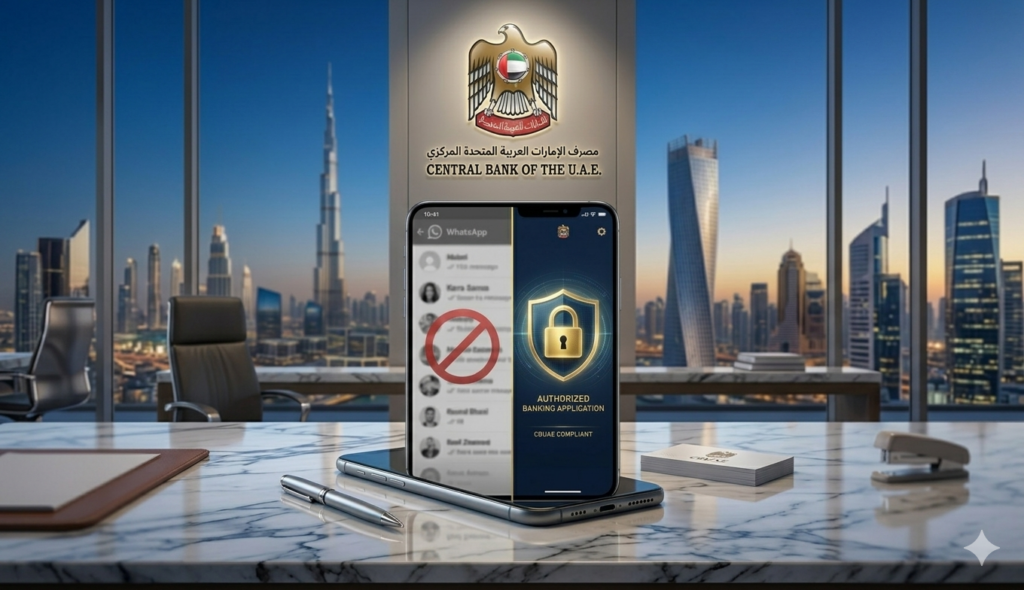
The Central Bank of the United Arab Emirates (CBUAE) has issued a major regulatory mandate that fundamentally changes how residents and businesses interact with their financial institutions. In a decisive move to protect the nation’s financial ecosystem, the regulator has prohibited all banks and licensed financial entities from using WhatsApp and other instant messaging platforms for conducting monetary transactions or handling sensitive customer data.
This directive is not merely a suggestion; it is a strict requirement designed to mitigate rising threats in the digital landscape. As cybercriminals become more sophisticated, the UAE is taking proactive steps to ensure that its banking sector remains one of the most secure in the world. Businesses should pay close attention to these changes as they transition their communication and transaction habits to more secure, official channels.
CBUAE Regulatory Directive on Instant Messaging and WhatsApp
The CBUAE has instructed all banks and licensed financial institutions within the UAE to immediately cease using instant messaging platforms to deliver financial services. This mandate covers a wide range of activities, including banking transactions, customer communication, and the handling of personal data. The regulator issued this notice after identifying that these platforms were increasingly being used as service channels, which introduced unacceptable levels of risk to the financial system.
The policy applies to all licensed institutions governed under the Consumer Protection Regulation and Standards. By removing informal messaging apps from the banking process, the CBUAE aims to create a “safe, secure, and confidential environment” for all customers. This shift represents a fundamental move toward tighter regulatory control over how financial institutions communicate with the public.
Primary Security Risks Identified by the Central Bank UAE
The decision by the CBUAE stems from a comprehensive review of the security risks associated with informal communication channels. While WhatsApp and similar apps offer convenience, they were never designed to meet the rigorous security and compliance standards required for high-stakes financial operations.
The regulator identified several critical vulnerabilities that forced this ban:
- Fraud and Account Takeovers: Messaging apps are frequent targets for hackers looking to gain control of user accounts to steal funds.
- Impersonation: Scammers often create fake profiles that look like official bank accounts to trick users into revealing sensitive information.
- Social Engineering Attacks: Criminals use psychological manipulation over chat to convince customers to divulge passwords or transfer money.
- Confidentiality Breaches: There are significant concerns regarding the unauthorized disclosure or storage of sensitive customer information when transmitted through third-party apps.
By moving banking services back to controlled environments, the regulator aims to close the door on these sophisticated “micro-scams” that have emerged as a challenge for the sector.
Related News: RZAM App – The AI-Powered Defense for UAE Digital Security | Cybersecurity
Restricted Activities for UAE Banking World and Financial Institutions
The CBUAE has been very specific about what banks can no longer do on instant messaging platforms. The ban is comprehensive and covers both the collection of information and the execution of financial tasks.
Financial institutions are strictly barred from using messaging apps for the following:
- Requesting or sharing customer information: Banks cannot ask for your ID, address, or account details via a chat app.
- Initiating or confirming financial transactions: This includes money transfers, bill payments, and instructions for loans or credit.
- Sending authentication details: Banks are prohibited from sending passwords, PINs, or one-time passwords (OTPs) through these apps.
- Exchanging sensitive documents: Any document containing personal or financial information must be sent through secure, approved channels.
- Managing disputes or account changes: Any formal request to change account settings or report a problem must be handled through official portals.
This could shape the market in the coming months as financial institutions overhaul their digital customer service strategies.
Data Residency and National Sovereignty Regulations
A cornerstone of the CBUAE’s new policy is the enforcement of data residency laws. National regulations require that all personal and financial data processed within the country must reside within the UAE.
Messaging applications like WhatsApp often process and store data on servers located abroad. This means that when a customer sends a bank statement or a copy of their ID via WhatsApp, that information may be stored in a data centre outside the UAE’s jurisdiction. This is a direct violation of local data protection standards.
By forcing banks to use local apps and servers, the CBUAE ensures that UAE resident data remains under the protection of UAE law. This move aligns with a global trend where governments are seeking greater “data sovereignty” to protect their citizens from foreign data breaches.
Transitioning to Authorized Secure Channels
With the ban on WhatsApp, the CBUAE is directing all traffic toward authorized and secure channels. The goal is to move every customer interaction into a “controlled environment” where the bank can guarantee security and confidentiality.
Approved channels for banking services in the UAE include:
- Official Mobile Banking Apps: These apps are built with high-level encryption and multi-factor authentication.
- Online Banking Portals: Secure websites managed directly by the banks.
- Official Call Centres: Verified phone lines where identity can be confirmed through secure protocols.
- Physical Branch Operations: In-person banking remains the most secure method for complex transactions.
Many UAE banks are already preparing for this shift by rolling out in-app verification systems to replace traditional SMS or WhatsApp-based OTPs. This transition ensures that even the authentication process stays within the bank’s own secure infrastructure. For investors, this trend is worth watching as it signals a more mature and resilient digital economy in the UAE.
Deadlines and Regulatory Penalties for Non-Compliance
The Central Bank has set a firm deadline for all licensed financial institutions to comply with these new rules: April 30, 2026.
By this date, every bank must confirm compliance and outline the “corrective measures” they have taken to eliminate the use of messaging apps. This includes submitting evidence that they have migrated their customers to secure platforms.
Banks that fail to meet this deadline or continue to use unauthorized messaging apps face serious consequences. The CBUAE has warned of supervisory actions and financial sanctions for non-compliance. To ensure these rules are followed internally, banks are also required to strengthen their internal controls, which include employee monitoring and mandatory staff training to prevent the informal use of messaging platforms for work.
Impact on UAE Banking Customers and Daily Transactions
For the average customer, this change may initially feel like a loss of convenience. In recent years, many people in the UAE have become accustomed to asking their bank a quick question or sending a document via WhatsApp. However, the CBUAE emphasizes that the security benefits far outweigh the temporary inconvenience.
Customers should expect their banks to stop responding to financial queries on WhatsApp. Instead, they will be redirected to download the bank’s official app or log in to a secure web portal. While the primary focus is on security, this move also simplifies the legal landscape for consumers. By using only official channels, there is a clear digital paper trail for every transaction and interaction, which is vital if a dispute ever arises.
Financial institutions must also stop launching any new services on messaging platforms immediately. They must identify and shut down all existing use cases to ensure they are ready for the 2026 deadline.
Also Read: Crystal Ball System – Israel-UAE Strategic Partnership with EDGE Group for Modern Security
The Future of UAE Digital Banking Security
The ban on WhatsApp banking is part of a broader commitment by the UAE to maintain the integrity of its financial system. As the country continues its rapid digital transformation, the CBUAE is ensuring that this growth does not come at the expense of safety.
We are seeing a shift toward more integrated, high-security financial technology. The phasing out of OTPs in favor of biometrics and app-based verification is just the beginning. The UAE’s goal is to create a digital environment where fraud is significantly harder to commit and where customer data is treated with the highest level of respect and legal protection.
Banks must now focus on building trust through their own technology rather than relying on third-party platforms. For the UAE, this is a necessary step to remain a global leader in finance and a safe haven for international investment.
Frequently Asked Questions
The CBUAE identified significant security risks including fraud, identity theft, impersonation, account takeovers, and social engineering. Additionally, using third-party messaging apps often involves storing sensitive customer data outside the UAE, which violates national data residency laws.
All banks and licensed financial institutions must be fully compliant and confirm their corrective actions to the CBUAE by April 30, 2026.
The directive prohibits using messaging apps for financial services, transactions, and customer data collection. Banks are instructed to move all customer communication to approved, controlled channels like official apps and websites.
The CBUAE-approved channels include official mobile banking applications, secure online banking portals, authorized call centres, and physical bank branches.
No. The Central Bank has explicitly stated that using a VPN or similar tool does not exempt any financial institution from these requirements.
Banks that fail to comply by the 2026 deadline face supervisory actions and potential financial sanctions from the Central Bank.
No. The directive specifically prohibits sending authentication details like passwords, PINs, or OTPs through messaging apps. Many banks are moving toward secure in-app verification to replace these methods.
You should not provide any sensitive information on WhatsApp. Official UAE banking regulations now state that banks must use secure, authorized channels for data collection. Report any suspicious requests to your bank through their official mobile app or website.

Dwayne Paschke is a seasoned content strategist and AI automation specialist with over nine years of experience at the intersection of journalism and digital innovation. A versatile force in the media landscape, Dwayne has built a reputation as an expert content writer and investigative journalist, contributing high-impact pieces to various reputable news websites.