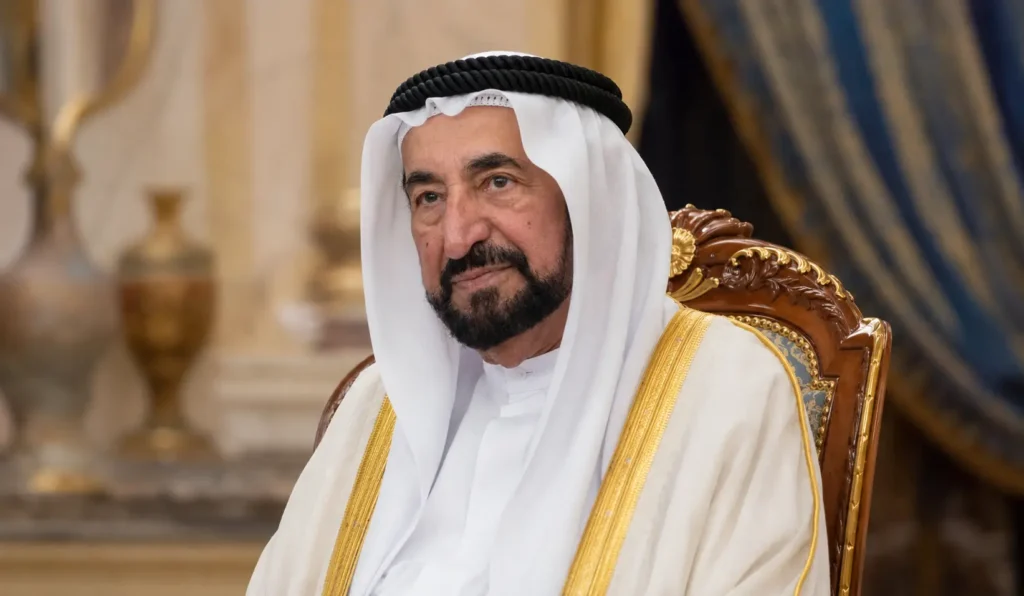
The geopolitical and economic period of the United Arab Emirates underwent a fundamental shift in 1972 when His Highness Sheikh Dr. Sultan bin Muhammad Al Qasimi assumed leadership of Sharjah. Industry veterans observe that while regional neighbors focused heavily on rapid fossil fuel extraction, Sharjah initiated a long-term strategic pivot toward intellectual capital and cultural infrastructure. His reign is defined by a cultural renaissance that prioritizes education, historical research, and the preservation of Arabic and Islamic identity over traditional oil-based urban development.
Today, the results of this 52-year vision are undeniable. As of 2026, Sharjah boasts a robust, diversified economy where 96% of economic activity is non-oil based, leading the region in diversification. With a 45% year-on-year increase in FDI projects reported in early 2026, the “Sharjah Model” has transformed from a local mission into a global standard for sustainable growth. By establishing Sharjah as the UNESCO Cultural Capital of the Arab World (1998) and World Book Capital (2019), Sheikh Sultan has provided a blueprint for how a mid-sized economy can achieve global authoritativeness through the Orange Economy.
Why It Matters
- Knowledge-Based Economic Diversification: By establishing the world’s largest University City, Sharjah created an engine for high-skilled labor that now supports a workforce of over 1.1 million people.
- Historical Soft Power: The Ruler’s intellectual output, exceeding 83 published titles, has systematically challenged colonial narratives that previously dictated the risk profiles of the Gulf.
- Institutional Resilience: The implementation of the AE/SCNS/NCEMA 7000:2021 business continuity standard ensures that Sharjah’s academic and social services remain resilient against global market shocks.
Also Read: Why Investors Aren’t Leaving Dubai Real Estate Even in Crisis?
Qasim’s Academic Foundation of Leadership
Field reports suggest that the leadership of Sheikh Sultan is defined by a rigorous academic pedigree that informs every policy decision. Born on July 2, 1939, his early exposure to the Eslah Al Qasimia School set the stage for a career defined by formal inquiry. Before assuming the role of Ruler, he served as the UAE’s first Minister of Education in 1971, a position that allowed him to design the initial framework for the country’s modern schooling system.
His academic credentials are not merely honorary; they involve high-level research at global tier-1 institutions. He holds a PhD in History from the University of Exeter and a PhD in the Political Geography of the Gulf from Durham University. This dual expertise allows him to manage Sharjah not just as a political entity, but as an intellectual project.
Gold Nugget: Proper education acts as a critical barrier against destructive ideologies, effectively contributing to stable nation-building and a predictable business environment.
For global investors, this focus on intellectual stability translates to a more secure long-term asset class. The integration of rigorous historical research with state governance has allowed Sharjah to maintain a distinct identity within the UAE’s federal structure, prioritizing long-term stability over short-term volatility.
His Capital Allocation in Educational Infrastructure
On-the-ground data shows that the University City of Sharjah (UCS) is the cornerstone of this strategy. Established in 1998, it currently serves as the largest integrated university city globally, hosting over 22 institutions with diverse academic and research focuses. The management of this “city within a city” follows the ISO 9001:2015 quality management system, ensuring international service delivery standards.
The financial and operational scale of this project is significant. Recent strategic reports indicate a continuous expansion plan, where the University of Sharjah—which the Ruler founded in 1997—has begun spinning off specialized independent institutions to meet specific market demands.
| Institution | Year Established | Economic Focus |
| University of Khorfakkan | 2022 | Marine Sciences & Maritime Economics |
| University of Kalba | 2023 | Sports Sciences & Regional Sports Industry |
| University of Al Dhaid | 2024 | Agricultural Sciences & Food Security |
For regional founders, the takeaway is clear: the Sharjah model prioritizes the creation of specialized talent pools aligned with specific economic sectors. This targeted approach ensures that the labor market is populated by specialists who drive innovation in niche fields like marine biology and veterinary medicine.
Abu Al-Kizan Project’s Marine and Maritime Infrastructure
Industry veterans observe that the Ruler’s current capital allocation strategy has moved toward massive, specialized coastal developments. A primary example is the 7-million-square-foot Abu Al-Kizan Marine Village. Unlike traditional residential developments, this project is designed as a technical hub for the maritime economy, supporting Sharjah’s strategic intent to become a regional leader in marine logistics and offshore research.
This aligns with the recent technological expansion of the Sharjah Maritime Academy. Field reports indicate that the academy is now integrating advanced simulation technologies to train the next generation of maritime officers, directly feeding specialized labor into the UAE’s expanding blue economy.
His Landmark Architectural and Scholarly Projects
On-the-ground data shows that the Ruler’s commitment to “Science and Knowledge” is physically manifested in the newly completed Khorfakkan University Tower. This structure serves as both a functional academic space and a symbolic lighthouse for the Eastern Region’s intellectual development.
Furthermore, the 2026 completion of the Encyclopedia of Rhetorical Interpretation represents a scholarly milestone. This 68-volume work involved a global network of dozens of researchers, providing a definitive semantic analysis of the Holy Qur’an. For the business community, these projects are not merely academic; they solidify Sharjah’s authoritative status in the global “Knowledge Economy,” attracting high-net-worth intellectual migrants and researchers to the emirate.
The Specialized Research Pivot
Strategic reports suggest a maturation of the knowledge economy, shifting from a centralized model to a decentralized network of specialized hubs. This includes:
- Decentralized Research: The transformation of university branches into autonomous, world-class research institutions.
- Targeted Labor Creation: Ensuring that the labor market is not flooded with generalists, but populated by specialists in Marine Biology, AgTech, and Sports Management.
Also Read: Frank Meyer on Digital Transformation and Leadership at Etihad Airways
Challenging the Historical Risk Profile of the Gulf
One of the most impactful aspects of Sheikh Sultan’s work is his role as a revisionist historian. His seminal book, The Myth of Arab Piracy in the Gulf, published in 1986, directly challenges the 19th-century colonial accounts provided by British officials. These records historically categorized the Qawasim tribes as pirates to justify naval interventions.
Sheikh Sultan’s research, drawing on previously unused Bombay Archives, argues that the Gulf was historically a peaceful waterway for trade. He posits that the piracy label was a strategic “Big Lie” used by the East India Company to dismantle Arab maritime competition and secure a monopoly on trade routes to India.
By correcting the historical record, Sheikh Sultan has effectively lowered the perceived historical risk of the region, reframing the Arab maritime tradition as one of commerce rather than conflict. This intellectual labor provides a foundation for Arab identity rooted in trade and exchange. His prolific writing career, encompassing historical, literary, and theatrical works, serves as a mechanism for cultural diplomacy.
Economic Impact of the “Orange Economy”
Sharjah’s commitment to culture has yielded tangible economic and reputational benefits. Under the Ruler’s guidance, the emirate has earned numerous global titles. These accolades drive a specific type of investment centered on the Orange Economy, the sector based on intellectual property, creativity, and culture.
Industry veterans observe that the Ruler’s personal interest in the arts has transformed the city into a regional hub with 16 museums and world-class performing arts academies.
Gold Nugget: As of 2025, capital investment in Sharjah reached AED 7.74 billion, with the “creative industries” acting as a major pull for foreign direct investment.
For global analysts, the Sharjah Model represents a sophisticated use of soft power. By positioning itself as a “Healthy City” and “Child-Friendly City,” Sharjah attracts families and long-term residents, creating a stable demographic base that supports domestic consumption and real estate markets.
Global Philanthropy and Institutional Continuity
The Ruler’s influence extends far beyond the borders of the UAE. He has been a critical supporter of global institutions, contributing millions toward the Institute of Arab and Islamic Studies at the University of Exeter. His philanthropic reach includes establishing health, housing, and educational centers in numerous countries, reflecting a commitment to service that earned him the King Faisal Prize in 2002.
Within Sharjah, the focus has shifted toward institutional resilience. The adoption of the AE/SCNS/NCEMA 7000:2021 Business Continuity Management System is a technical move designed to ensure that critical services remain uninterrupted during crises. For business leaders, the takeaway is the importance of a “Quality Policy” in public institutions. The University City’s commitment to periodic assessments ensures that the infrastructure supporting the knowledge economy remains at peak efficiency.
Also Read: Used HP Pavilion 15 Laptop Price in Sharjah Industrial Area
Honorable Degrees He Was Awarded With
| Country | Year | University | Degree |
| Pakistan | 1983 | Faisalabad University | Doctorate in Science (DSc) |
| Sudan | 1986 | Khartoum University | Doctor of Law |
| United Kingdom | 1993 | University of Exeter | Doctorate in Arabic and Islamic Studies |
| Russia | 1995 | Russian Academy of Sciences | Doctor of History |
| United Kingdom | 2001 | University of Edinburgh | Doctorate in Humane Letters |
| Malaysia | 2001 | International Islamic University | PhD and Doctor of Education |
| Canada | 2004 | McMaster University | Doctor of Law |
| Germany | 2006 | University of Tübingen | Doctor of Philosophy |
| Egypt | 2009 | Cairo University | Doctorate in Humane Letters |
| South Korea | 2011 | Hanyang University | Doctor of Social Science |
| France | 2012 | Paris Diderot University | Doctorate in Humane Letters |
| Italy | 2019 | Polytechnic University of Turin | Doctorate in Urban and Regional Development |
| Spain | 2019 | Autonomous University of Madrid | Honoris Causa |
| Sudan | 2020 | Sudan University of Science and Technology | PhD in Drama |
Final Verdict
As Sharjah moves toward the 2030 horizon, the legacy of Sheikh Sultan bin Muhammad Al Qasimi will be viewed as a masterclass in long-term economic planning. By investing in the engines of enlightenment, he has created a city that is resilient, culturally rich, and intellectually competitive on the global stage.
The transition from a traditional administration to a PhD-led, ISO-certified academic governance model provides a definitive case study for the future of the Middle East. For regional founders and global investors, the conclusion is inevitable: the highest returns are found in specialized knowledge hubs that prioritize long-term stability and economic diversification over short-term gains.
FAQs – Frequently Asked Questions
Sheikh Sultan is the Ruler of Sharjah, a member of the UAE Federal Supreme Council, and a prominent historian and author who has led the emirate since 1972.
It is the largest integrated university city in the world, established in 1998 to provide a sustainable environment for education, research, and high-quality lifestyle services.
He holds a BSc in Agricultural Engineering from Cairo University, a PhD in History from the University of Exeter, and a PhD in Political Geography from Durham University.
This book challenges colonial-era historical accounts, arguing that the “piracy” label was a strategic fabrication by the British East India Company to control trade routes.
As of 2026, he has authored at least 83 books, covering topics ranging from Gulf history and geography to literature and theater.
He founded the University of Sharjah and the American University of Sharjah, and more recently established specialized independent universities in Khorfakkan, Kalba, and Al Dhaid.
His honors include the King Faisal Prize for Service to Islam, the Nile Award for Arab Innovators (2024), and over 20 honorary doctorates from global institutions.
Sharjah University City follows the AE/SCNS/NCEMA 7000:2021 standard to ensure that critical educational and social services remain operational during emergencies.

Dwayne Paschke is a seasoned content strategist and AI automation specialist with over nine years of experience at the intersection of journalism and digital innovation. A versatile force in the media landscape, Dwayne has built a reputation as an expert content writer and investigative journalist, contributing high-impact pieces to various reputable news websites.