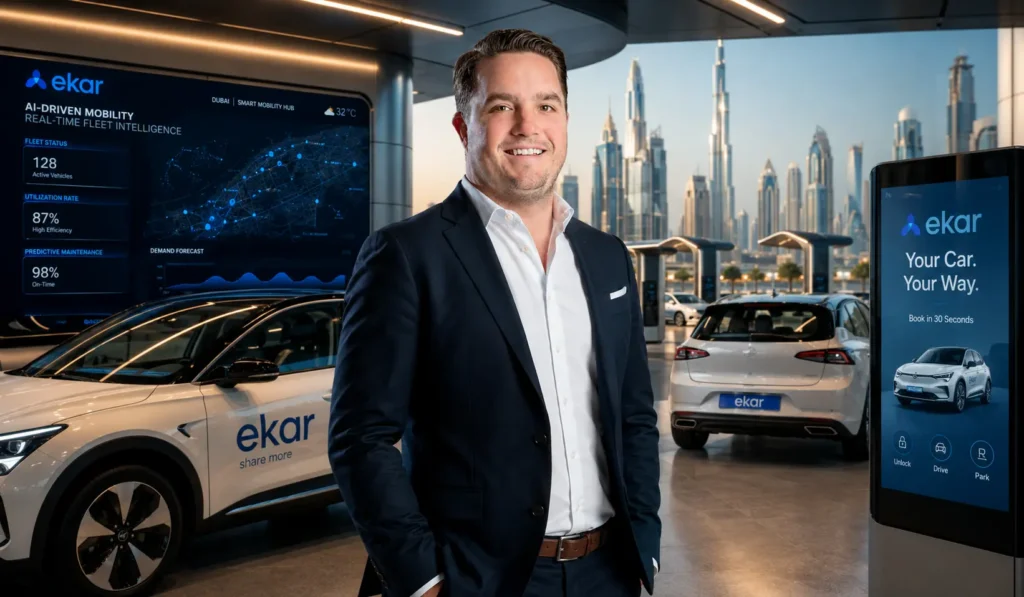
The transport system in the Middle East is undergoing a massive digital transformation, and Vilhelm Hedberg is at the center of this change. As the founder of ekar and the chairman of Lynx Holdings, Hedberg has transitioned from a logistics professional to a pioneering mobility tech entrepreneur. His work has reshaped how individuals and businesses in the UAE and the wider region approach vehicle ownership and fleet management.
For investors, this trend of shifting from ownership to shared mobility is worth watching. Hedberg’s career highlights the growing intersection between transportation, technology, and capital markets. This article explores his background, the rapid growth of ekar, and his current efforts to turn vehicle fleets into a new type of investment asset.
How Vilhelm Hedberg Built His Career in Logistics and Mobility?
Vilhelm Hedberg was born in Caracas, Venezuela, to Norwegian parents. This international upbringing provided him with a unique perspective on global business from a young age. He recalls watching his father conduct international business deals, often adapting his tone and accent to connect with people from different cultures. This exposure planted a “seed” in his mind regarding the importance of cultural connection in business.
Hedberg spent his adolescence in England before his family moved to Florida in 1993. He completed his high school education there and later graduated from the University of Florida with a Bachelor of Business Administration. Seeking further international expertise, he earned an MBA in International Business from EAE Business School in Barcelona.
His professional career began in the logistics sector. In the UAE, he worked for Wilhelmsen Lines, where he was responsible for the shipment of over one million automobiles across the Middle East. This role gave him deep insights into the scale and complexity of the automotive industry. He later became a partner at QMS Global, a major ISO certification company, where he led the development of their operations in Asia and Africa. After four to five years of operating this business, he sold it to focus on his next venture — ekar.
Vilhelm Hedberg Led ekar’s Rise in the Middle East Market
In 2016, after two years of meticulous planning, Hedberg launched ekar. It was established as the Middle East’s first pay-as-you-go personal mobility service. The vision was to create a user-friendly platform that allowed people to book cars through their smartphones or laptops for short-term use.
A major turning point for the company occurred in 2016 when Dubai’s Roads and Transport Authority (RTA) selected ekar to provide 100 vehicles for its car-sharing project. The service officially launched to the public on January 15, 2017. Hedberg recalls this as a proud moment, particularly when he was able to show the operational business to his father.
The company quickly expanded its client base to include major regional players such as Saudi Aramco, Emirates Airlines, and Etihad Airways. By 2019, ekar’s Dubai service was recognized as the highest-utilized free-floating car-sharing service in the world. The company’s rapid growth was reflected in its staffing, which grew from just three employees in late 2016 to over 100 by the end of 2018.
Also Read: Ahmed Ben Chaibah As The Founder of AquaFun – Entrepreneurial Journey
Making ekar a Regional Leader in Mobility Technology
Under Hedberg’s leadership, ekar transitioned from being a simple consumer app to a comprehensive mobility technology company. A key milestone in this evolution was the development of their own proprietary software. This allowed the company to empower the broader car rental industry rather than just operating its own fleet.
When the COVID-19 pandemic impacted global travel, ekar utilized its “Mobility OS” to help traditional car rental companies. By injecting their cars into ekar’s digital platform, these companies could offer seamless digital rental and leasing experiences to their own customers. This strategic decision allowed ekar to scale without the heavy capital expenditure of buying every vehicle in the fleet.
The platform now facilitates connections between fleet owners, original equipment manufacturers (OEMs), and renters. Today, ekar is the largest self-drive mobility platform in the Middle East, with over 350,000 registered members. It has achieved more than 1 million downloads and facilitated over 2 million trips.
How On-Demand Transport Is Changing Urban Economies?
Hedberg’s motivation for starting ekar was partly driven by a desire for social and environmental impact. He notes that for every shared car on the road, approximately 10 privately owned cars are removed. This reduction in vehicle ownership has several positive effects on urban environments:
- Reduced Traffic Congestion: Fewer cars on the road lead to smoother traffic flow in busy cities like Dubai and Riyadh.
- Lower Parking Demand: As more people switch to on-demand mobility, the need for vast parking infrastructure decreases.
- CO2 Emission Savings: By 2019, ekar had already contributed to savings of roughly 40,000 metric tons of CO2 emissions in the UAE alone.
Businesses should pay close attention to these changes as they reflect a broader shift toward sustainable urban growth. Hedberg’s expertise in this area has led to his involvement in Masdar’s Smart Cities Advisory Committee, where he helps shape the future of transport infrastructure.
ekar’s Financial Success and Regional Expansion Story
The financial trajectory of ekar demonstrates the significant appetite for mobility tech in the Middle East. The company has raised over $50 million to $60 million from both regional and international investors. At its peak, the platform reached $100 million in annual revenue.
The company’s footprint has expanded beyond the UAE into a total of four countries, with plans to add more. In Saudi Arabia, ekar has achieved top rankings in both the iOS and Android app stores. The fleet size managed through their software is also growing rapidly, with targets to reach 11,000 cars.
This growth is supported by advanced technology, including AI-driven systems for fleet rebalancing and dynamic pricing. These systems ensure that vehicles are available where they are needed most while maximizing revenue for fleet owners.
Transition to Lynx Holdings and the “Fintech-ization” of Mobility
While ekar remains a significant part of his legacy, Hedberg has expanded his focus through Lynx Holdings. As Founder and Chairman, he is currently leading Fleet Fund Alpha EMEA. This is a regulated investment platform designed to treat vehicle fleets as a sophisticated institutional asset class.
Hedberg describes this as the “fintech-ization” of mobility. The goal is to unlock institutional capital for ride-hailing, delivery, and rental operators. By structuring vehicle assets into scalable investment vehicles backed by long-term leasing and operational data, Lynx Holdings aims to provide a more stable way to finance large-scale transport operations across Europe, the UK, and the Gulf.
This could shape the market in the coming months as institutional investors look for new ways to gain exposure to the gig economy and urban delivery sectors without taking on the direct risks of fleet operation.
Leading Discussions on the Future of Transport and MaaS
Hedberg’s influence extends into the venture capital and sustainability sectors. He serves on the Investment Committee at Antler, a global early-stage VC firm. In this role, he helps identify and support new tech disruptors, sharing the lessons he learned while scaling ekar.
He is also a frequent speaker at major industry events, such as the MOVE events and ME RAIL. His discussions often focus on how Mobility-as-a-Service (MaaS) can increase car utilization and how mobility companies can diversify their business models to survive and thrive in a changing economy.
Also Read: What Makes Vishal Vaghela a Key Cybersecurity Leader to Watch?
Barriers to Growth in the Global Mobility Market
Despite the success of shared mobility, the industry faces several challenges:
- Regulatory Uncertainty: Different countries have different rules regarding car-sharing and digital leasing, which can complicate international expansion.
- Infrastructure Requirements: The success of mobility platforms depends on high-quality digital infrastructure and urban planning that supports shared transport.
- Market Competition: As the sector grows, competition from traditional rental companies and other tech startups is increasing.
Hedberg believes that the future lies in integrated mobility and smart infrastructure. The shift away from personal car ownership toward “on-demand” access appears to be a long-term trend driven by both economic necessity and environmental concerns.
FAQs – Frequently Asked Questions
Vilhelm Hedberg is a Norwegian-born entrepreneur based in the UAE. He is the founder of ekar, the Middle East’s first and largest self-drive mobility platform, and the chairman of Lynx Holdings.
ekar is a mobility technology company that offers a pay-as-you-go car-sharing service. It allows users to book vehicles via an app for short-term use, providing an alternative to traditional car ownership.
ekar has raised over $50 million to $60 million from various regional and international investors.
By promoting car-sharing, ekar helps reduce the number of cars on the road. By 2019, the company had saved approximately 40,000 metric tons of CO2 emissions in the UAE.
Lynx Holdings focuses on the “fintech-ization” of mobility. Through Fleet Fund Alpha EMEA, it works to transform vehicle fleets into an institutional asset class for investors.
Hedberg was named SME Leader of the Year in 2018 and has been recognized as an Endeavor Entrepreneur. ekar has also been listed as a top startup by Forbes Middle East and LinkedIn.
ekar started in Dubai, UAE, and has expanded to four countries, including a significant presence in Saudi Arabia.
He worked in logistics and quality management, specifically at Wilhelmsen Lines and QMS Global, where he gained experience in shipping and ISO certification.

Dwayne Paschke is a seasoned content strategist and AI automation specialist with over nine years of experience at the intersection of journalism and digital innovation. A versatile force in the media landscape, Dwayne has built a reputation as an expert content writer and investigative journalist, contributing high-impact pieces to various reputable news websites.