The world of global security and business stability relies on a constant flow of information. At the center of this information network is the National Security Operations Center (NSOC). Originally designed as a “watch center” for military crises, the NSOC has evolved into a 24/7 “nerve center” that protects both national interests and the digital backbone of the global economy.
For businesses and investors, especially in rapidly growing hubs like the UAE, understanding how these centers operate is vital. They provide the stability needed for international trade and protect critical infrastructure from evolving threats. This article explores the history, technology, and future of the NSOC, showing its transition from a 1970s radio room to a futuristic command hub.
Initial Development and Operational Foundations of the NSOC
The need for a centralized operations center became clear during the 1960s. During this time, the United States faced multiple international crises, including tensions in the Middle East and the Soviet invasion of Czechoslovakia. At the time, the National Security Agency (NSA) had separate offices for different geographic regions, which made it difficult to get a complete global picture during a crisis. A turning point occurred in April 1969 when North Korea shot down a US Navy EC-121 aircraft. Major General John E. Morrison, Jr., then the Assistant Director for Production, found it difficult to coordinate a response because he had to move between various separate watch centers to gather information. This frustration led him to propose a single, dedicated watch center.
Overview In A Video:
In December 1968, the National Sigint Watch Center (NSWC) was created. It began limited operations in December 1972 and was formally inaugurated on February 21, 1973, as the National Sigint Operations Center (NSOC). It was located on the third floor of the OPS-1 building at the NSA’s headquarters in Fort Meade, Maryland. In 1996, the facility was renamed the National Security Operations Center to reflect its broader mission, which included information security.
For investors, this trend of centralizing security operations is worth watching.
When NSOC Was Needed? Improvements with Time
The technology used within the NSOC has changed dramatically over the last 50 years. In the 1970s, the watch floor was a large open space filled with desks, paper, and early computer terminals. These terminals allowed officers to access teletype links with listening posts and review time-sensitive reports.
By the 1980s, the environment became more structured with the introduction of office cubicles and more advanced computers. In the 1990s and early 2000s, the center integrated video terminals and more powerful workstations to handle the increasing volume of digital data.
Interesting Article: UAE Cyber Pulse Initiative – National Cybersecurity Strategy
Key technology milestones include:
- 1970s: Use of “Call Director” telephones and SOLIS (Sigint On-Line Information System) for retrieving reports from the previous 14 months.
- Early 1980s: Introduction of the IBM 5150 computer.
- Late 1980s: Implementation of the Multimedia Information Network Exchange (MINX), which allowed for video calls, a massive advancement for its time.
- 1990s: Adoption of Sun Microsystems SPARCstations and the use of the National Secure Telephone System (NSTS), often called “gray phones”.
- 2010s: Transition to large video walls and futuristic “spaceship-like” workstation designs.
- 2020s: Moving to the new Morrison Center with touchless door activators, sit/stand desks, and massive 4K video screens.
What NSOC Did in Response During Crisis?
The NSOC operates on a 24/7 basis, ensuring that decision-makers have the most current information available. It focuses on a “0 to 72 hour” window, managing immediate responses to unfolding crises. One of its most critical tools is the CRITIC system, designed to deliver high-priority intelligence to the President in ten minutes or less.
Significant events handled by the NSOC include:
- Iran Hostage Crisis (1981): President Jimmy Carter kept a direct line open to the NSOC to monitor Iranian air traffic control and NSA collection capabilities in real time.
- Invasion of Kuwait (1990): The first alert of Saddam Hussein’s move into Kuwait arrived as a CRITIC message.
- USS Cole Attack (2000): A CRITIC message was sent to the NSOC within minutes of the terrorist attack in Yemen.
- September 11 Attacks (2001): After an initial evacuation, the NSOC was converted into a “war room” to compile information on the hijackers and coordinate with field stations globally.
These examples show that the NSOC is not just a monitoring station; it is an active participant in global stability. When a crisis occurs, the center’s ability to provide “actionable intelligence” to military and civilian leaders is a primary defense against further escalation.
National Security Operations Center’s (NSOC’s) Move to the Morrison Center
In late 2022, the NSOC moved from its original 1950s-era building to a state-of-the-art facility called the Morrison Center. This seven-story building on the NSA’s East Campus is named after John E. Morrison, Jr., the center’s founder.
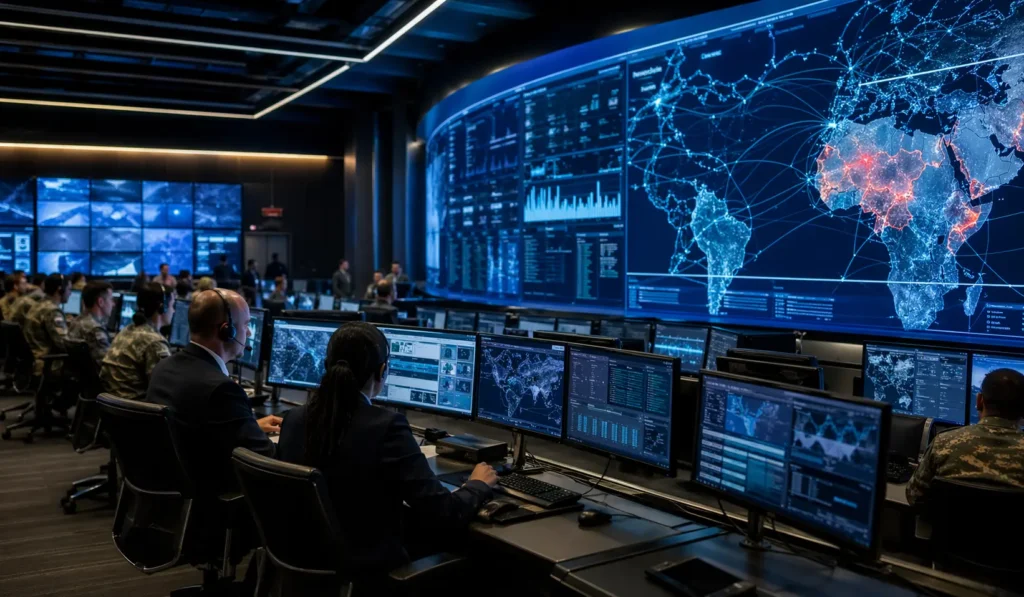
The new facility is designed for the modern workforce, featuring a spacious watch floor with huge video screens and workstations equipped with multiple computer screens. It also includes a 24/7 cafeteria, a fitness center, and a multipurpose conference center.
This move represents a strategic decision to modernize the working environment for “mission-essential” personnel who work in eight-hour shifts across five rotating teams. The integration of a KVM-switch at each desk allows officers to switch between different classified networks instantly, improving their efficiency during high-pressure events.
Businesses should pay close attention to these changes as they set the standard for high-security corporate environments.
Global Influence and Government Policies
The NSOC model has been adopted by various governments and organizations worldwide to manage cyber and national security threats. In the Middle East and South Asia, this “whole-of-government” approach is becoming a standard for national resilience.
Examples of global NSOC frameworks include:
Pakistan: Recently accelerated the integration of key ministries, such as the Ministry of Foreign Affairs and the National Electric Power Regulatory Authority, into a unified NSOC framework. This tiered model allows for faster identification of multi-vector cyber campaigns.
Sri Lanka: Operates a National Cyber Security Operations Center (NCSOC) focused on protecting critical national infrastructure. They provide 24/7 monitoring, incident response, and “threat hunting” to identify stealthy threats.
Texas, USA: The state legislature created its own NSOC to provide network security for state agencies, including monitoring, alerting, and incident response.
These centers are governed by strict standards, such as ISO 27001 and NIST frameworks, to ensure ethical and legal compliance. For countries like the UAE, which are major hubs for digital finance and logistics, the presence of such robust security frameworks is a key factor in attracting foreign investment.
Disruptions And Uncertainties
Despite the advanced technology, the NSOC faces significant challenges. One major risk is infrastructure failure. In July 2006, high temperatures and power generation problems in Maryland caused server and communications failures at the NSA. This forced the activation of an alternate NSOC site in Georgia, codenamed DECKPIN.
Another challenge is the sheer volume of data. As threats evolve from traditional military movements to complex cyberattacks, the NSOC must manage “SIEM log monitoring” and “Endpoint Detection and Response” (EDR). There is also the risk of “insider threats,” where systems must monitor user behavior to detect unauthorized data transfers.
The transition to digital-heavy environments also brings a human challenge. Some veterans of the agency have noted that while the technology is better, the reliance on charts and graphs can reduce the level of human interaction that was common in the 1970s and 80s.
This could shape the market in the coming months as companies look for better ways to balance AI with human oversight.
Threat And Future of National Security Operations Center (NSOC)
The future of the NSOC lies in the integration of Artificial Intelligence (AI) and Machine Learning (ML). These technologies are being used for faster threat detection and to analyze patterns that are too complex for human analysts to spot in real time.
Predicted trends for operations centers include:
Unified Visibility: Merging Network Operations Centers (NOC) and Security Operations Centers (SOC) into a single NSOC to reduce costs and improve response times.
Proactive Threat Hunting: Moving away from just responding to alerts and instead actively searching for hidden indicators of compromise within networks.
Cloud and IoT Support: Modern NSOCs will increasingly focus on securing remote work environments, 5G networks, and the Internet of Things (IoT).
National Resilience Frameworks: More countries will likely adopt the “tiered” model seen in Pakistan to coordinate defense across both public and private sectors.
As global tensions remain high, the role of the NSOC will only grow. Its ability to provide situational awareness in a 72-hour window is the difference between a minor incident and a global crisis.
Final Words
The National Security Operations Center (NSOC) has evolved from a basic watch room into a highly advanced command hub that supports global stability and security. Its ability to deliver real-time intelligence, manage crises, and adapt to emerging technologies makes it a critical asset for governments and businesses alike. As cyber threats grow and digital infrastructure expands, the NSOC model will continue to shape how organizations approach risk, resilience, and decision-making. For investors and policymakers, understanding its role is essential, as it not only safeguards national interests but also underpins the trust and stability required for global economic growth.
FAQs – Frequently Asked Questions
NSOC stands for the National Security Operations Center. It was originally known as the National Sigint Operations Center when it was established in 1973
The NSOC provides 24/7 situational awareness and time-sensitive reporting on signals intelligence (SIGINT). It is the center responsible for managing an agency’s response to an unfolding crisis.
While the NSOC monitors general world events and SIGINT, the NSA/CSS Threat Operations Center (NTOC) focuses specifically on cyber threats against US computer systems and coordinating network operations.
A CRITIC is a Critical Intelligence report of the highest importance. The system is designed to deliver this information to national leadership, including the President, within ten minutes of an event.
The move was part of a modernization effort to provide a more advanced, accessible, and futuristic workspace for the agency’s 24/7 mission. The new building offers better technology, sit/stand desks, and improved facilities for staff.
Yes. Many modern IT and cybersecurity firms now offer “Network and Security Operations Center” services. These combine traditional network monitoring (uptime/bandwidth) with advanced cybersecurity protection.
The NSOC has alternate facilities (such as the one in Georgia codenamed DECKPIN) that can take over critical functions if the primary headquarters loses power or the ability to operate.
Generally, national NSOCs focus on critical infrastructure and government networks. For example, Sri Lanka’s NCSOC handles incidents of national significance and does not process personal disputes or social media issues.

Daniel Carter covers UAE startups, venture capital, and AI innovation, delivering strategic, investigative reporting on emerging technology ecosystems.