Some leaders manage the present competently. A very few reshape the future before it arrives.
Sheikh Mohammed bin Rashid Al Maktoum belongs to the second category, and the evidence is not theoretical. It is written in concrete, glass, and steel across a city that, within living memory, was a collection of wind-tower buildings on the edge of a creek in the Arabian Gulf.
But the physical transformation of Dubai, spectacular as it is, is actually the least interesting part of what Sheikh Mohammed built. The more interesting creation is institutional: the regulatory environments, the aviation infrastructure, the financial frameworks, the government performance systems, and the attraction mechanisms that turned Dubai into a city the world’s most ambitious people and companies want to be in.
That took something beyond vision. It took a specific leadership philosophy that produced specific outcomes. Understanding that philosophy honestly, without either uncritical hagiography or reflexive cynicism is worth doing.
The Inheritance and What He Did With It
Sheikh Mohammed became Crown Prince of Dubai in 1995 and Ruler in 2006, following the death of his father Sheikh Maktoum. But he had been practically driving the emirate’s transformation since the early 1990s, when he was overseeing the development of key infrastructure projects and free zones that would define Dubai’s commercial identity.
He inherited an emirate with a geographic advantage, Dubai Creek had been a natural trading harbor for centuries, but very little else in the way of commercial infrastructure. What his father and grandfather had built was the foundation: the commitment to trade and openness, the early free zone concept at Jebel Ali, and the willingness to think beyond oil in ways that neighboring Gulf states had not yet matched.
Sheikh Mohammed built on that foundation with a velocity and scale that transformed it from a foundation into a tower.
The Decision-Making Philosophy: Speed as Strategy
One of the most consistent observations about Sheikh Mohammed’s leadership style, reported across decades of accounts from people who have worked within or alongside Dubai’s government, is an almost pathological intolerance for delay.
He has spoken and written extensively about this in his books “My Vision” and “Flashes of Thought,” he articulates a leadership philosophy centered on speed of execution, personal accountability, and the belief that most organizational problems are not problems of resources or ideas but of will and decision-making courage.
This is not simply a rhetorical stance. It manifests in specific institutional design choices. The Dubai government under his leadership developed one of the most sophisticated government performance management systems in the world, quarterly performance reviews against specific measurable targets for each government department, with consequences for underperformance that are actual rather than theoretical.
The government entity performance culture this created is unusual in any context but particularly striking in a Gulf state context: ministers and senior officials are expected to show measurable progress against specific timelines in ways that most public sector environments never demand.

The Infrastructure Bets That Defined the Empire
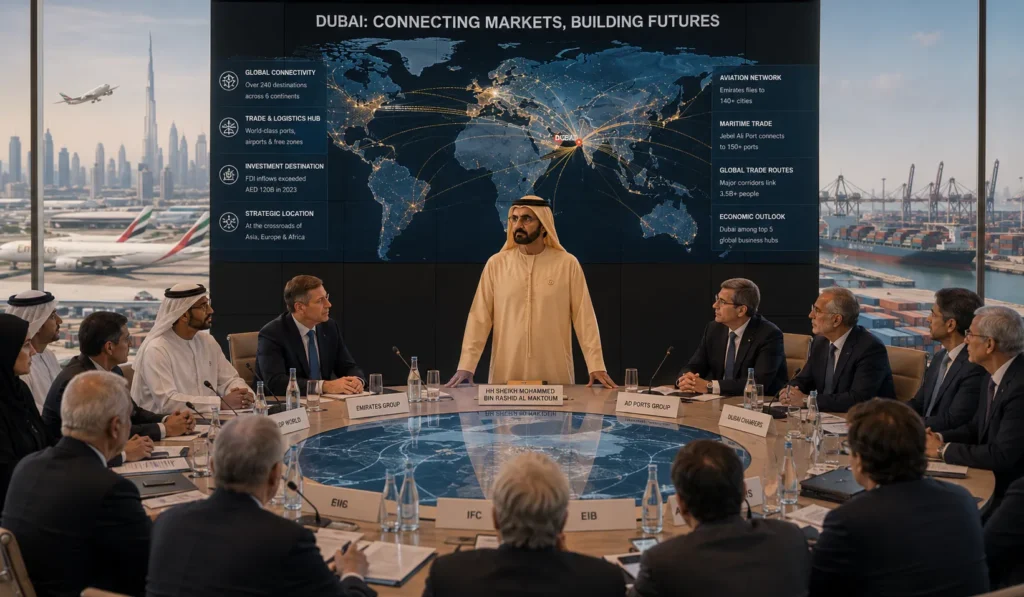
The strategic logic that most consistently defined Sheikh Mohammed’s empire-building was the willingness to build infrastructure at scale before the demand existed, betting that the infrastructure itself would create the conditions for the demand to develop.
Emirates airline is the clearest example. In 1985, launching a commercial airline from Dubai required believing that a city with limited existing traffic would become a significant global aviation hub. That belief required either extraordinary confidence in the transformation underway or the understanding that the airline itself would be part of causing the transformation. Sheikh Mohammed held both.
The same logic applied to Jebel Ali Port, expanded to enormous scale before trade volumes justified it. To the Burj Khalifa, built at a height that was commercially questionable but globally attention-getting in ways that marketing alone could never replicate. To the free zones — each one a bet that sectors not yet represented in Dubai would be attracted by the right regulatory environment.
The pattern is consistent: create the supply, then attract the demand. In environments where this logic fails, it fails expensively. In Dubai, it succeeded, repeatedly, in ways that vindicated the approach.
Related Story: UAE Leadership Meeting Highlights National Development Priorities and Government Coordination
The Personal Brand and Global Positioning
Sheikh Mohammed’s contribution to Dubai’s rise is not only institutional. It is personal in ways that matter.
He is an active presence on social media; his accounts communicate the vision, the culture, and the daily rhythm of the leadership in ways that make Dubai feel dynamic and intentional to a global audience. He competes internationally in endurance horse racing, a visibility that has given him genuine international recognition beyond the political sphere. His poetry, he is a published Arabic poet of recognized quality, adds a dimension of cultural depth to a persona that could otherwise be read as purely commercial.
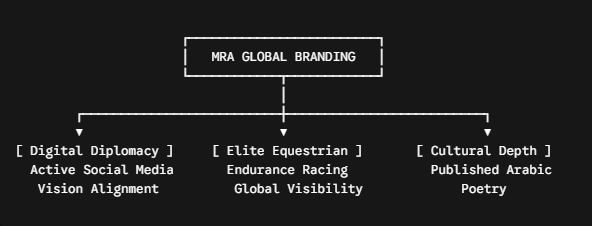
This personal brand is strategic as much as personal. When global investors, executives, and political leaders think about Dubai, they often associate the city with the specific energy of its leadership in ways that few other cities can claim. London does not have a single person who represents its commercial ambition. New York does not. Dubai does, and that personification creates a clarity of vision and a reliability of purpose that investors and business builders find reassuring.
Also Read: How Sheikh Sultan Bin Muhammad Al Qasimi Made Sharjah Cultural Capital of the Arab World
The Government Reform Dimension
Among Sheikh Mohammed’s less-discussed but most significant contributions is the sustained effort to professionalize and reform Dubai’s government machinery.
The Mohammed bin Rashid School of Government, established in 2005, trains government officials in public policy and management. The Arab Strategy Forum brings regional policy makers together for substantive discussion. The World Government Summit, held annually in Dubai, has become one of the world’s most significant gatherings of government leaders, attended by heads of state, ministers, and senior officials from across the world, and provides the platform and relationships that sustain Dubai’s diplomatic engagement globally.
The government performance management system with its measurable targets, public reporting, and genuine accountability culture has been studied and partially replicated by governments across the region. The UAE’s consistent ranking near the top of regional and global government effectiveness indices reflects, at least partially, the institutional investments this approach has generated.
The Honest Assessment: Complexity and Balance
Any balanced account of Sheikh Mohammed’s leadership must acknowledge the dimensions that complicate the success narrative.
The Governance Matrix
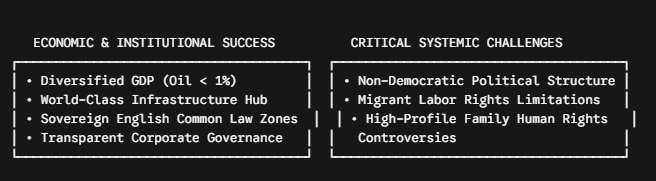
The UAE’s political system is not democratic in the conventional sense — there are no competitive national elections, and political expression operates within defined parameters that differ significantly from liberal democratic norms. Workers’ rights protections, particularly for the migrant labor that built much of what Dubai has become physically, have been a persistent area of international criticism that reform efforts have only partially addressed.
The Sheikha Latifa episodes, where the Ruler’s daughters made international news in circumstances that generated significant concern created a human rights dimension to his public persona that no account of his leadership can responsibly omit.
These dimensions coexist with the real achievements. Understanding Sheikh Mohammed’s legacy honestly requires holding both the extraordinary ambition and institutional creativity that transformed a city, and the political and human rights dimensions that complicate the celebratory narrative.
That complexity is itself, in a way, the most honest tribute to the scale of what was built: it is a real place, with real consequences, for real people, not simply an impressive story.
Final Verdict
Sheikh Mohammed bin Rashid Al Maktoum built something rare: a city that the world wanted to be in before it needed to be.
The sequencing of that achievement creating attraction before the attractions existed, building demand by first building supply is a leadership lesson that operates across any context where transformation is the goal. The specific institutional innovations, from free zones to common law financial courts to government performance systems, are practical blueprints that other governments and urban administrators have studied and partially adopted.
The empire he built is extraordinary. It was also built with an authority structure that allows for the kind of long-term decision-making that democratic systems struggle to sustain — an advantage that comes with genuine costs in participation and accountability. Both things are true.
What’s not in question is that the ambition was genuine, the execution was remarkable, and the city that resulted is one of the most compelling commercial creations in the history of urban development.
FAQs – Frequently Asked Questions
He is the Vice President and Prime Minister of the UAE, and the Ruler of Dubai. He has been the primary driver of Dubai’s transformation into a global business hub over several decades of leadership.
His philosophy emphasizes speed of decision-making, personal accountability, long-term infrastructure investment before demand justifies it, and the systematic attraction of international talent and business through regulatory innovation.
Sheikh Mohammed’s government commissioned and oversaw the development of the Burj Khalifa through Emaar Properties. The decision to build at unprecedented height was a deliberate global attention strategy consistent with Dubai’s brand-building approach.
It is a philanthropic platform encompassing over 35 humanitarian and development initiatives spanning education, health, and community development, with commitments exceeding $20 billion.
International human rights organizations have criticized aspects of the UAE’s political system, migrant worker conditions, and specific high-profile cases involving members of the ruling family. These criticisms coexist with genuine achievements in economic development and governance reform.
He is the author of “My Vision: Challenges in the Race for Excellence” and “Flashes of Thought,” which articulate his leadership philosophy. He is also a recognized Arabic poet.
Through a combination of strategic infrastructure investment, the creation of the World Government Summit, active international diplomatic engagement, personal social media presence, and the development of global events including Expo 2020 Dubai.
His stated vision focuses on making Dubai and the UAE leaders in AI, positioning the country as the world’s best place to live and work, continuing to attract global talent and capital, and sustaining the economic diversification that has reduced oil dependence to near zero in Dubai’s GDP.
Daniel Carter covers UAE startups, venture capital, and AI innovation, delivering strategic, investigative reporting on emerging technology ecosystems.