The United Arab Emirates (UAE) has established itself as a global leader in strategic drug interdiction and counter-narcotics operations. As a major international hub for trade and logistics, the country faces unique challenges from sophisticated criminal syndicates attempting to use its infrastructure as a transit point. Protecting the integrity of these trade routes is vital for the UAE’s economic stability and its goal of reaching $1.3 trillion in financial wealth by 2027.
In recent years, UAE authorities have shifted from traditional policing to a data-driven, proactive national strategy. This approach involves high-level international cooperation and the deployment of advanced surveillance technology. Recent operations have resulted in the seizure of narcotics worth billions of dirhams, highlighting the scale of the threat and the effectiveness of the response.,,
This article examines the strategic decisions, technological tools, and international partnerships that define the UAE’s current security scenario. For investors and businesses, understanding these security frameworks is essential for assessing the country’s long-term stability.
Massive Captures Expose Industrial-Level Smuggling
The sheer volume of narcotics intercepted by UAE authorities provides a clear picture of the professional nature of global drug trafficking. One of the most significant events in recent history was “Operation Storm,” which targeted the world’s largest Captagon smuggling operation.,
Dubai Police successfully seized 86 million Captagon pills weighing 13.763 tonnes., The market value of this single shipment exceeded Dh3.87 billion (approximately $1 billion)., This operation demonstrated that criminal gangs are willing to invest massive resources into a single smuggling attempt.
Another major success was “Operation Scorpion,” which targeted the cocaine trade. In this instance, authorities thwarted an attempt to smuggle 500 kilograms of pure cocaine into the country. The street value of this haul was estimated at over Dh500 million ($136 million). These figures show that the UAE is a primary target for high-value narcotics, necessitating a zero-tolerance policy.
Also Read: Dr. Hoda Al Khzaimi – Leading the UAE’s Global Strategy for Cybersecurity and Emerging Technologies
How Captagon Became a Regional Security Concern?
Captagon has become a central focus for security agencies across the Middle East. Often referred to as “the poor man’s cocaine,” it is an amphetamine-based pill that is highly addictive and frequently laced with caffeine., It is currently one of the most popular illegal substances among youth in the Gulf region.
Research indicates that Captagon is produced in massive quantities in Syria. During the Syrian civil war, armed groups reportedly used the drug to boost the courage of fighters by reducing fear. Today, the trade has evolved into a multi-billion dollar illegal industry involving powerful figures in business and the military.,
The UAE acts as a critical barrier in preventing these substances from reaching the wider regional market., By dismantling these shipments at the point of entry, the UAE protects not only its own citizens but also the stability of neighboring countries. Businesses should pay close attention to these changes in regional security dynamics.
A Decade of High-Impact Drug Enforcement
The evolution of UAE security can be traced through a series of high-profile operations that show increasing levels of sophistication.
- October 2019: UAE police revealed common smuggling methods, including swallowing capsules and hiding drugs in tires, to educate the public and logistics sectors.,
- 2020: International cooperation intensified as Italy seized 14 tonnes of Captagon, highlighting the global nature of the trade.
- October 2021: “Operation Scorpion” resulted in the seizure of 500kg of cocaine and the arrest of a Middle Eastern intermediary for an international syndicate.,
- September 2023: “Operation Storm” broke records by seizing 86 million Captagon pills hidden in construction materials.,
- August 2025: The UAE played a lead role in a global bust involving 25 countries, resulting in the seizure of 822 tonnes of drugs worth $2.9 billion.
- April 2026: A joint operation between Dubai, Sharjah, and Bahrain dismantled a 13-member gang and extradited a ringleader from abroad.,
This timeline suggests a trend toward larger, more complex operations involving multiple jurisdictions. For investors, this trend is worth watching as it reflects the UAE’s growing influence in global security.
Sophisticated Methods Used by Smuggling Syndicates
As the UAE improves its detection capabilities, criminal organizations have turned to “clever and creative” methods to bypass security. Authorities have identified several primary methods currently used to move narcotics across borders.
One common method is stashing drugs in large cargo containers on ships. Dealers take advantage of the massive volume of shipments passing through UAE maritime ports, hoping their contraband will be overlooked., In “Operation Storm,” the gang hid 86 million pills inside 651 thick iron and wood doors and 432 decorative home panels.,
On land, gangs often hide narcotics in the tires and auto parts of trucks and lorries., Over the past two years, police have seized huge volumes of drugs from trucks entering the country. In 2018 alone, over 1,000kg of drugs worth Dh200 million were seized in Abu Dhabi through land border checks.
Airports remain a high-risk area where individual couriers attempt to smuggle drugs by swallowing capsules filled with heroin or crystal meth., Despite these efforts, modern inspection systems at airports have made it increasingly difficult for these couriers to succeed.,
UAE and Bahrain Unite to Dismantle Drug Network
In April 2026, the UAE National Anti-Narcotics Authority announced the successful dismantling of a cross-border trafficking network., This operation was a joint effort involving police from Dubai, Sharjah, and authorities in Bahrain., The month-long operation led to the arrest of 13 suspects of various Asian and African nationalities.,
The detained individuals included six Indian citizens, three Iranians, two Pakistanis, one Egyptian, and one Sri Lankan., They were operating under the direction of an Asian drug kingpin based in Bahrain., Through regional cooperation, the ringleader was arrested in Bahrain and extradited to the UAE to face justice.,,
The seizure included 56.6 kilograms of narcotic substances, 8,159 psychotropic tablets, and a large quantity of electronic cigarettes filled with hashish oil., The total value of the seized drugs was estimated at Dh3.3 million., This operation underscores the UAE’s ability to reach across borders to target the architects of criminal networks.,
The UAE’s High-Tech Drug Detection Systems – X-Ray, AI, and K9
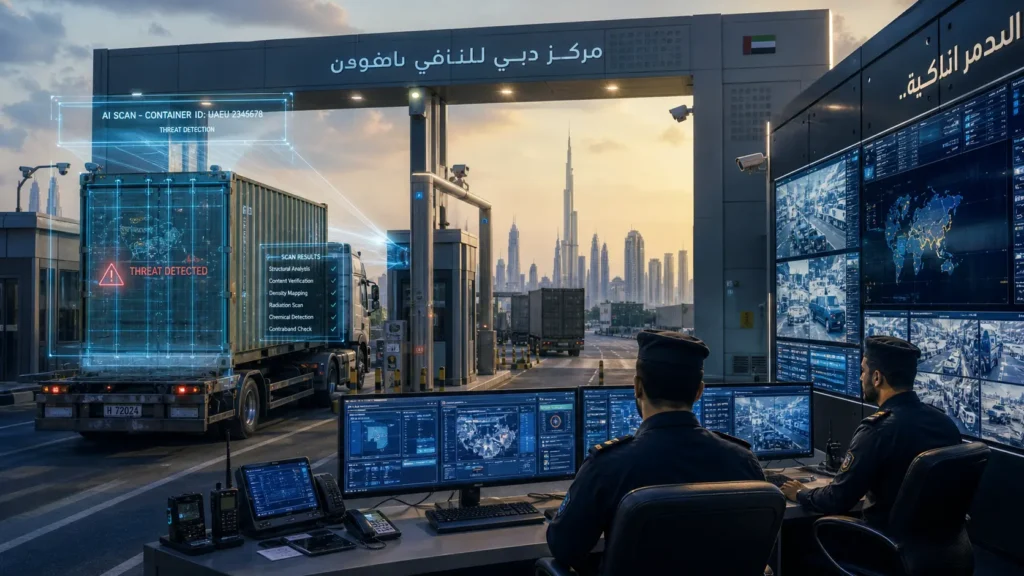
The success of these operations is largely due to the integration of advanced technology at all entry points. The UAE’s national strategy includes equipping land, sea, and air ports with sophisticated surveillance and inspection systems.,
X-ray detection devices are a cornerstone of maritime security., These machines allow customs officials to see through thick iron doors and wooden panels without having to dismantle every shipment., In “Operation Storm,” X-ray technology was instrumental in identifying the hidden compartments within the furniture.,
In addition to high-tech machinery, the UAE relies heavily on specialized police dog units (K9)., These dogs are trained to detect a variety of substances that may be shielded from electronic sensors. This combination of human intelligence, animal instinct, and mechanical precision has made the UAE one of the most difficult environments for smugglers to operate in.
Strict Laws Drive Strong Anti-Narcotics Enforcement
The UAE maintains a strict zero-tolerance policy toward drug possession and trafficking. The legal framework is designed to be a powerful deterrent, with drug smugglers facing possible death sentences., While actual executions are rare, the severity of the potential penalty reflects the government’s stance on protecting society.
Government leadership, including Lt. Gen. Sheikh Saif bin Zayed Al Nahyan, Deputy Prime Minister and Minister of Interior, provides continuous guidance for these operations., The Ministry of Interior emphasizes that the UAE will remain a “haven of security” and is prepared to counteract anyone who threatens the well-being of Emirati society.
The national strategy also involves blocking the digital infrastructure used by drug dealers. In the first quarter of 2026, Dubai Police successfully blocked 110 websites that were promoting illegal drugs., This proactive approach extends to social media and encrypted messaging platforms, ensuring that the market for narcotics is squeezed both physically and digitally.
Also Read: Is Trust Infrastructure the Real Future of Hiring?
Multi-Nation Alliances Target Drug Networks
Because drug trafficking is a transnational crime, the UAE has taken a leadership role in international organizations. The International Security Alliance (ISA) was established in 2017 by the UAE and France to address global security challenges.
The ISA currently includes 11 member countries:
- UAE
- France
- Senegal
- Morocco
- Spain
- Bahrain
- Italy
- The Netherlands
- Slovakia
- Singapore
- Israel
In 2025, the ISA conducted a massive joint operation involving 25 countries., This operation led to the arrest of 12,564 suspects worldwide and the seizure of drugs worth $2.9 billion. This level of field coordination and intelligence exchange is unprecedented and has significantly developed proactive mechanisms to control cross-border illicit drug flows. This could shape the market in the coming months as more global networks are dismantled.
Why Drug Enforcement Matters for Business Stability?
The fight against narcotics is not just a social issue; it is a critical business concern. Drug trafficking is often linked to other forms of financial crime, such as money laundering and fraud. A joint UAE-US-Chinese crackdown recently resulted in nearly 300 arrests for financial crimes, showing how these illegal activities are interconnected.
For the UAE to remain an attractive destination for foreign direct investment (FDI), it must maintain its reputation as a safe and law-abiding jurisdiction. High-profile drug busts reassure international corporations that the government is capable of maintaining order and protecting trade routes.,
The logistics and shipping sectors are particularly impacted by these operations. While intense inspections can pose challenges to the speed of shipment processing, they are necessary to ensure that the global supply chain is not corrupted by criminal elements. Companies operating in the UAE must ensure their own internal compliance and security measures are robust to avoid being unwittingly used by traffickers.
What Lies Ahead for Anti-Narcotics Strategies?
Despite significant successes, several challenges remain. The high profitability of the drug trade means that as one network is dismantled, another often emerges to take its place. The “poor man’s cocaine” market is particularly resilient due to the low cost of production in conflict zones like Syria.
Future risks include the use of even more sophisticated technology by criminals, such as drones or autonomous underwater vehicles, to move small batches of high-value drugs. Authorities will need to continue investing in AI-driven surveillance and predictive analytics to stay ahead of these evolving tactics.
Predicting the future of the market, we can expect:
- Increased use of regional extradition treaties to target ringleaders.
- Greater integration of X-ray and AI technology at smaller entry points.
- Expansion of the International Security Alliance to include more countries from Asia and South America.
- Stricter regulations on the precursors used to manufacture psychotropic tablets and electronic cigarette oils.,
The UAE’s strategic position as a global trade hub makes its counter-narcotics efforts a permanent pillar of its national security and economic strategy.,
FAQs – Frequently Asked Questions
Operation Storm,” announced in September 2023, is one of the most significant. It resulted in the seizure of 86 million Captagon pills weighing 13.763 tonnes, with a market value of Dh3.87 billion.,
Captagon is an amphetamine pill often called “the poor man’s cocaine.” It is highly addictive and widely used among youth in the Gulf. It is produced in large quantities in Syria and is a major source of funding for criminal networks.,
The most common methods include hiding drugs in maritime cargo containers (often inside furniture or decorative panels), swallowing capsules to transport them through airports, and concealing narcotics in the tires or auto parts of trucks crossing land borders.,
The UAE has a zero-tolerance policy. Drug smugglers can face severe penalties, including life imprisonment and the death penalty, though executions are rare in practice.,
The UAE is a founding member of the International Security Alliance (ISA). It also conducts joint operations with regional partners, such as Bahrain, and international partners like the US and France, to share intelligence and extradite criminal leaders.,,
Authorities use advanced X-ray detection devices to scan containers and vehicles, along with highly trained police dog units (K9). They also monitor and block websites and social media accounts used to promote drugs.,,
The operation involved the UAE National Anti-Narcotics Authority, Dubai Police, Sharjah Police, and Bahraini authorities. It led to the arrest of 13 people from India, Iran, Pakistan, Egypt, and Sri Lanka, and the extradition of an Asian ringleader from Bahrain.,,
By maintaining a safe environment and secure trade routes, these operations protect the UAE’s reputation as a global business hub. They prevent the infiltration of organized crime into the legal economy and support the country’s goal of increasing its national wealth.,,

Dwayne Paschke is a seasoned content strategist and AI automation specialist with over nine years of experience at the intersection of journalism and digital innovation. A versatile force in the media landscape, Dwayne has built a reputation as an expert content writer and investigative journalist, contributing high-impact pieces to various reputable news websites.