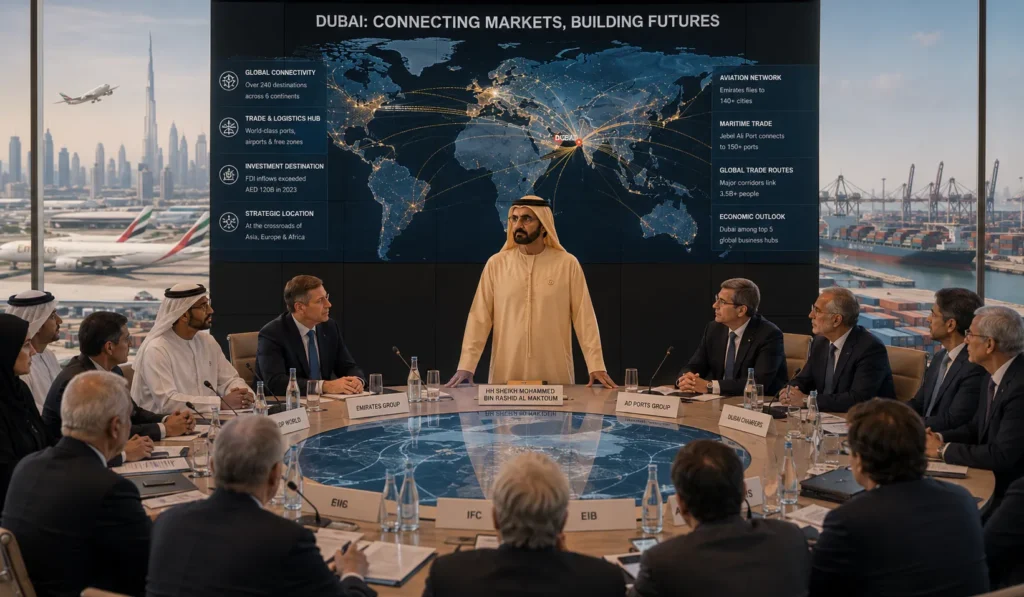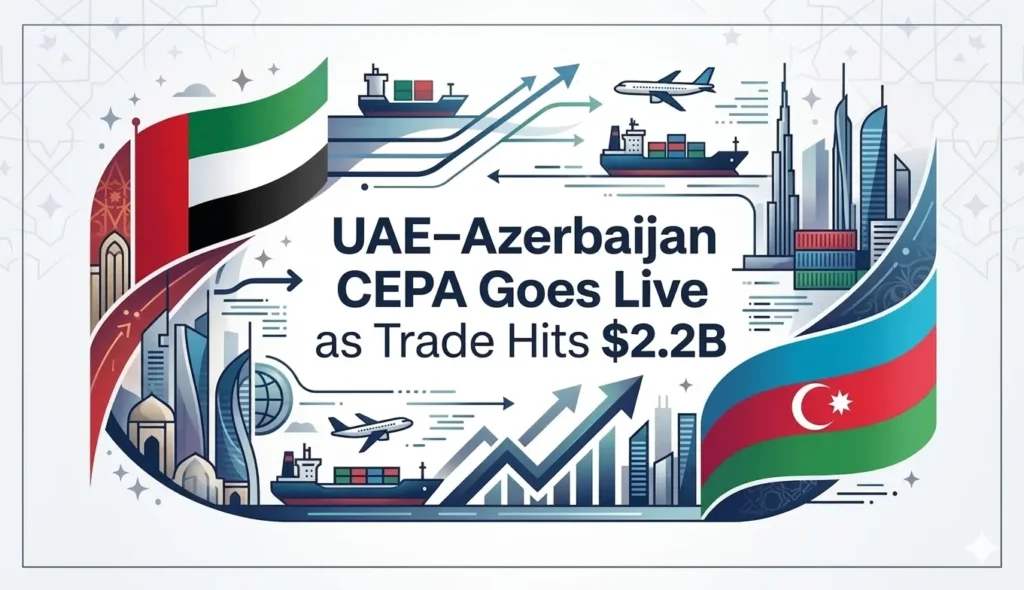
The entry into force of the Comprehensive Economic Partnership Agreement (CEPA) between the United Arab Emirates and Azerbaijan represents a significant shift in the economic landscape of the Eurasian region. This agreement marks a transformative moment in bilateral ties, promising to accelerate trade flows and create new investment opportunities. As the global economy navigates a period of significant geopolitical tension and shifting trade routes, the UAE is positioning itself as a central hub linking Asia, Europe, and emerging Eurasian markets. This strategy is part of a broader vision to diversify the national economy and achieve $1 trillion in total trade value by the year 2031.
The Influence of the UAE–Azerbaijan CEPA on Regional Trade
The CEPA has officially entered into force, following a period of robust growth in non-oil trade between the two nations. In 2025, non-oil trade reached a record $2.2 billion, representing a 31.4% increase over the previous two years. This growth underscores the strength and resilience of the relationship even before the formal implementation of the pact. By eliminating or reducing tariffs on a vast majority of goods and services, the agreement facilitates greater market access and enhances global reach for exporters in both countries.
For the first time in Azerbaijan’s history, a trade agreement includes a dedicated services chapter. This provision is expected to unlock massive potential in sectors such as finance, consulting, construction, and professional services. Businesses should pay close attention to these changes, as they represent a fundamental opening of the Azerbaijani market to Emirati expertise and capital. Azerbaijan’s strategic location at a crucial juncture in North-South trade further enhances the value of this partnership, offering a gateway to Central Asia and the Caucasus.
$1B+ Investments and New Trade Corridors Signal Deeper UAE–Azerbaijan Partnership
The UAE is already Azerbaijan’s largest Arab trading partner, accounting for roughly 40% of its trade with the Middle East and North Africa (MENA) region. Emirati investments in Azerbaijan currently exceed $1 billion, making the UAE the leading Arab investor in the country. The new agreement is expected to foster even deeper collaboration in key areas such as logistics, renewable energy, and advanced manufacturing.
Policymakers view these diversified trade corridors as essential for sustaining long-term growth and protecting the economy from external market volatility. The CEPA program, which has already seen agreements signed with countries like India, Indonesia, Turkey, and South Korea, is one of the most extensive bilateral trade initiatives ever undertaken by an emerging economy. This network of agreements is designed to attract foreign investment and strengthen global supply-chain integration.
Also Read: Why the Anantara World Islands Dubai Resort Has Ceased Operations?
Azerbaijan and the World Economic Forum (WEF)
Parallel to its trade agreements, Azerbaijan is deepening its cooperation with the World Economic Forum (WEF). A new cooperation plan for 2026 was recently discussed between the Center for Analysis and Coordination of the Fourth Industrial Revolution (C4IR) and WEF leadership. The C4IR Azerbaijan Center has been recognized as one of the three most active centers in the global WEF network.
The 2026 cooperation plan focuses on several high-tech global initiatives, including:
- Artificial Intelligence (AI) applications in the energy sector.
- The transformation of industrial clusters.
- The Strategic Intelligence platform and the Global Beacon Network.
- Advancements in TradeTech and GovTech.
- Participation in the AI Management Alliance.
This focus on the Fourth Industrial Revolution indicates that Azerbaijan is moving beyond traditional energy exports to become a knowledge-based economy. The collaboration aims to organize joint events and expand Azerbaijan’s participation in global technological initiatives.
UAE – China Strategic Partnerships and Record Trade
The UAE’s economic expansion is not limited to the Eurasian corridor. Recent conferences in Beijing have explored strengthening the UAE-China strategic partnership in trade and investment. Under the theme “From Vision to Value,” the two nations signed 24 Memorandums of Understanding (MoUs) to bolster economic ties.
Non-oil trade between the UAE and China surpassed the $100 billion mark for the first time in 2025, reaching $111.5 billion. This represents a record annual growth of 24.5%. China remains the UAE’s largest trading partner, accounting for 11% of its total non-oil trade. Conversely, the UAE is China’s leading trading partner in the Middle East and Africa, contributing more than 20% of China’s non-oil trade with the region over the last decade. This could shape the market in the coming months as these two major economies integrate their economic visions further.
Energy Markets at Risk as Geopolitical Pressures Intensify
While bilateral trade flourishes, the global economic outlook remains clouded by geopolitical uncertainty. Tensions between the United States and Iran continue to influence market sentiment and energy prices. Reports indicate that uncertainty surrounding ceasefire talks has led to fluctuations in U.S. stocks and rising oil prices. Iran’s control over the Strait of Hormuz—a critical choke point for global oil and gas shipping—gives it significant leverage in energy markets.
The International Energy Agency (IEA) has warned that the ongoing conflict in the Middle East could fundamentally reshape the global energy map, impacting supply and prices for the foreseeable future. For investors, this trend is worth watching, as energy costs remain a primary driver of global inflation. For instance, in the United Kingdom, inflation is expected to rise due to higher fuel prices caused by regional conflict, even after a period of falling to 2.3%.
Financial Markets Performance and Investor Sentiment
Stock markets in the Gulf region have shown mixed performance in response to these developments. In early 2026, Dubai shares advanced for three consecutive days, supported by major developers like Emaar Properties and positive profit forecasts from First Gulf Bank. Abu Dhabi’s index also saw significant gains, driven by strong dividend announcements and bank liquidity.
However, global markets have remained cautious. Major U.S. indices, including the S&P 500, Nasdaq, and Dow Jones, have faced retreats as investors weigh geopolitical risks and changing economic indicators. In Europe, stocks have struggled to hold early gains due to uncertainty over international talks. Despite these pressures, certain sectors like Indian fast-moving consumer goods (FMCG) and private banking have shown resilience, with indices like the Nifty crossing key milestones.
UAE Leads Digital Transformation Through Innovation and Technology
Innovation remains a critical pillar for future economic growth. In Dubai, leaders of tech “unicorns” have hailed the city as a global innovation hub, citing business-friendly regulations and high-quality infrastructure as key drivers of the digital economy. The UAE has also introduced new technologies to streamline business operations, such as a unified e-KYC platform for banking services and an eInvoicing 4-Corner model.
Globally, technological advancements are being recognized as major economic contributors:
- In the U.S., data scientists are winning awards for using big data and AI to empower financial industries.
- Browser gaming is projected to reach a market value of over $3 billion by 2028.
- Nigeria is leveraging AI to accelerate economic development and create new jobs.
- South Korea’s screen industry (movies and TV) contributes an estimated 24 trillion won to its GDP.
How Developing Economies Are Responding to Global Pressures
While major economies dominate the headlines, emerging markets are also making strategic moves. Pakistan has been active in inviting global investors to partner in infrastructure and trade initiatives. Despite a fragile economy struggling with debt, Pakistan has received financial support from Saudi Arabia to stabilize its health. The country is also attempting to balance its relationships between Gulf rivals while facilitating talks between the U.S. and Iran.
In other regions:
- Syria received a $200 million grant from the World Bank to modernize its railway network.
- India is projected by the UN to lead regional growth at 6.4%, despite facing risks from high energy costs and external volatility.
- Argentina is dealing with a dilemma between lowering high inflation and boosting economic growth under new leadership.
Also Read: Amazon and Anas Bukhash Launch Ramadan Card Game to Spark Meaningful Conversations
UAE’s Resilience in Focus
The ability of nations to withstand global crises has become a primary focus for economists. The UAE, in particular, has been cited for its resilience, maintaining a strong financial position with assets worth Dh 7.34 trillion. This financial strength allows the country to manage global pressures and continue its ambitious trade expansion programs without seeking external funding.
This resilience is not limited to finance. In the educational sector, students in the UAE returned to classrooms in April 2026 following disruptions, and major exam results like the CBSE Class 10 were released early, demonstrating organizational stability. Even in the face of “winter-like” weather anomalies in April, the nation has continued to function effectively.
Final Thoughts
The global economic outlook for 2026 is defined by a move toward strategic connectivity and diversification. The UAE-Azerbaijan CEPA is a prime example of how middle powers are creating new trade architectures to bypass traditional vulnerabilities. By focusing on high-growth sectors like AI, renewable energy, and professional services, these nations are preparing for a future that is less dependent on oil and more integrated with global technological trends.
While geopolitical tensions in the Middle East and elsewhere continue to pose risks to energy prices and market stability, the proactive expansion of trade networks suggests a path forward for sustainable growth. Businesses should pay close attention to these changes, as the emergence of new trade hubs and digital economies will define the winners of the next decade.
FAQs – Frequently Asked Questions
The Comprehensive Economic Partnership Agreement (CEPA) is a bilateral trade pact that eliminates or reduces tariffs on a majority of goods and services between the UAE and Azerbaijan. It aims to increase non-oil trade, which already reached $2.2 billion in 2025.
It is the first time Azerbaijan has included a services chapter in a trade agreement. This opens up new opportunities for businesses in sectors like finance, consulting, construction, and professional services to operate more freely between the two nations.
Non-oil trade between the UAE and China reached a record $111.5 billion in 2025, a 24.5% increase from the previous year. China remains the UAE’s largest trading partner.
The cooperation focuses on the Fourth Industrial Revolution, specifically AI applications in the energy sector, TradeTech, GovTech, and the transformation of industrial clusters.
The conflict has caused uncertainty in global stock markets and led to rising oil prices. Experts warn it could fundamentally change global energy supply routes, especially around the Strait of Hormuz.
The UAE aims to increase its non-oil foreign trade to $1 trillion annually by 2031 and double its economy’s size to exceed $800 billion within the same timeframe.
No. The UAE ambassador recently stated that the country has significant assets worth Dh 7.34 trillion and is not seeking external funding, highlighting its strong financial resilience.
While inflation recently fell to 2.3% due to dropping energy prices, it is expected to rise again to approximately 3.3% due to higher fuel costs resulting from Middle East tensions.

Dwayne Paschke is a seasoned content strategist and AI automation specialist with over nine years of experience at the intersection of journalism and digital innovation. A versatile force in the media landscape, Dwayne has built a reputation as an expert content writer and investigative journalist, contributing high-impact pieces to various reputable news websites.