The world’s billionaires now control more wealth than at any point in recorded history. But wealth and power are not the same thing, and the gap between the two is where the most important questions of our time are being answered.
In 2025, global billionaire wealth crossed $18.3 trillion for the first time, a figure that grew three times faster than the five-year average, according to Oxfam’s annual inequality report. The number of billionaires worldwide topped 3,000 for the first time. Elon Musk became the first individual whose net worth surpassed half a trillion dollars. These are not just financial statistics. They are signals of a structural shift in how power is distributed on Earth.
The question is no longer whether billionaires are wealthy. It is whether their wealth has crossed a threshold where it constitutes a form of governance, one that operates without elections, without term limits, and without accountability to the people it affects.
Tracking the Rise of Extreme Wealth
To understand billionaire power, you first need to understand the sheer scale of the numbers involved.
According to the Club of Rome, a person earning $75,000 a year would need to work more than 13,000 years to accumulate $1 billion in total income. Yet the world’s five richest men doubled their combined fortunes between 2020 and 2024, from $405 billion to $869 billion, growing at an average of $14 million per hour. Meanwhile, 44 percent of the global population lives below the World Bank’s upper-middle-income poverty threshold of $6.85 per day.
The 12 richest men in the world in 2025 owned more wealth than the bottom half of humanity combined, roughly 4 billion people – Take a look at this article here for more details into the richest people.
This is not merely an economic imbalance. It is a power imbalance. Because at a certain scale, money stops being a measure of success and starts being a mechanism of control.
Billionaires Are 4,000 Times More Likely to Hold Office
The most alarming finding from Oxfam’s 2026 Davos report is not about money. It is about democracy.
According to the research, billionaires are 4,000 times more likely to hold public office than an average citizen. In 2023, 74 of the world’s 2,027 billionaires held executive or legislative government positions, a 3.6% probability, compared to 0.0009% for ordinary citizens.
And for those who don’t hold office directly, campaign finance offers an equally effective alternative. In the 2024 U.S. elections, one in every six dollars spent across all candidates, parties, and committees came from just 100 billionaire families, per Oxfam. The Washington Post found that at least 44 of America’s 902 billionaires, or their spouses, have been elected or appointed to state or federal office in the past decade. This group includes Commerce Secretary Howard Lutnick, SEC Chairman Paul Atkins, and Illinois Governor JB Pritzker.
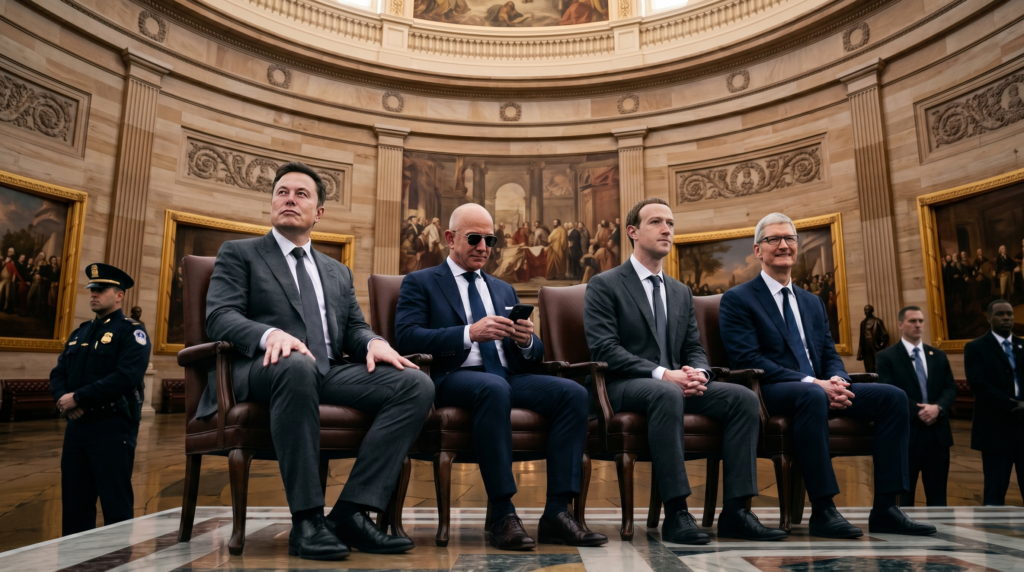
The symbolic crowning moment came on January 20, 2025. At Donald Trump’s inauguration, the front rows of the Capitol Rotunda were occupied by Elon Musk, Jeff Bezos, Mark Zuckerberg, Sundar Pichai, and Tim Cook, the world’s wealthiest technology executives. Their presence was not coincidental. Each had made substantial financial contributions to the event. As one commentator in London’s The Standard put it, the ceremony signalled the arrival of the “era of the Tech Baron.”
Investors and businesses operating in regulated industries should monitor how the alignment between billionaire donors and government policymakers evolves, particularly in antitrust, tax, and technology regulation.
Who Owns the Main Information Channels
Power over money and politics is compounded by something less visible but arguably more dangerous: power over information.
The world’s richest man owns X (formerly Twitter), the platform that shapes global political discourse more than any other social media network. The family of the second-richest man controls Paramount, which owns CBS News, and is in advanced talks to acquire Warner Bros. Discovery, owner of CNN. The third-richest man controls Facebook, Instagram, and WhatsApp. The fourth-richest owns The Washington Post. Another billionaire controls Fox News, The Wall Street Journal, and the New York Post.
According to Oxfam’s findings, billionaires now own more than half of the world’s largest media companies and all of the main social media platforms.
This is not a coincidence. It is a strategy. When a billionaire owns a news organization, they gain leverage over regulators who fear bad press, politicians who want favorable coverage, and competitors who depend on the same distribution. Jeff Bezos acquiring The Washington Post and Jeff Bezos negotiating with the U.S. government over Amazon’s antitrust exposure are not separate events. They are the same conversation.
Also Read: How Mega Companies Decide Billion-Dollar Investments
Control over media is the force multiplier that makes all other forms of billionaire power sustainable over time.
Market Control as a Foundation for Private Wealth
Beyond politics and media, the most durable source of billionaire power is economic monopoly.
According to Oxfam, companies associated with the ten richest men spent $88 million lobbying the U.S. government in 2024 alone. Amazon accounts for 70% or more of online purchases in Germany, France, the United Kingdom, and Spain. Africa’s richest man, Aliko Dangote, founder and chairman of the Dangote Group, holds a near-monopoly on cement across Nigeria and significant market power across the continent.
In the United States, 95% of profits made by large healthcare corporations flow directly to shareholders rather than workers or long-term investment. As monopolies concentrate market power, wealth concentrates further, and the political influence to protect that monopoly grows in proportion.
Oxfam’s “Takers, Not Makers” report found that approximately 60% of billionaire wealth is unearned, derived from inheritance, monopoly power, or crony connections rather than entrepreneurship. Every billionaire under 30 in 2024 inherited their wealth. For the first time in recorded data, more new billionaires got rich through inheritance in 2023 than through building new businesses.
Where Extreme Wealth Faces Constraints
The picture is not one of unchecked omnipotence. Billionaires face genuine constraints, and understanding those limits matters as much as understanding their influence.
Geopolitical borders remain the most significant check on billionaire power. Russia’s invasion of Ukraine resulted in the freezing and seizure of oligarch assets across Western jurisdictions almost overnight. Chinese billionaires have disappeared from public life with no warning when they ran afoul of the Communist Party’s political priorities. The Forbes list of Chinese billionaires shrank by 93 members between 2023 and 2024.
Democratic institutions, when functioning, impose meaningful limits. Courts regularly rule against billionaire-backed regulatory rollbacks. Antitrust proceedings against Meta and Google have proceeded despite aggressive lobbying. In 2025, European regulators continued to fine tech companies at record levels regardless of their political connections in Washington.
Public accountability is also a constraint that billionaires consistently underestimate.
Elon Musk’s appointment to lead the Department of Government Efficiency (DOGE) was accompanied by widespread protests across the United States and Europe. A British campaign group launched billboard-hacking campaigns targeting him across London. Tesla sales fell in multiple markets in early 2025 as consumers linked brand loyalty to his political alignment.
The fundamental tension is structural: billionaires need functioning democracies, stable legal systems, and educated workforces to generate and protect their wealth. When they undermine those systems, they erode the conditions that made their wealth possible in the first place.
Also Read: Who Are Richest People Worldwide in 2026 – Full Ranked List with Net Worth
The Impact of Global Wealth on Developing Economies
The billionaire power conversation tends to center on American and European figures. But the implications for the developing world are substantial.
When BlackRock, Vanguard, and State Street, whose largest shareholders are among the world’s billionaires, control investment flows into emerging markets, they effectively set the financial terms for sovereign development decisions. Countries seeking foreign direct investment must align policies with what large institutional investors find acceptable.
The IMF and World Bank, while multilateral, are heavily influenced by the priorities of their largest member states, whose governments are, in turn, influenced by their largest campaign donors.
Final Verdict
Billionaires do not rule the world in the conspiratorial sense. They cannot unilaterally pass laws, deploy armies, or eliminate rivals without consequence. But the question was never about absolute power, it was about disproportionate power, and on that metric, the evidence is overwhelming.
Through capital markets, media ownership, political donations, technology infrastructure, and philanthropic leverage, the world’s wealthiest individuals exercise influence over public life that no democratic election granted them and no regulatory framework adequately constrains.
The Soros-sterling episode proved billionaires can break central banks. The Musk-Twitter acquisition proved they can reshape global public discourse. The AWS and Starlink examples prove they operate infrastructure governments depend on. The Gates Foundation model proves they can effectively set health and education policy in countries where they hold no office.
Related Article: Emirates A380 Starlink Wi-Fi Installation and Rollout
What’s changing now is speed and visibility. Social media means billionaire decisions ripple through economies and politics within hours. And an increasingly aware public is asking whether the concentration of this much power in this few hands is compatible with democratic governance.
That question has no clean answer. But it is the defining political economy question of the early 21st century, and the answer will shape markets, governments, and societies for decades to come.
Businesses operating in any jurisdiction where billionaire-backed companies compete, invest, or lobby should treat this not as background noise but as a live strategic variable.
FAQs – Frequently Asked Questions
Elon Musk leads directly via government advisory roles and tech infrastructure, while figures like Rupert Murdoch and the Koch family wield influence through media and political donations.
Yes, via massive currency speculation or capital flight, though well-regulated and diversified modern economies generally have strong protective buffers.
This is highly contested; because most of their wealth sits in unrealized stock gains, many pay very low effective tax rates relative to their total worth.
In authoritarian states, billionaires serve at the absolute pleasure of the government, whereas in democracies, they aggressively lobby to shape government behavior.
Vote for campaign finance reform and antitrust regulation, support independent media, and use selective consumer spending to send meaningful market signals.
It provides critical funding for global issues like vaccines, but it also strips elected democracies of their decision-making power over public goods.
Major initiatives include the EU’s Digital Markets Act, aggressive U.S. antitrust lawsuits, and various international proposals for a global minimum wealth tax.
Daniel Carter covers UAE startups, venture capital, and AI innovation, delivering strategic, investigative reporting on emerging technology ecosystems.