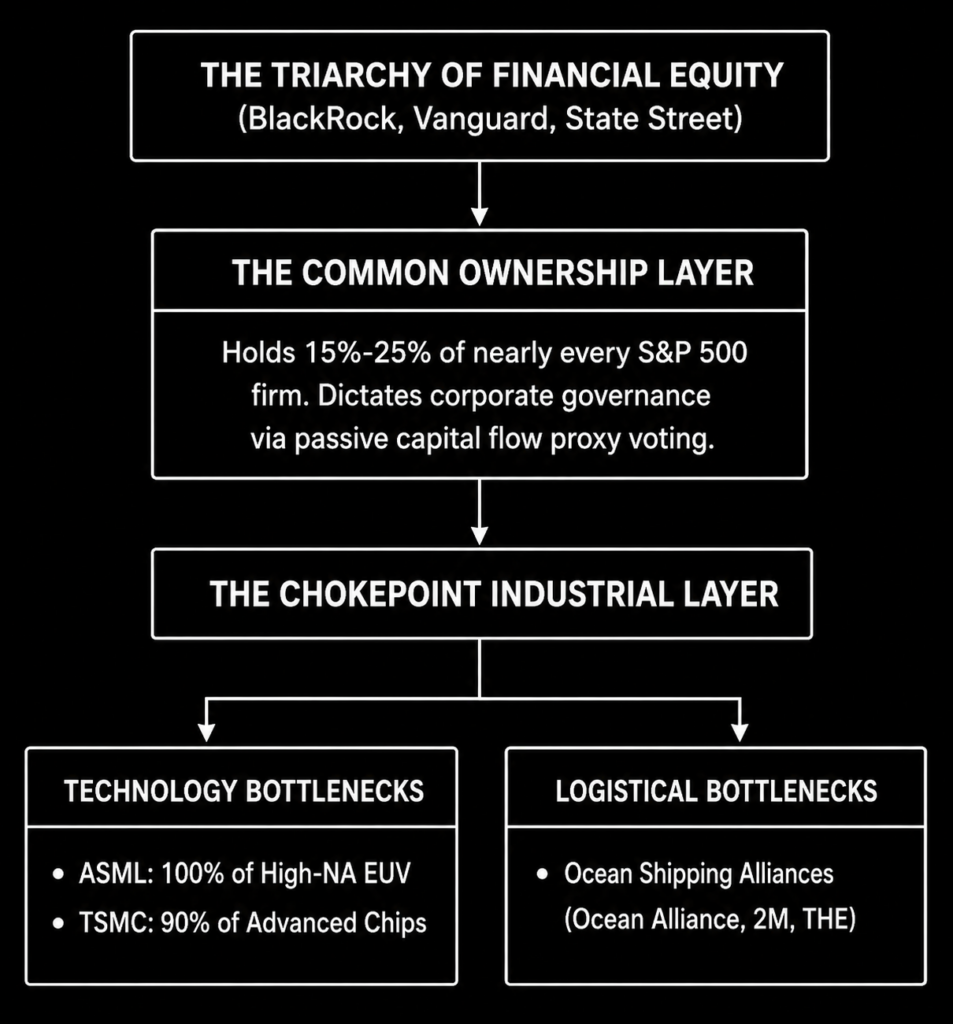
The global economy is primarily controlled by a highly concentrated network of institutional asset managers and specialized industrial monopolies. Institutional asset managers like BlackRock, Vanguard, and State Street exercise significant financial influence through common ownership, collectively serving as the primary shareholders in nearly every major publicly traded corporation. Operationally, economic control is further concentrated within specialized technological and logistical gatekeepers, such as TSMC and ASML within the global semiconductor ecosystem, which control critical, non-substitutable chokepoints in global production chains.
The Interlocking Matrix: Who Formally Controls the Global Economy?
True economic control isn’t about consumer brand recognition. It lies within a concentrated network of institutional asset managers and specialized industrial chokepoints.
To the average consumer, the global economy looks like an endless landscape of fierce corporate competition. In any supermarket aisle or digital marketplace, thousands of brands pitch products, creating the illusion of a highly decentralized corporate ecosystem.
However, if you strip away the logos, marketing campaigns, and subsidiary shells, the global economy reveals a completely different architecture. True economic power is not scattered across thousands of independent entities. Instead, it is concentrated within an incredibly tight network of institutional asset managers, financial clearinghouses, and specialized industrial monopolies.
This concentration of control represents one of the most critical structural realities of modern capitalism. It is not driven by hidden corporate conspiracies, but rather by the legal, systemic aggregation of equity and supply chain bottlenecks. To understand who actually controls the global marketplace, we must examine the two primary layers of modern economic centralization: financial equity aggregation and industrial chokepoint monopolies.
Layer 1: The Institutional Capital Giants and Common Ownership
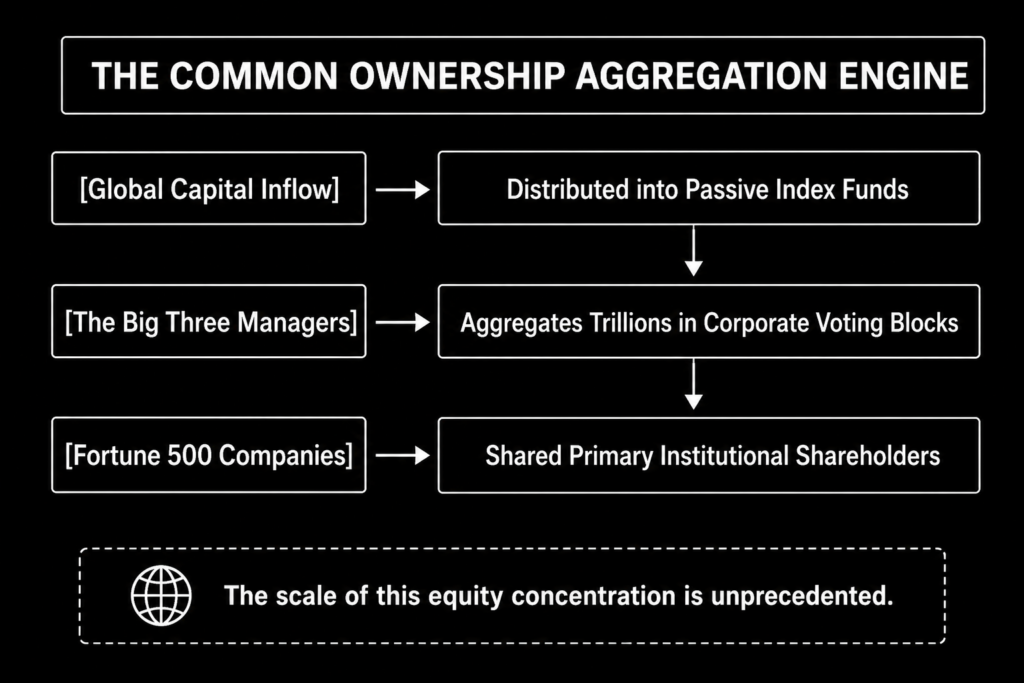
The most pervasive form of control over the global economy is exercised by a group of financial institutions known as the “Big Three” passive asset managers: BlackRock, Vanguard, and State Street Global Advisors.
These three entities do not operate like traditional private equity firms or hedge funds that buy companies outright to run them actively. Instead, they act as massive financial repositories for institutional and retail capital, managing the trillions of dollars that pour into index funds, mutual funds, and corporate pension plans.
| Asset Management Firm | Primary Product Engine | Estimated 2026 Aggregate AUM | Core Market Leverage |
| BlackRock Financial | iShares ETFs / Aladdin Risk | $11.2 Trillion | Passive Index Flows & Corporate Proxies |
| The Vanguard Group | Low-Cost Mutual Funds / ETFs | $9.6 Trillion | Long-Term Retail Capital Blocks |
| State Street Global | SPDR ETFs / Custody Asset Services | $4.8 Trillion | Institutional Clearing & Liquidity |
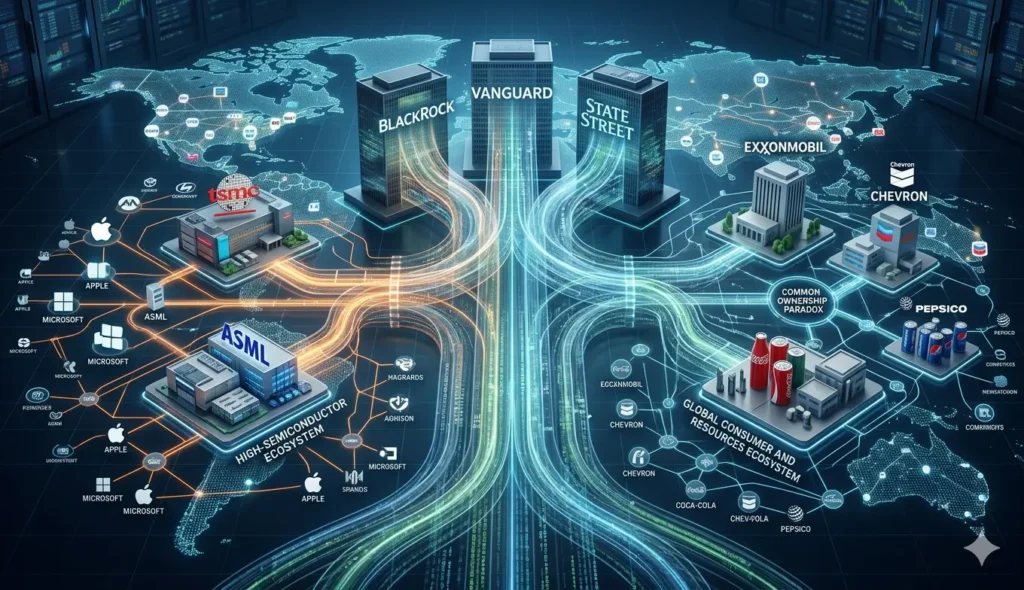
This scale creates a phenomenon economists call the Common Ownership Paradox. If you examine competing giants across any major industry such as PepsiCo and Coca-Cola, Apple and Microsoft, or ExxonMobil and Chevron, you will find that their primary institutional shareholders are nearly identical. BlackRock and Vanguard are routinely the top two shareholders in almost every major publicly traded company on Earth.
While these asset managers do not micro-manage daily operational decisions, they wield massive structural control through two distinct mechanisms:
The Real Power of Proxy Voting
As the legal holders of these massive equity blocks, these three firms vote on key shareholder resolutions, determine executive compensation packages, and approve or reject board member nominees. If a major corporation wants to alter its long-term strategic direction, it must align with the core proxy voting guidelines established by these primary asset managers.
Also Read: Anthropic Overtakes OpenAI to Become the First Trillion Dollar Private AI Firm
The Aladdin Risk Management Network
BlackRock does not just manage capital; it also operates Aladdin, an enterprise risk-management software system that processes and analyzes global financial portfolios. Institutional banks, insurance networks, and competing investment firms utilize Aladdin to manage their risk exposures, meaning a single risk-modeling methodology guides a significant portion of all institutional capital worldwide.
Layer 2: The Industrial and Technological Chokepoint Monopolies
While institutional asset managers control the financial equity layer, a separate group of specialized corporations exercises immense operational control by maintaining absolute monopolies over critical global supply chain chokepoints.
The most glaring example of this operational leverage is found within the global semiconductor ecosystem, the foundational building block of the modern digital economy.
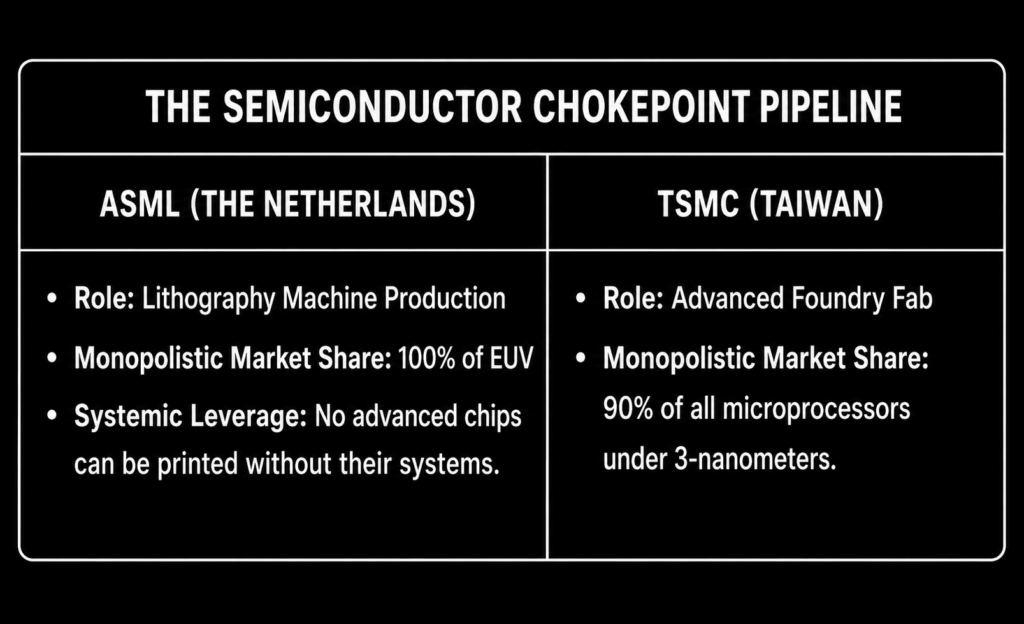
Without these two companies, global technology production would grind to an immediate halt. No amount of financial capital from Wall Street can replicate their proprietary engineering ecosystems in the short term, giving them unique structural leverage over global industrial policy.
Layer 3: Logistical and Commodity Cartels
Operational control also extends directly into the physical transportation networks that keep global trade moving. The global maritime shipping sector is dominated by a small group of integrated container shipping lines, organized into three major global alliances: the Ocean Alliance, 2M/Gemini Cooperation, and THE Alliance.
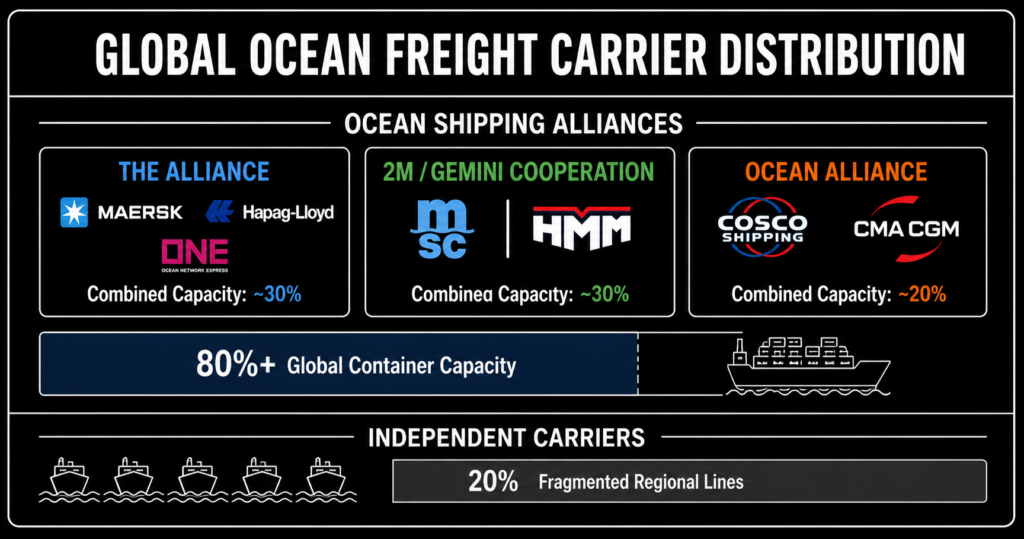
These shipping alliances control over 80% of all global container shipping capacity. By coordinating shipping schedules, capacity management, and port utilization strategies, these corporate coalitions effectively dictate the speed, cost, and logistics efficiency of international trade. When these alliances adjust their route capacities, it directly impacts retail inventory availability, manufacturing supply chains, and consumer price inflation across continents.
Also Read: How Mega Companies Decide Billion-Dollar Investments
Advanced Content Elements: Myths vs. Realities
- Myth: Large corporate monopolies operate completely free from state control or oversight.
- Reality: In the modern geopolitical landscape, the world’s most dominant corporations operate via a model of close public-private interdependence. Entities like TSMC, ASML, and major energy conglomerates rely heavily on state subsidies, national security protections, and preferential trade policies, turning them into key instruments of national industrial strategy.
- Myth: The growth of passive index funds means individual retail investors are the ones directing corporate behavior.
- Reality: While retail investors own the underlying economic shares, they surrender their voting power to the asset management firms that bundle those funds. This structural dynamic concentrates massive proxy voting power within a small group of institutional executives, completely separate from the individual capital providers.
Final Verdict
True economic power is not defined by corporate logos or consumer-facing brands. It is defined by structural leverage.
The global economy is guided by a highly concentrated financial and operational matrix. On one side sit institutional capital managers who pool the world’s equity and steer corporate governance via proxy voting. On the other side sit highly specialized industrial monopolies that control the essential supply chain chokepoints of modern industry. For institutional investors, corporate leaders, and policymakers, understanding the mechanics of this interlocking matrix is the key to managing risk across global markets.
FAQs – Frequently Asked Questions
Academic research suggests that when competing firms share the same primary institutional shareholders, executive management teams may face less pressure to engage in aggressive price competition.
Sovereign wealth funds routinely pool their capital into funds managed by BlackRock and State Street to access global equity markets efficiently, creating an integrated loop of state and institutional capital.
It is incredibly difficult due to the massive capital requirements and deep engineering expertise involved. Replicating ASML’s lithography technology requires decades of research and a highly difficult, specialized global network of thousands of component suppliers.
Control is heavily concentrated within major Wall Street clearing houses and credit rating agencies (S&P, Moody’s, Fitch). By adjusting corporate credit ratings, these agencies directly determine a company’s borrowing costs.
Cloud infrastructure providers (such as Amazon Web Services, Microsoft Azure, and Google Cloud) control the digital hosting environments for modern enterprise applications, meaning even non-tech companies rely entirely on their infrastructure to maintain daily operations.
Visa and Mastercard hold a near-duopoly over consumer transaction rails, while SWIFT dominates international interbank messaging.
It is a circular loop. Vanguard is owned by its own index funds. However, BlackRock and State Street are publicly traded, and their top shareholders are predictably each other.
Vitol, Trafigura, and Glencore move the world’s oil and metals, while the “ABCD” giants (ADM, Bunge, Cargill, Louis Dreyfus) control global grain logistics.

UK-based journalist covering UAE entrepreneurship, executive branding, and leadership growth across global business ecosystems.