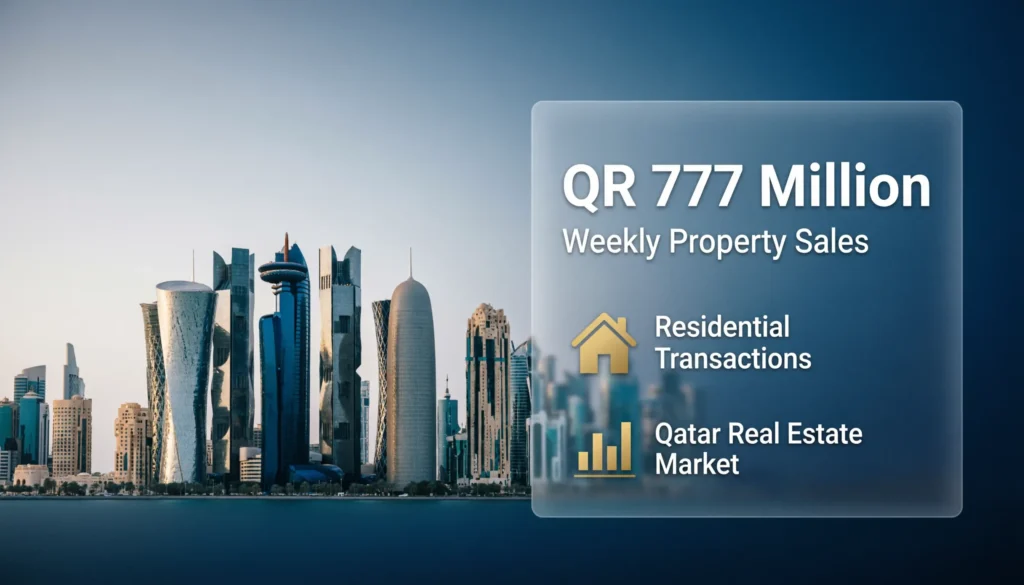
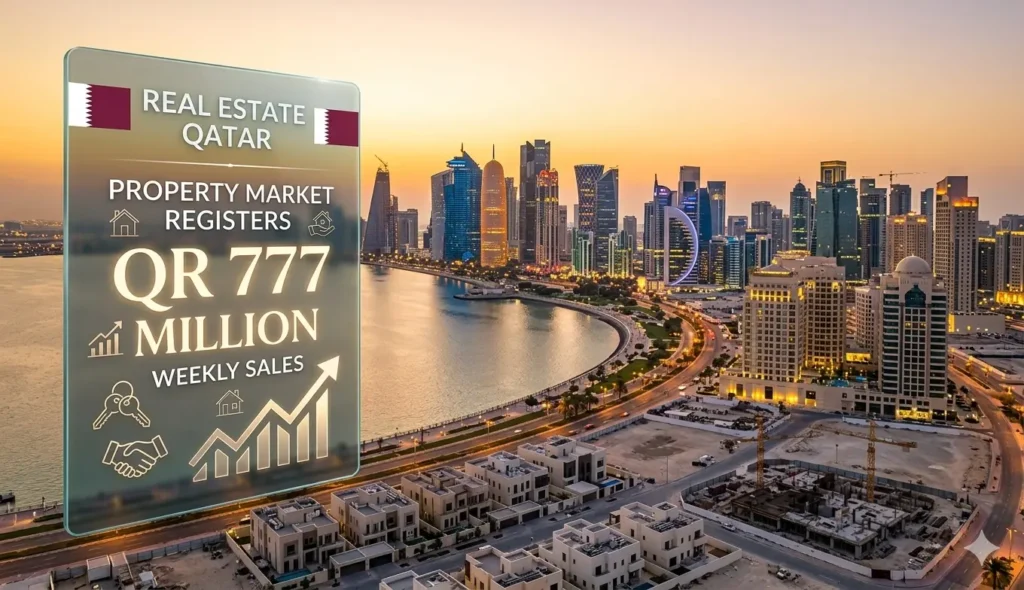
The Qatari real estate sector has demonstrated a significant surge in trading activity during the first half of April 2026, signaling a period of robust momentum and investor confidence. According to official data released by the Department of Real Estate Registration at the Ministry of Justice, the total volume of real estate trading for the week of April 5 to April 9, 2026, exceeded QR 777 million. This figure represents the combined value of traditional sales contracts and residential unit transactions, highlighting a multifaceted market that caters to diverse investment needs.
During this specific five-day trading period, the market reached a total registered value of QR 725,258,705 in primary sales contracts. This high level of liquidity suggests that the Qatari property market remains a primary pillar of the national economy, driven by both domestic demand and strategic urban development. The diversity of the transactions—spanning from vacant land to large-scale commercial buildings—points toward a market that is expanding in multiple directions simultaneously.
Sales Contracts Dominate as Qatar Property Market Expands Across Sectors
The weekly bulletin issued by the Ministry of Justice provides a granular look at the components of this QR 777 million surge. The bulk of the trading volume was concentrated in standard sales contracts, which accounted for approximately QR 725.26 million of the total. These contracts typically involve larger land parcels, commercial assets, and established residential buildings.
The data shows that the trading volume is being supported by a wide variety of property types.
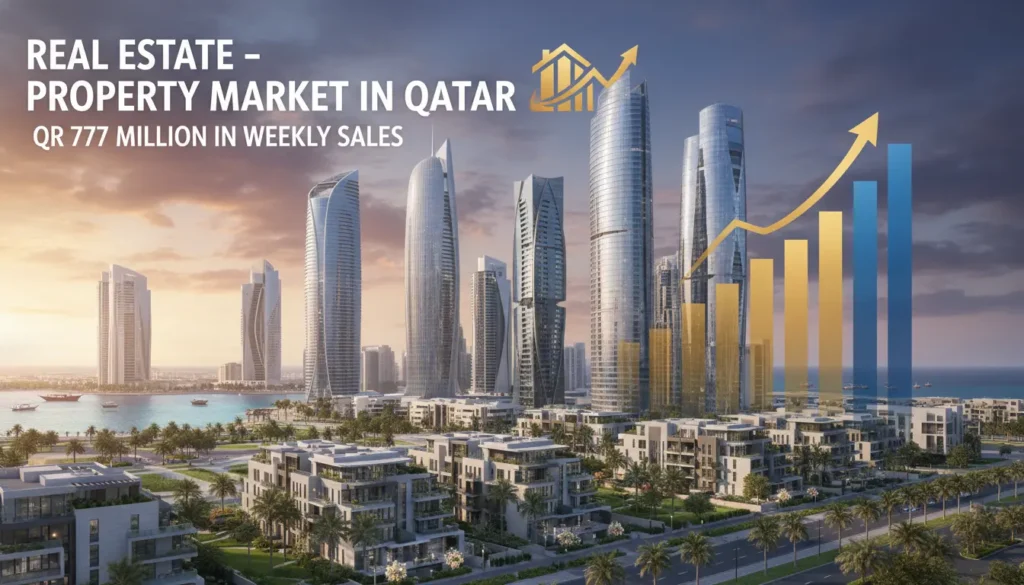
The list of traded assets during the April 5–9 period included:
- Vacant land
- Private residences
- Residential buildings
- Commercial shops
- Administrative offices
- Large-scale commercial buildings
This range of property types indicates that the market is serving different sectors of the economy, from retail and logistics to corporate administration and private housing. The inclusion of administrative offices and commercial buildings in the weekly trading highlights the ongoing demand for corporate space as Qatar continues to develop its business infrastructure.
Related News: Dubai Offices & Commercial Real Estate 29% Prices Increased
Qatar’s Residential Segment Records Active Trading in Weekly Report
While large-scale contracts dominate the total volume, the residential unit segment of the market remains a vital and active component. For the week ending April 9, 2026, sales contracts specifically for residential units reached a total of QR 51,971,523. This segment focuses on apartments, individual units within complexes, and purpose-built living spaces.
The steady demand for residential units reflects the broader urban expansion of Qatar, where new residential communities are being developed to accommodate a growing population and professional workforce. This segment is particularly important for individual investors and residents looking for modern housing solutions in areas like Lusail and The Pearl.
Businesses should pay close attention to these changes, as the growth in residential trading often precedes increased demand for local retail and service-based infrastructure in those areas.
Nationwide Distribution of Property Deals Reflects Market Expansion
The April 2026 trading data reveals a broad geographic spread, indicating that real estate activity is not confined to the capital city but is distributed across several key municipalities.
The sales activity during this period was concentrated in the following municipalities:
- Doha: As the primary economic hub, Doha continues to see high-value transactions across all property types.
- Al Rayyan: This municipality remains a popular area for residential and land investments.
- Al Wakrah and Al Wukair: These areas are increasingly becoming focal points for both residential development and commercial interest.
- Al Daayen: Known for its rapid development, Al Daayen continues to attract significant investment in vacant land and residential complexes.
- Umm Salal: This municipality saw activity in both land and housing units.
- Al Khor and Al Dhakhira: These northern areas maintain steady trading, often linked to industrial and community growth.
- Al Shahaniya: Recorded transactions point toward expanding interest in peripheral areas.
Beyond these municipalities, specific high-profile zones saw significant concentrated activity. These include:
- Lusail 69: A key component of Qatar’s future-facing urban planning.
- The Pearl: Continues to be a premier destination for luxury residential unit sales.
- Al Kharaej: Another area within the Lusail development seeing active trading.
This geographic diversity suggests an “expanding spatial dynamics” that moves beyond traditional urban cores into newer, master-planned environments.
Qatar Real Estate – Stable Growth Across 2025–2026
To understand the significance of the April 2026 figures, it is essential to compare them with previous performance benchmarks. The volume of real estate transactions in the week immediately preceding (March 29 to April 2, 2026) exceeded QR 729 million. Comparing the two weeks shows that the market has maintained a consistent level of activity, with the April 5–9 period reaching approximately QR 777 million when all categories are totaled.
Looking further back into the first quarter of 2026, the market showed even higher peaks. For instance, during the week of February 15–19, 2026, real estate trading reached QR 931,373,587, with residential unit sales accounting for QR 69,669,982 of that total. While the April figures are slightly lower than this February peak, they remain significantly higher than late 2025 levels. In September 2025, for example, weekly trading was recorded at approximately QR 686 million, and in late December 2025, it was around QR 657 million.
This year-on-year and month-on-month growth indicates a “strong momentum” in the property market. The shift from QR 657 million in late 2025 to a sustained level between QR 729 million and QR 931 million in 2026 suggests a rising trajectory for the sector.
Interesting Article for Investor: Why Dubai Has Become a Strategic Base for Global Entrepreneurs and Private Capital
Qatar’s Broader Economic Goals And National Vision 2030
The surge in real estate trading does not happen in isolation; it is deeply connected to Qatar’s broader economic goals and the Qatar National Vision 2030. The government’s focus on diversifying the economy and building a digital-first infrastructure is creating a supportive environment for property investment.
Several recent business developments highlight this economic vitality:
- Financial Infrastructure: Qatar is establishing itself as a regional hub for advanced financial infrastructure, utilizing a regulated digital finance approach to build a strong economic foundation.
- Digital Ecosystems: Local companies like Snoonu are launching platforms such as “Snoonu Cloud” to power digital ecosystems, which encourages entrepreneurship and creates demand for administrative and commercial spaces.
- Startup Empowerment: The launch of the “Snoonu Startup Factory” aims to provide mentorship and market opportunities to new founders, further fueling the need for commercial real estate.
- Sustainability Initiatives: Major players like McDonald’s Qatar are aligning with Qatar Vision 2030 through environmental efforts such as mangrove planting and beach cleanups. Similarly, Doha Festival City hosted the “Sustainable Futures” event to promote conscious lifestyle choices.
These initiatives contribute to a “Contemporary, market-driven urban condition” where investment logic is increasingly shaped by sustainability and technology.
How Different Property Types Are Driving Market Activity
The current market shows a pragmatic mix of property types, which some analysts describe as being shaped more by “investment logic than by cohesive spatial narratives”. This means that investors are highly responsive to market needs, leading to a healthy variety of developments.
Commercial properties, including retail shops and administrative offices, are becoming increasingly prominent in the weekly bulletins. This is likely driven by the relocation and expansion of major entities. For example, the Ministry of Commerce and Industry recently relocated to a new headquarters, and other businesses like Landmark Group Qatar are adapting their operations to meet seasonal trading challenges.
The “typological diversity” of the market—meaning the wide variety of property types—suggests that Qatar’s real estate sector is resilient and capable of serving different economic interests. Whether it is vacant land for future development or finished residential units for immediate occupation, the market is providing liquidity across the board.
What Strong Property Growth Means for Qatar’s Future Planning
The high volume of transactions raises important questions about long-term urban resilience and planning. As development extends beyond traditional urban cores into peripheral municipalities like Al Shahaniya and Al Daayen, the need for a “clearly articulated urban hierarchy” becomes more important to avoid fragmentation.
However, the current level of liquidity is a strong signal of confidence. The fact that transactions are spanning multiple municipalities and zones like Lusail and The Pearl indicates that the “Architectural Ambition” of the country is being backed by actual market activity.
This could shape the market in the coming months, especially as the country prepares for major industry events. For example, the Real Estate Regulatory Authority (Aqarat) is preparing to host the third edition of the Qatar Real Estate Forum in October 2026. Such forums are critical for discussing sector challenges, such as transforming real estate brokers into full-fledged advisors to ensure greater transparency.
Major Factors Supporting Qatar’s Real Estate Expansion
Several external and internal factors are expected to continue driving the Qatari real estate market throughout 2026:
- Scholarship Programs: Qatar has launched an expanded scholarship program for 2026–2027 to boost national expertise in key sectors, which will likely increase the demand for high-quality residential and educational infrastructure.
- Aviation Expansion: Qatar Airways continues to expand its international flight services to over 150 destinations, facilitating easier access for international investors and tourists.
- Infrastructure Improvements: Ongoing projects by the Public Works Authority, such as road enhancements in Azghawa, improve the accessibility and value of properties in those areas.
- Financial Hub Status: The entry of entities like Lesha Capital into international markets, such as Saudi Arabia, further strengthens Qatar’s position as a sophisticated financial center.
These factors, combined with the “robust trading volumes” seen in April, suggest that the real estate sector will remain a central component of Qatar’s economic narrative.
FAQs – Frequently Asked Questions
The total volume of real estate trading reached over QR 777 million during the period from April 5 to April 9, 2026.
Sales were concentrated in several municipalities including Doha, Al Rayyan, Al Wakrah, Al Daayen, Umm Salal, Al Khor, and Al Dhakhira. Specific areas with high activity included Lusail 69, The Pearl, and Al Kharayej.
The transactions included a wide variety of assets such as vacant land, private residences, residential buildings, commercial shops, administrative offices, commercial buildings, and individual residential units.
The market has shown significant growth since late 2025. While trading was around QR 657 million to QR 686 million per week in late 2025, it rose to a range between QR 729 million and QR 777 million (and even higher in February) during early 2026.
Official reports often categorize general sales contracts (which include land and full buildings) separately from the sales of specific residential units (such as apartments). In the week of April 5–9, general sales contracts totaled QR 725.26 million, while residential units totaled QR 51.97 million.
The reports indicate “relatively stable market activity” with “sustained demand”. The consistent weekly volume exceeding QR 700 million suggests a healthy and reliable trading environment.
Yes, the Real Estate Regulatory Authority (Aqarat) is scheduled to host the third edition of the Qatar Real Estate Forum in October 2026 to discuss sector developments and challenges.
The Vision 2030 provides a framework for economic diversification, sustainability, and digital transformation. This attracts investment into new sectors and geographic areas, driving the development and trading of modern commercial and residential properties.

Dwayne Paschke is a seasoned content strategist and AI automation specialist with over nine years of experience at the intersection of journalism and digital innovation. A versatile force in the media landscape, Dwayne has built a reputation as an expert content writer and investigative journalist, contributing high-impact pieces to various reputable news websites.