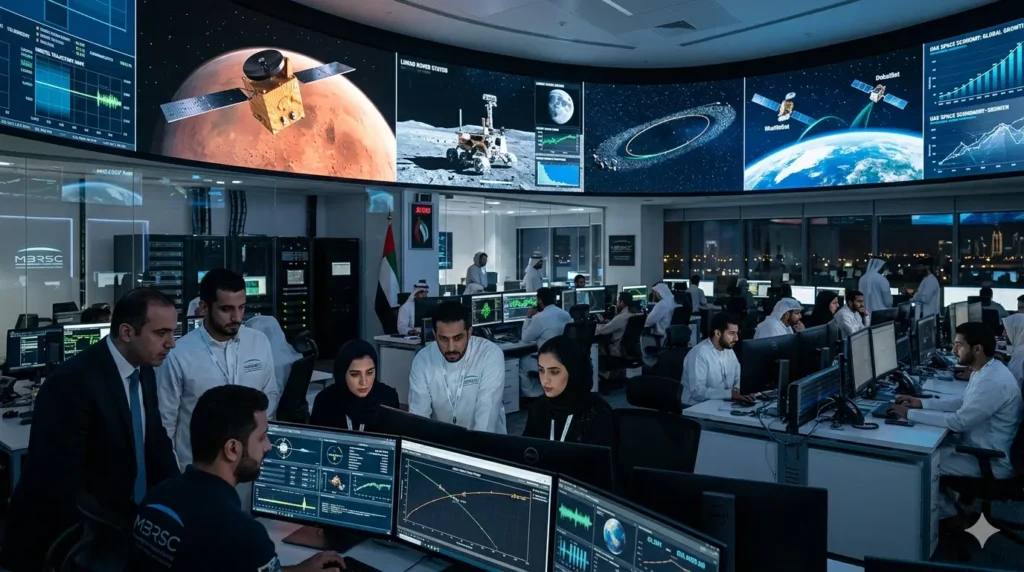
The United Arab Emirates has successfully transitioned from a regional player to a global leader in the space sector. This development is a strategic move to diversify the national economy and reduce reliance on oil. Now, the UAE space program is at a critical “tipping point” as it moves from government-funded projects to private-sector leadership.
For investors and global partners, understanding the regulatory and commercial framework of the UAE Space Agency (UAESA) is essential. The sector currently represents one of the most high-growth industries in the Middle East, with multi-billion dollar investments already in place. This article provides a deep analysis of the industry’s history, current market data, and the future of commercial spaceflight in the UAE.
The UAE’s National Vision for Its Space Program
The UAE’s interest in space began in the 1970s when the late Sheikh Zayed bin Sultan Al Nahyan met with the NASA Apollo moon landing team. This meeting established a long-term national vision for science and technology. This vision eventually led to the creation of the Thuraya Telecommunications Company in 1997 and Yahsat in 2007.
In 2006, the Emirates Institution for Advanced Science and Technology was launched, which later became the Mohammed bin Rashid Space Centre (MBRSC). The UAE Space Agency was formally established by federal decree in 2014 to regulate the sector. Its primary headquarters are in Abu Dhabi, with an additional branch in Dubai.
The agency was designed to be financially and administratively independent while reporting directly to the Cabinet. Its mandate includes coordinating the growing space sector and fostering international partnerships for knowledge transfer. What happens when a nation decides to move from the desert to the stars in just a few decades?
How the UAE Reached New Frontiers in Space with Its UAE Space Agency
The UAE has followed an accelerated timeline for its space missions. Each project has served to build local technical expertise and international credibility. The following milestones highlight the rapid progression of the UAE national space program:
- 2014: Formal establishment of the UAE Space Agency.
- 2018: Launch of KhalifaSat, the first satellite 100% designed and built in the UAE.
- 2020: Launch of the Emirates Mars Mission (Hope Probe).
- 2021: The Hope Probe successfully entered Martian orbit.
- 2023: The Rashid Rover reached the Moon but was destroyed during the landing attempt.
- 2024: Launch of the UAE’s first Synthetic Aperture Radar (SAR) satellite for Earth observation.
- 2025: Signed agreement for the Lunar Gateway project to provide the Emirates Airlock.
- 2028: Planned launch of the Emirates Mission to the Asteroid Belt.
The extension of the Hope Probe mission until 2028 demonstrates the UAE’s commitment to long-term scientific data collection. This mission continues to provide the global scientific community with a holistic view of the Martian atmosphere.
Why Investors Are Watching the UAE Space Agency Closely
The UAE has invested nearly AED 44 billion ($12 billion) in its space industry to date. This investment is spread across government initiatives, commercial projects, and research and development. This could shape the market in the coming months as new private players enter the field.
Related Article: Yousuf Hamad Al Shaibani’s Leadership in Dubai’s Digital Security and Space Sectors
Recent data from the UAE Space Agency provides a clear breakdown of the sector’s economic structure:
- 57% of establishments in the country are now engaged in the space economy.
- 55.7% of current spending is driven by the government.
- 44.3% of spending is allocated to commercial space projects.
- 14.8% increase in spending has been recorded for research, development, and exploration.
The UAE uses advanced technology for satellite communications, specializing in mobile communications, photography, and military applications. With over 250 employees at the UAESA, the agency acts as a hub for high-tech job creation. For investors, this trend toward a balanced public-private spending model is worth watching.
How do Businesses Get Benefits by the UAE Space Agency?
The government’s goal is for the private sector to lead the national space program within this decade. Industry experts suggest that the next 10 years will be instrumental in the full commercialization of the sector. Businesses should pay close attention to these changes as the barriers to entry for space startups are lowered.
A new UAE space company has recently been announced with the ambitious goal of developing 50 satellites per year. Additionally, the agency has established a Space Data Center and a National Space Fund to support private initiatives. The “Space Economy” initiative is specifically designed to provide the infrastructure needed for commercial success.
International partnerships are also pivoting toward commercial entities. For example, the UAE and Mitsubishi signed an agreement for the upcoming mission to the asteroid belt. This shift suggests that future interplanetary missions will involve significant private-sector supply chains.
Government Policies for the Space Agency
The UAESA serves as the federal regulator, ensuring that all space activities comply with international law. The agency manages several critical services for companies looking to operate in the UAE. These services are essential for maintaining safety and organizational standards in orbit.
Key regulatory services provided by the UAESA include:
- No Objection Certificates (NOC): Required for various national space activities.
- Space Activity Authorization: Licenses for both low-risk and standard space missions.
- Space Object Registration: Ensuring all UAE-linked objects in space are properly documented.
- Authorization Renewal and Amending: Services to manage the lifecycle of existing space licenses.
These policies are part of the “Higher Policy for Science, Technology, and Innovation,” which prioritizes the exploration of celestial bodies. The agency also works closely with the International Astronautical Federation (IAF) to enhance the UAE’s position as a global player.
International Partnerships in the UAE Space Program
The UAE does not operate its space program in isolation. It has become a central hub for regional and international collaboration. The Arab Satellite 813 Project is a major regional initiative focused on Earth observation and communication across Arab nations.
The UAE is also a key partner in the NASA-led Lunar Gateway project. Through the MBRSC, the UAE will provide the “Emirates Airlock,” a critical component of humanity’s first space station in lunar orbit. This project will eventually see an Emirati astronaut orbit the Moon.
Furthermore, the Abu Dhabi Space Debate and the Space Research Conference serve as global platforms for policy discussion. These events allow the UAE to lead conversations on space security, sustainability, and the future of the global space economy.
Interesting Article: UAE Cyber Security Council and Digital Defense Strategy 2026
Why Space Exploration Is So Complex and Risky
Space exploration remains a high-risk endeavor, as demonstrated by the Emirates Lunar Mission in 2023. The Rashid Rover, which was intended to explore new areas of the Moon, was destroyed when communication was lost seconds before landing. This event highlighted the extreme difficulties of soft-landing on celestial bodies.
There are also economic risks associated with the transition to a private-sector model. While the government has historically borne most of the financial responsibility, the success of the new strategy depends on the private sector’s ability to innovate and sustain growth. Can the private sector maintain the necessary levels of R&D investment without continuous government subsidies?
Technical challenges also exist for upcoming missions. The journey to the asteroid belt involves a 5-billion-kilometer trip, which is far more complex than the previous mission to Mars. Managing such long-range missions requires advanced communication systems and highly durable spacecraft.
Related Article: UAE Space Platform Opens Satellite Data Access for Students and Start-ups
Emirates Mission to the Asteroid Belt (EMA)
The “Emirates Mission to the Asteroid Belt” (EMA) is the next major frontier for the UAESA. Launching in 2028, the MBR Explorer spacecraft will fly by seven different asteroids over several years. This could shape the market in the coming years as the UAE explores the potential for asteroid mining.
The mission will target specific asteroids for study:
- 10253 Westerwald
- 623 Chimaera
- 13294 Rockox
- 88055 Ghaf
- 23871 Ousha
- 59980 Moza
- 269 Justitia: The final destination where a landing craft will be delivered in 2034.
The scientific goal is to understand the origins of these asteroids and evaluate their resource potential. If successful, the UAE could become a pioneer in the commercial extraction of space resources. This long-term vision ensures that the UAE remains at the forefront of space exploration for the next two decades.
Final Thoughts
The UAE Space Agency has played a transformative role in shaping the country’s space economy, turning a national vision into a rapidly expanding global presence. Through strategic investments, strong regulatory frameworks, and international partnerships, the UAE has positioned itself as a key player in modern space exploration. Its achievements, from Mars missions to planned asteroid exploration, reflect both ambition and long-term planning. While challenges such as technical risks and financial sustainability remain, the continued focus on innovation and private-sector involvement strengthens future prospects. Overall, the UAE’s space program is not only advancing science but also driving economic diversification and global collaboration.
FAQs – Frequently Asked Questions
The UAE Space Agency was established by federal decree in July 2014 to develop and regulate the national space industry.
KhalifaSat, launched in October 2018, was the first satellite 100% designed and manufactured in the United Arab Emirates by Emirati engineers.
The Hope Probe successfully entered Martian orbit in February 2021. Its mission has been extended until 2028 to continue its study of the Martian atmosphere.
The Rashid Rover was part of the Emirates Lunar Mission in 2023. Unfortunately, communication was lost during the landing attempt, and the spacecraft crashed into the Moon.
The UAE is a partner in the NASA-led Lunar Gateway project. It is responsible for providing the “Emirates Airlock” for the space station and will send an Emirati astronaut to orbit the Moon.
The UAE has invested approximately AED 44 billion, which is roughly $12 billion, into its space sector.
Scheduled for 2028, the mission aims to study seven asteroids to understand their origins and investigate the potential for future asteroid mining.
Yes, the agency provides various career opportunities, including vacancies, internships, and volunteering programs through its dedicated career portal.

Aisha Al Mansoori is a UAE-based business and technology analyst covering startups, venture capital, AI, fintech, and innovation trends shaping the Emirates’ economy.