Somewhere right now, a market is opening. A stock price is moving three points in a direction that, because of equity stakes measured in the tens of billions, will shift one person’s net worth by more than the annual GDP of a small nation. By the time you read any published ranking of the world’s wealthiest people, it is already partially outdated.
That’s the first thing worth understanding about billionaire net worth rankings: they are not fixed facts. They are snapshots of equity valuations, private asset estimates, and public holdings data, all of which change continuously, some of which are precisely knowable and some of which are estimates. Forbes, Bloomberg, and other wealth tracking publications use methodologies that are rigorous but inherently imprecise for privately held assets, closely held companies, and complex trust and holding structures.
Which means the number next to someone’s name isn’t the truth. It’s the best available approximation.
But the approximations are useful not for ranking human virtue or merit, but for understanding which industries and geographies are generating extreme wealth in the current economic era, and why.
Current Top of the Global Wealth Rankings
The upper tier of the global billionaire rankings features a sharp consolidation of figures whose fortunes are fundamentally tied to the massive expansion of the digital and physical infrastructure of the modern world.
Macroeconomic Distribution of the World’s Elite Fortunes
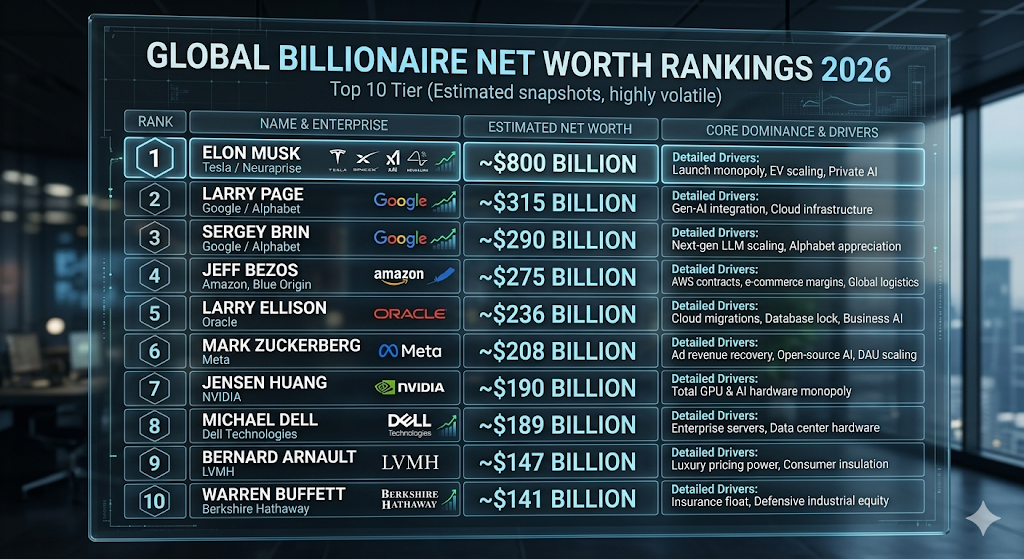
To put the current era into focus, the real-time tracking metrics show a heavy concentration of multi-hundred-billion-dollar fortunes anchored almost entirely within the American technology ecosystem:
2026 Tech Global Giants Today
Elon Musk has operated at the absolute peak of global wealth rankings. His wealth is distributed across multiple private and public companies, Tesla, SpaceX, X (formerly Twitter), xAI, the Boring Company, and Neuralink with SpaceX representing an immense private company valuation component as its satellite launch infrastructure approaches a functional global monopoly. Tesla’s public equity remains the most volatile significant element of his wealth, creating swings of billions of dollars on single trading days. His wealth concentration in companies he operationally controls is unusual at this scale most comparable fortunes are more diversified.
Conversely, the massive ascendancy of Google co-founders Larry Page and Sergey Brin into the absolute upper stratosphere of the top three positions underscores a broader macroeconomic reality: the world is aggressively pricing in the value of proprietary data and computation. Alphabet’s multi-layered monopoly on digital search, video data ingestion, and cloud computing has seen its equity multiply exponentially.
Jeff Bezos retains enormous wealth primarily through retained Amazon equity and has diversified into aerospace through Blue Origin, media through acquisitions, and real estate. The difference between his current ranking and Musk’s reflects the divergence in Amazon and Tesla/SpaceX valuations over recent years, along with Bezos’s more conventional wealth management approach.
Larry Ellison, Oracle’s founder and largest shareholder has seen his wealth amplify with Oracle’s emergence as a significant player in AI infrastructure and cloud services, a position few anticipated given Oracle’s database-legacy reputation. Enterprise AI demand has been extremely good for Oracle’s business. Similarly, Jensen Huang of NVIDIA makes his historic debut in the global top ten, personifying the hardware bottleneck of the digital age. Without his silicon chips, the software empires built by the rest of the list cannot mathematically operate.
Mark Zuckerberg’s position in the top tier has stabilized with Meta’s strategic pivot into open-source AI infrastructure and the sustained performance of its core advertising platforms. His equity stake in Meta, a company he founded and continues to control via super-voting shares, represents the core of a fortune that has been highly volatile but has structurally adapted to the shifting attention economy.
Bernard Arnault leads the European billionaire rankings through LVMH, the luxury conglomerate that controls Louis Vuitton, Dior, Hennessy, Moët, Bulgari, and dozens of other premium brands. His fortune is structurally different from the technology billionaires, it’s rooted in brands that have appreciated over decades, not companies whose valuations are driven primarily by hyper-growth multiple expectations.
Increasing Wealth in Asia Including India and Other Countries
One of the most significant structural stories in global billionaire rankings over the past decade is the rise of Indian industrial and technology wealth, positioning the subcontinent as a dominant center of heavy-industry asset aggregation.
Mukesh Ambani has led Indian wealth rankings through Reliance Industries, a massive conglomerate spanning petrochemicals, retail, and telecommunications that has been systematically transformed through strategic investment in Jio, now India’s largest telecom operator. Reliance’s deep integration into retail and digital platforms positions it as the inescapable infrastructure backbone across multiple sectors that define India’s domestic consumer economy.
Gautam Adani’s trajectory has been extraordinary, and turbulent. His Adani Group, spanning ports, airports, green energy, and logistics infrastructure across India, generated one of the fastest large-scale wealth accumulations in recent history, followed by a highly publicized short-seller attack, and a subsequent structural recovery. His position in the rankings reflects both the genuine physical scale of the Adani business empire and the global market’s evolving assessment of its corporate governance and capital structure.
Chinese billionaire wealth remains considerably less transparent than Western or Indian equivalents both because of the prevalence of privately held corporate structures and because unique regulatory and political dynamics in China create genuine uncertainty about the long-term sustainability of hyper-concentrated private wealth. The relative retreat of consumer-tech figures like Jack Ma or the shifting valuations of creators like Zhang Yiming (TikTok) reflect a political economy that creates entirely different risk profiles for extreme wealth accumulation than those that apply in Western, laissez-faire geographies.
Also Read: Secret Wealth Formula of Self-Made Billionaires
Financial Architecture of Extreme Fortunes
To understand why these lists exist and how they behave, one must dismantle the mechanics of modern ultra-high-net-worth capital management. A billionaire’s wealth does not sit in a traditional retail bank account; it exists as an intricate web of assets structured through sophisticated vehicles designed for capital preservation, tax optimization, and generational transfer.
At this level of wealth, individual billionaires rely on Family Offices, private wealth management advisory firms that handle the entire financial and legal world of a single ultra-wealthy family. These offices do not merely buy index funds. They operate like elite institutional venture capital and private equity firms. They deploy capital directly into early-stage technology startups, acquire massive commercial real estate portfolios, and purchase private debt.
Furthermore, the legal architecture of this wealth is fundamentally built upon multigenerational trust structures and offshore holding companies located in highly favorable regulatory jurisdictions like the Cayman Islands, Luxembourg, or South Dakota. By transferring equity stakes into irrevocable trusts or family-controlled foundations, the ultra-wealthy can legally separate themselves from personal ownership of an asset while maintaining absolute operational control over it. This structural shield drastically mitigates exposure to capital gains, estate taxes, and public litigation, ensuring that the wealth remains intact even if the individual steps down from active corporate leadership.
What the Rankings Don’t Capture
The net worth rankings are incomplete in ways that matter for understanding global wealth concentration honestly.
Sovereign wealth and royal family assets in Gulf states, Southeast Asia, and some European nations are structurally opaque, partially because they are not publicly traded on stock exchanges, and partially because the boundary line between state-owned assets and personal family wealth is deliberately blurred. The Al Saud family’s aggregate wealth, the Qatari ruling family’s sovereign holdings, and similar concentrations in other absolute monarchies are not captured in published billionaire lists, despite commanding trillions in real-world purchasing power.
Institutional family wealth, dynastic structures and multigenerational trusts is also systematically underrepresented. Old European and American family wealth that has been quietly nested in diversified, professionally managed private holding corporations for generations doesn’t trigger public equity tracking databases. The families behind historic dynasties like the Rothschilds, the Wallenbergs, the Thyssens, or the traditional industrialists rarely appear in conventional rankings because their capital is fractured among hundreds of heirs or held in invisible, unlisted trusts.
Undisclosed ownership through nominee structures, shell companies, and complex holding arrangements creates additional blind spots. Independent researchers studying beneficial ownership transparency consistently find that publicly reported wealth concentrations significantly understate true wealth concentration in geopolitical systems where financial opacity is structurally available.
Economic Significance Beyond the List
There is a much more important question than who tops the list: what does the concentration of extreme wealth at this scale mean for the broader global economy?
Billionaire wealth at the top tier is no longer simply economic, it is political, infrastructural, and media-shaping. Elon Musk’s ownership of X gives him immediate control over a platform that functions as a primary global town square for real-time political discourse. He simultaneously runs the world’s most significant private space company, with government contracts that make global telecommunications and military defense arrays partially dependent on state relationships with a single individual. Bezos owns The Washington Post. Arnault controls highly influential French media empires.
The concentration of core media, cloud technology infrastructure, transport logistics, and raw political access in the hands of a small number of individuals who are simultaneously the world’s wealthiest is a phenomenon without meaningful historical precedent. It creates dynamics that are neither straightforwardly good nor straightforwardly bad, but are genuinely consequential for democratic systems and free market competition. Understanding billionaire rankings, seriously, requires holding that deep structural context alongside the daily moving numbers.
FAQs – Frequently Asked Questions
Elon Musk maintains the top position globally, with net worth estimates hovering near the $800 billion mark, driven by SpaceX’s private valuation and his core Tesla equity stakes.
No. Virtually all of their reported net worth is held in corporate equity, private company shares, and real estate. Their actual liquid cash reserves are only a tiny fraction of their total estimated wealth.
Because their wealth is tied directly to public stock markets. If a company’s stock price drops by 5%, a billionaire holding $100 billion in that equity instantly loses $5 billion in paper net worth within minutes.
Yes. Opaque royal families, rulers of sovereign Gulf states, and multi-generational dynastic families utilize private trusts and state-blended asset structures that completely evade public wealth tracking indices.
A private, highly specialized wealth management firm that manages the investments, legal assets, estate planning, and tax structures of a single ultra-high-net-worth individual or family dynasty.
The artificial intelligence infrastructure sector, which supercharged the net worths of cloud computing platform providers, chip manufacturers like Jensen Huang, and enterprise software founders.
They frequently use a strategy called “Buy, Borrow, Die.” They take out low-interest personal loans against their massive stock portfolios to fund their lifestyles, avoiding the capital gains taxes triggered by selling equity.
Their historic wealth has been deliberately diluted across hundreds of descendants over generations or safely locked inside opaque, unlisted corporate trusts that cannot be tracked by public market indices.

Dwayne Paschke is a seasoned content strategist and AI automation specialist with over nine years of experience at the intersection of journalism and digital innovation. A versatile force in the media landscape, Dwayne has built a reputation as an expert content writer and investigative journalist, contributing high-impact pieces to various reputable news websites.