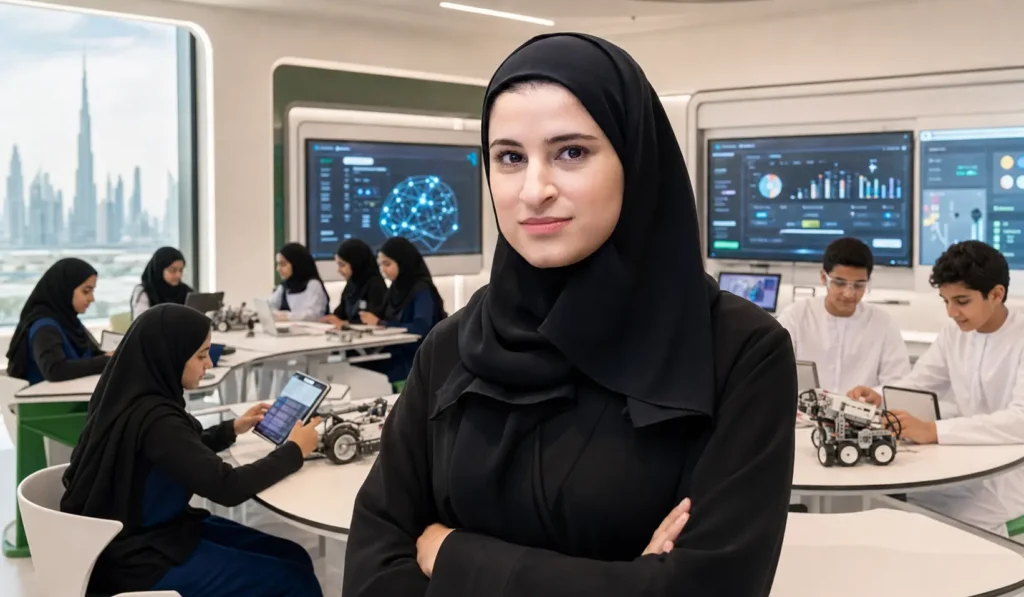
At the center of the UAE’s progress towards the education is Sarah bint Yousef Al Amiri, the current Minister of Education. Her career represents the nation’s rapid advancement in space exploration, advanced technology, and human capital development.
Understanding her leadership is essential for anyone tracking the UAE’s strategic goals for 2031 and beyond. Her journey from a software engineer to a global leader in space science provides a roadmap for how the UAE intends to integrate technology into every level of society. This article examines her career, the strategic decisions behind the Emirates Mars Mission, and her current mandate to reform the national education system.
Starting Out in the UAE’s First Earth Observation Satellite Projects
Sarah Al Amiri was born in 1987 and grew up in Abu Dhabi during a period of intense national development. Her interest in space began at age 12 after she saw a photograph of the Andromeda galaxy. However, at that time, the UAE did not have a formal space program, making a career in aerospace seem unrealistic.
She chose to pursue a Bachelor of Science in Computer Engineering at the American University of Sharjah, which she completed in 2008. She later earned a Master of Science in the same field from the same institution in 2014. Her academic training focused on systems design and computational structures, which became the foundation for her later work in satellite technology.
Her professional career began in 2009 when she joined the Emirates Institution for Advanced Science and Technology (EIAST), now the Mohammed bin Rashid Space Centre (MBRSC). She started as a software engineer, working on the UAE’s first Earth observation satellites, DubaiSat-1 and DubaiSat-2. These projects were critical for building the nation’s early technical capabilities in remote sensing and urban planning.
Sarah Al Amiri and the UAE’s Progress in Space, Science, and Education
The career of H.E. Sarah Al Amiri is marked by a series of rapid promotions and high-responsibility appointments. These milestones reflect the government’s trust in her ability to manage complex, multi-year projects.
- 2009: Joins EIAST as a software engineer for DubaiSat-1.
- 2011–2014: Serves as Head of Research and Development at MBRSC.
- 2014: Appointed Deputy Project Manager and Science Lead for the Emirates Mars Mission (Hope Probe).
- 2016: Appointed Head of the Emirates Scientist Council at age 29.
- 2017: Named Minister of State for Advanced Sciences in the UAE Cabinet.
- 2018: Becomes Chair of the UAE Council for the Fourth Industrial Revolution.
- 2020: Appointed Chairwoman of the UAE Space Agency and Minister of State for Advanced Technology.
- 2021: The Hope Probe successfully enters Mars orbit, making the UAE the fifth nation to reach the planet.
- 2022: Appointed Minister of State for Public Education and Advanced Technology and Chair of the Emirates Schools Establishment.
- 2024: Named Minister of Education of the United Arab Emirates.
This timeline illustrates a strategic move by the UAE government to place technically proficient leaders in roles that bridge the gap between science and policy.
The Hope Probe — Proving the UAE’s Ability to Deliver Complex Global Projects
The Emirates Mars Mission, known as the “Hope Probe,” was the most ambitious scientific project in the history of the Arab world. Al Amiri served as the Science Lead, overseeing the selection of instruments and the design of the mission’s orbital path. The mission was intended to coincide with the UAE’s 50th anniversary in 2021.
Unlike many previous Mars missions, the Hope Probe focused on a specific scientific gap: a comprehensive global map of the Martian atmosphere. The team wanted to understand how hydrogen and oxygen escape the planet and how the lower and upper atmospheres interact. To achieve this, Al Amiri coordinated an international team of 200 Emirati engineers and scientists in partnership with the University of Colorado Boulder, UC Berkeley, and Arizona State University.
The project was managed under strict budget and time constraints, which Al Amiri notes forced the team to innovate rather than follow traditional methods. The spacecraft was launched from Japan in July 2020 and successfully achieved orbit insertion in February 2021.
For investors and technology partners, the success of the Hope Probe proved the UAE could execute high-risk, large-scale international projects on time.
Strategic Planning in the UAE’s Space and Innovation Agenda — Sarah Al Amiri’s Role
The space program was never just about reaching Mars; it was a “shock to the system” designed to accelerate the UAE’s industrial and scientific development. Al Amiri has consistently argued that space exploration serves as a driver for economic diversification.
By investing in space, the UAE is fostering a private sector focused on satellite-enabled services and data analytics. The National Space Strategy 2030, which Al Amiri oversaw, aims for the space industry to contribute significantly to the national GDP. This strategy focuses on building national capabilities and encouraging startups to enter the aerospace sector.
Furthermore, the mission had a profound impact on gender representation in STEM. Women made up 80% of the Hope mission’s science team and 34% of the overall mission team. Al Amiri views this diversity as a practical necessity, as different perspectives are required to solve complex engineering problems.
How the UAE Is Leading the Fourth Industrial Revolution?
In her role as the Chair of the Fourth Industrial Revolution Council, Al Amiri has been responsible for integrating emerging technologies like AI, robotics, and quantum computing into the national infrastructure. This work is closely tied to her former position at the Ministry of Industry and Advanced Technology.
The goal is to increase the competitiveness of local industries by adopting advanced manufacturing techniques. This includes the “Make it in the Emirates” initiative, which encourages companies to manufacture high-tech products within the country. Al Amiri has also championed the use of advanced technology to address climate change, as seen during her participation in COP28.
Businesses should pay close attention to these changes as they will define the regulatory landscape for technology in the region.
Also Read: Mohamad Ballout With Kitopi Turned Empty Kitchens Into a Billion-Dollar Machine
Transformation of the National Education System
In July 2024, Al Amiri was appointed Minister of Education, a role that expanded her portfolio to include the entire public education system. This appointment followed a major restructuring that merged the Emirates Schools Establishment with the Ministry of Education.
Her mandate is to transform the education system to meet the needs of the future workforce. This involves:
- Curriculum Modernization: Integrating STEM and advanced technology into early childhood and secondary education.
- Teacher Training: Providing educators with the skills to teach modern scientific concepts.
- International Partnerships: Building ties with global educational institutions to bring best practices to the UAE.
Recently, she signed two Memoranda of Understanding with the Russian Ministry of Education to collaborate on scientific research and talent development. These agreements focus on student exchanges and specialized training in physics, chemistry, and computer science.
Featured Among the World’s Top Emerging Leaders
Al Amiri’s contributions have been recognized by numerous international organizations. In 2015, the World Economic Forum named her one of its 50 Young Scientists. In 2020, she was included in the BBC’s 100 Women list, and in 2021, she was named to the TIME 100 Next list of emerging leaders.
She has used this platform to advocate for international cooperation in space and science. Under her leadership, the UAE signed the Artemis Accords, committing to peaceful and transparent space exploration in collaboration with NASA and other global agencies. This international outreach is a core part of the UAE’s strategy to position itself as a global hub for innovation.
What Makes Long-Term Space Planning Under Sarah Al Amiri So Uncertain?
Despite the successes, the UAE’s ambitious programs face several challenges. Critics have pointed out a heavy reliance on foreign expertise and technology for the core components of the space program. While the Hope Probe was a UAE-managed project, its scientific instruments and launch vehicle were developed through international partnerships.
There is also the risk of economic volatility. Ambitious projects like the 2028 mission to the asteroid belt require sustained federal funding. If oil prices fluctuate significantly, the government may face pressure to reallocate resources away from prestige-driven science projects toward more immediate social needs.
Furthermore, Al Amiri herself has noted the “leaky pipeline” in STEM, where women drop out of technical programs before starting their careers. Addressing this systemic issue is critical for the long-term sustainability of the UAE’s knowledge economy.
Also Read: UAE Space Investment Trends and the Strategic Leadership of H.E. Dr. Ahmad Belhoul Al Falasi
Emirates Asteroid Belt Mission (2028–2034)
The UAE’s space ambitions do not end with Mars. The next major project is the Emirates Mission to the Asteroid Belt, scheduled for launch in 2028. This mission involves a flyby of Venus and six asteroids, culminating in a landing on a seventh asteroid in 2034.
This mission is even more technically complex than the Mars mission and is designed to further test the nation’s autonomous systems and deep-space navigation capabilities. In parallel, Al Amiri will continue her work in education, ensuring that the next generation of Emiratis is prepared to lead these types of ventures.
This trend of merging high-level science with national education policy could shape the market in the coming months as new procurement and research opportunities arise.
FAQs – Frequently Asked Questions
She is the Minister of Education for the United Arab Emirates, appointed in July 2024. She also chairs the UAE Space Agency and the UAE Council of Scientists.
She served as the Science Lead and Deputy Project Manager. She was responsible for the mission’s scientific objectives and the team that designed the Hope Probe’s instruments.
The mission was designed to provide the first global map of the Martian atmosphere and to act as a catalyst for the UAE’s transition to a knowledge-based economy.
The probe has provided the most precise mapping of “discrete auroras” on Mars and has detected variations in atomic oxygen and carbon monoxide in the atmosphere.
The UAE is planning a mission to the Asteroid Belt, scheduled to launch in 2028, which will visit seven asteroids and perform a landing on one of them.
As Minister of Education, she is focusing on curriculum modernization, integrating advanced technology into schools, and building international partnerships for teacher training and research.
Women made up 80% of the science team and 34% of the overall mission team, highlighting a significant focus on gender diversity in the UAE’s STEM sector.
She earned both her Bachelor’s and Master’s degrees in Computer Engineering from the American University of Sharjah.

Dwayne Paschke is a seasoned content strategist and AI automation specialist with over nine years of experience at the intersection of journalism and digital innovation. A versatile force in the media landscape, Dwayne has built a reputation as an expert content writer and investigative journalist, contributing high-impact pieces to various reputable news websites.