The global AI race is no longer confined to Silicon Valley.
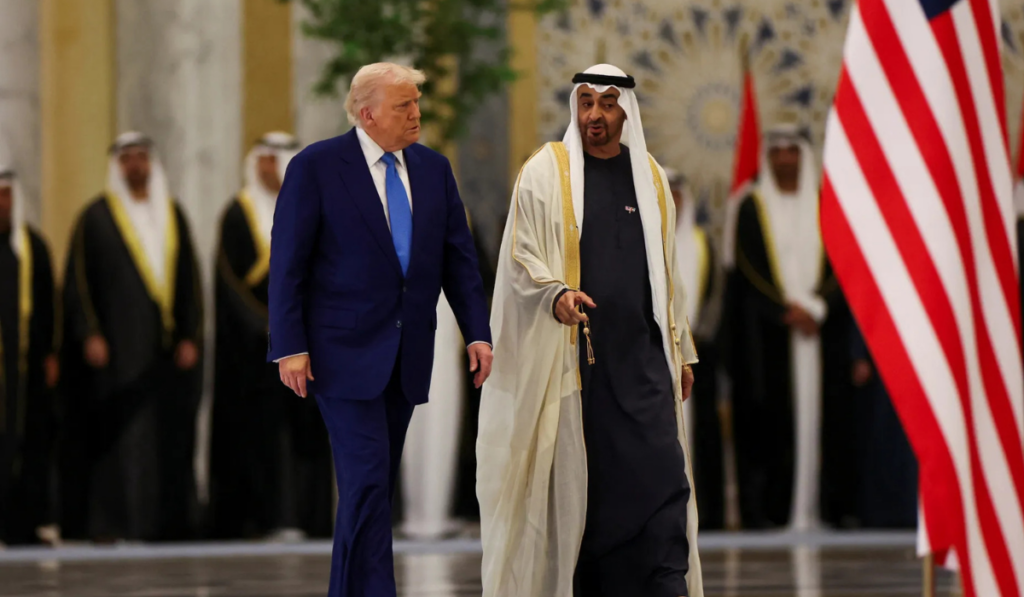
During his recent Middle East tour, former U.S. President Donald Trump signaled a strategic pivot: the United States is looking to the United Arab Emirates as a critical partner in expanding American AI influence beyond domestic borders.
According to a White House statement, the U.S. and the UAE agreed on approximately $200 billion in commercial deals. Among the most consequential components was an agreement to build what officials described as the largest AI campus outside the United States — alongside expanded access to advanced AI chips.
For the UAE, this marks a geopolitical breakthrough. Under previous export restrictions during the Biden administration, access to advanced semiconductor technology was more tightly controlled due to concerns about China ties. The new agreement signals a recalibration.
But this is not a sudden development. It is the culmination of a decade-long strategy.
The UAE’s Long-Term AI Strategy
The UAE appointed the world’s first Minister of Artificial Intelligence in 2017 — Omar Sultan Al Olama — signaling early intent to compete globally in emerging technologies.
The country formalized its ambitions under the UAE AI Strategy 2031, aiming to position itself as a global AI leader across healthcare, transport, energy, and government services.
More recently, the UAE made headlines through MGX — a state-backed AI investment firm — by participating in OpenAI’s $6.6 billion funding round, one of Silicon Valley’s largest capital raises. MGX operates with backing from major Abu Dhabi institutions, including Mubadala Investment Company.
This is not passive capital deployment. It is strategic positioning.
The Compute Advantage
One of the UAE’s most significant technological moves was the launch of Falcon — an open-source large language model developed by Abu Dhabi’s Technology Innovation Institute (TII). Falcon gained global attention for competing with leading Western models in benchmark performance.
Simultaneously, state-backed AI company G42 has been developing Arabic and Hindi language models to address gaps in non-English AI ecosystems.
Access to advanced chips — now reinforced through U.S.-UAE agreements — is critical. AI progress is constrained not just by talent, but by compute infrastructure.
Trump’s AI campus announcement effectively strengthens the UAE’s access to this strategic bottleneck.
Sovereign Wealth as AI Fuel
Unlike many emerging tech hubs, the UAE is not constrained by capital scarcity.
Abu Dhabi controls some of the world’s largest sovereign wealth funds, including the Abu Dhabi Investment Authority (ADIA) and Mubadala. These funds have historically diversified oil wealth into global assets.
Now, they are being redeployed into AI infrastructure, semiconductor investments, and research capacity.
According to a report by PwC, AI could contribute $96 billion to the UAE economy by 2030 — representing approximately 13.6% of its GDP.
This isn’t experimentation. It’s economic transformation.
The Talent Question
Capital and compute alone do not create AI ecosystems.
Between 2021 and 2023, the number of AI professionals in the UAE reportedly quadrupled to 120,000, according to remarks made by Al Olama at the Atlantic Council.
Policies such as the UAE’s Golden Visa program have streamlined long-term residency for highly skilled tech workers.
Educational infrastructure has also expanded. Institutions like Mohamed bin Zayed University of Artificial Intelligence (MBZUAI) — the world’s first graduate-level AI research university — and NYU Abu Dhabi have strengthened the research pipeline.
Still, critics point to labor-rights concerns affecting lower-skilled migrant workers, as highlighted by Human Rights Watch. The UAE has introduced labor reforms, but scrutiny remains.
For the country to sustain AI leadership, both high-skill attraction and systemic governance standards will matter.
Cooperation Over Competition
At the Atlantic Council, Al Olama framed AI not as a zero-sum competition, but as a network of global excellence nodes.
That framing is critical.
The UAE is unlikely to replace Silicon Valley. Instead, it is positioning itself as:
- A compute hub
- A capital hub
- A policy sandbox
- A bridge between East and West
Trump’s endorsement strengthens this intermediary role.
Why This Matters Geopolitically
AI is now infrastructure. It shapes defense systems, economic productivity, and geopolitical leverage.
By deepening ties with the UAE, the U.S. reinforces influence in a region where China has been expanding digital partnerships.
For the UAE, alignment with American AI infrastructure enhances credibility, access, and global positioning.
The result is not merely a campus.
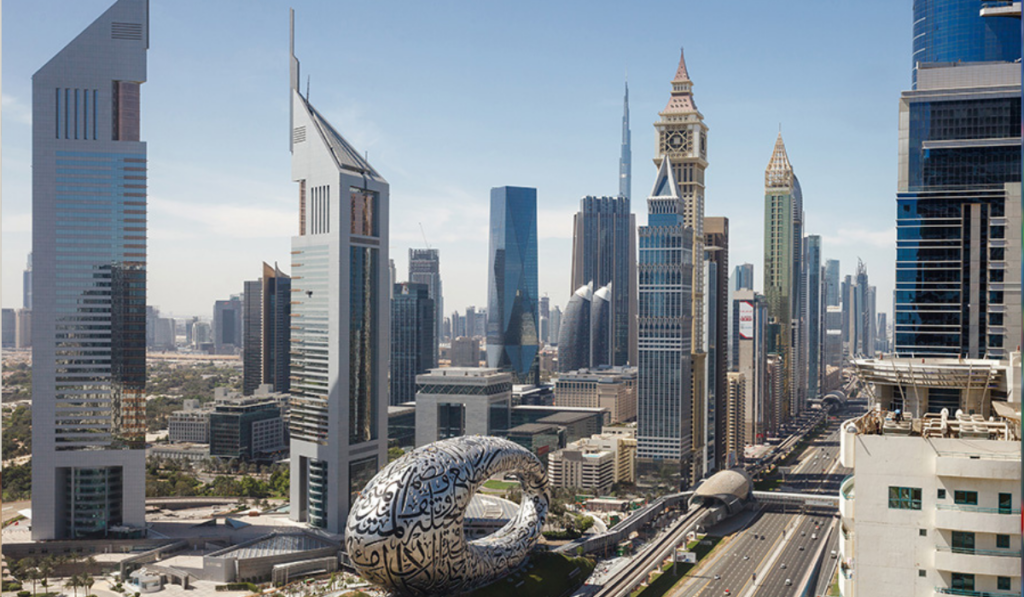
It is a strategic AI corridor linking Washington, Abu Dhabi, and global markets.
And in the next phase of AI expansion, geography may matter as much as algorithms.