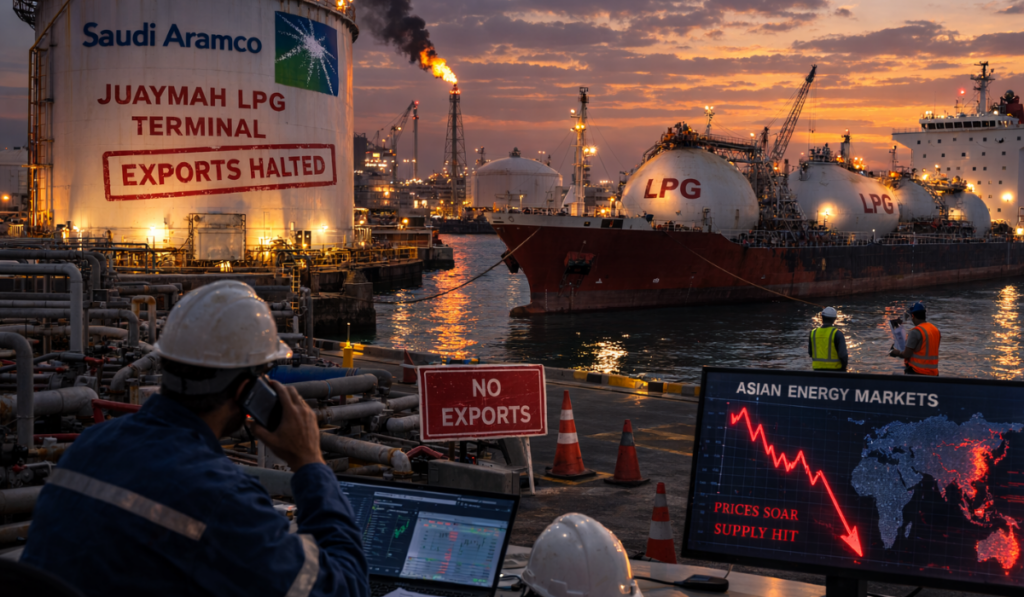
Saudi Arabia’s energy giant Saudi Aramco has suspended liquefied petroleum gas (LPG) exports from its Juaymah natural gas liquids (NGL) facility following structural damage to a segment of its delivery infrastructure — a move that is already tightening supply across key Asian markets.
In a statement, Aramco confirmed that on February 23, a section of the system transporting propane and butane at the Juaymah facility suffered structural damage.
While no leaks or injuries were reported, and domestic supply remains unaffected, the company has declared force majeure on shipments from the terminal.
Force majeure allows Aramco to suspend contractual delivery obligations due to unforeseen circumstances. For global LPG buyers, particularly in Asia, the declaration signals immediate supply risk.
Why Juaymah Matters
Located in eastern Saudi Arabia near the Jafurah gas field and the Ras Tanura refinery, Juaymah is one of the world’s largest export terminals for natural gas liquids.
According to shiptracking firm Kpler, Juaymah exported roughly 450,000 tonnes of LPG per month on average in 2024 and 2025. More than 60% of those exports were bound for India, while approximately 15% went to China.
Other key destinations include Japan and South Korea — markets heavily reliant on imported propane and butane for petrochemicals, heating, and industrial use.
While Aramco continues LPG exports from west coast facilities, Juaymah’s outage affects the kingdom’s eastern export flows — a critical corridor for Asian energy demand.
Immediate Market Reaction
The disruption has already rippled through pricing benchmarks.
Data from LSEG show that March propane futures on the Far East index surged nearly 5%, climbing above $590 per tonne — the highest level since April 2025.
Dubai-based energy trading firm NitrolTrading described the timing as particularly disruptive, noting that Saudi cargoes are critical during this seasonal demand window.
Asian importers often plan procurement cycles tightly around Saudi monthly contract pricing, making sudden cancellations difficult to absorb without turning to alternative suppliers such as Qatar, the United States, or the United Arab Emirates.
The Petrochemical Buffer
Saudi Arabia is not solely an exporter of LPG. It is also a major consumer.
The kingdom’s expansive petrochemical sector — anchored by companies like SABIC — can absorb part of its LPG output domestically. Analysts suggest that some volumes originally earmarked for export could be redirected internally, partially cushioning global impact.
However, for buyers dependent on contracted Saudi cargoes, replacement sourcing could come at a premium — particularly if U.S. Gulf Coast exports face logistical constraints or shipping bottlenecks.
Strategic Context: LPG in Asia
Asia accounts for the majority of global LPG demand growth, driven by:
- Residential fuel consumption in India
- Petrochemical feedstock demand in China
- Industrial use in South Korea and Japan
According to data from the International Energy Agency (IEA), LPG remains a critical transition fuel across emerging Asian economies.
Saudi Arabia has historically been a cornerstone supplier in this ecosystem, often shaping monthly contract pricing that influences regional benchmarks.
A prolonged disruption at Juaymah would therefore not only affect volumes, but potentially pricing structures across Asia.
How Long Will It Last?
Aramco has not disclosed a timeline for repairs, stating only that corrective measures are under evaluation.
Market impact will hinge on three variables:
- The severity of structural damage
- The speed of engineering remediation
- Availability of replacement cargoes from alternative exporters
If repairs are swift, price volatility could stabilize. If delays extend into multiple loading cycles, buyers may accelerate diversification strategies.
Broader Energy Market Implications
This incident underscores the fragility of global energy logistics.
Even in an era of diversified supply chains, infrastructure bottlenecks at single high-capacity terminals can shift regional balances quickly.
The Juaymah halt also serves as a reminder that energy security increasingly depends on:
- Infrastructure resilience
- Distributed export capacity
- Flexible contracting frameworks
For Asian importers, this disruption may reinforce the importance of strategic reserves and diversified supplier portfolios.
For Saudi Arabia, it highlights the importance of maintaining operational redundancy across export terminals.
The Bottom Line
Saudi Aramco’s suspension of Juaymah LPG exports may be temporary, but its ripple effects are already visible in Asian energy markets.
With propane prices climbing and cargoes canceled under force majeure, regional buyers are adjusting procurement strategies in real time.
Whether the disruption proves brief or extended, one reality remains clear:
In global energy markets, infrastructure reliability is as critical as production capacity.