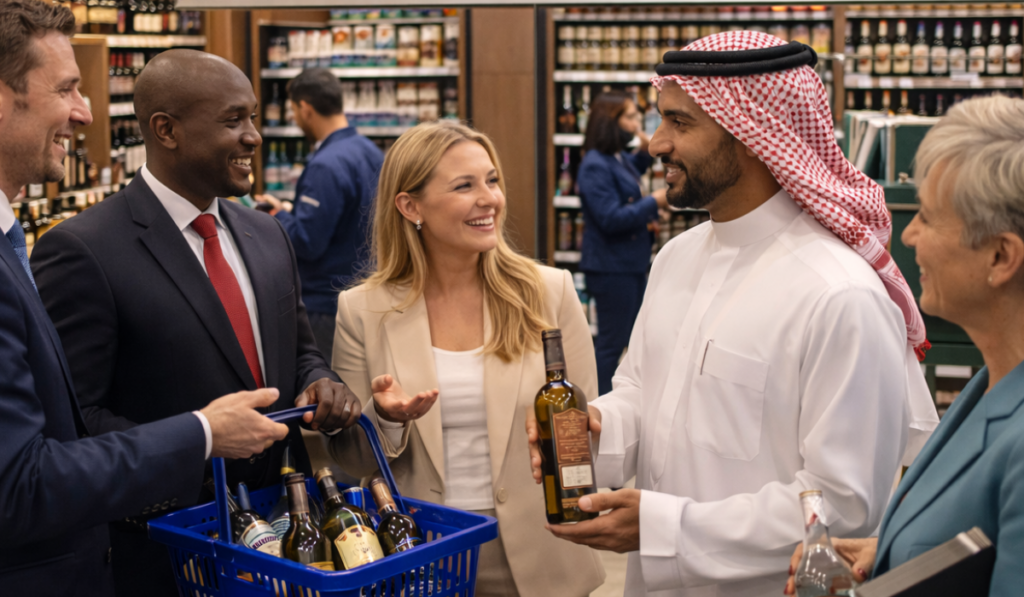
Saudi Arabia is preparing to open its first officially licensed alcohol retail outlet in Riyadh, marking a notable regulatory development within the Kingdom’s evolving economic framework. The move was first reported by Reuters, citing a source familiar with the matter.
According to the report, the store will be located in Riyadh’s Diplomatic Quarter and will serve exclusively non-Muslim diplomats. Access will be tightly regulated, with customers required to register via a government-linked mobile application and obtain prior clearance from the Ministry of Foreign Affairs.
The development reflects a controlled policy adjustment rather than a broader liberalization of alcohol laws. Alcohol remains prohibited for the general population under Saudi law, which is based on Islamic principles. The new retail outlet is expected to operate under strict supervision and quota limitations.
A Highly Restricted Framework
Under the reported guidelines, diplomats will be required to:
- Register through a designated mobile platform
- Secure a government-issued clearance code
- Adhere to monthly purchase quotas
The facility will operate within the Diplomatic Quarter — an area housing foreign embassies and diplomatic missions — and access will reportedly remain limited to non-Muslim embassy personnel.
The Center for International Communication (CIC) has indicated that updated regulatory measures aim to streamline alcohol access for diplomatic missions while addressing unauthorised imports through diplomatic consignments. The reforms are designed to align with international diplomatic conventions while tightening oversight mechanisms.
Economic Reform Context
The move comes amid Saudi Arabia’s broader economic transformation under Vision 2030, a national reform plan launched to diversify the Kingdom’s economy beyond oil dependency.
Vision 2030 includes major initiatives in tourism, foreign investment, infrastructure and entertainment. Riyadh has already seen the introduction of large-scale cultural events, international sporting tournaments and regulatory updates intended to attract global capital and talent.
However, the reported alcohol outlet should not be interpreted as a shift in public policy for residents. Saudi Arabia continues to prohibit alcohol consumption for its citizens and Muslim residents, and there has been no official indication that the policy will change beyond diplomatic allowances.
Most expatriates living in Saudi Arabia are Muslim workers from countries including Egypt, Pakistan, India, and Bangladesh, meaning access is expected to remain limited to a very small segment of the population.
Regulatory Control and Illicit Trade
One driver behind the change appears to be enforcement. Historically, some alcohol has entered the Kingdom through diplomatic shipments, which have occasionally resulted in grey-market distribution.
By introducing a monitored retail system with quota controls, authorities may be seeking to:
- Centralise oversight
- Reduce unregulated supply channels
- Strengthen customs compliance
Such measures would allow diplomatic access within defined boundaries while limiting misuse.
Balancing Reform and Tradition
Saudi Arabia’s leadership has consistently framed reforms as economic modernisation rather than cultural overhaul. The introduction of entertainment venues, cinemas and international tourism visas over recent years demonstrates a calibrated approach to reform.
The reported alcohol outlet fits within that pattern: tightly controlled, diplomatically focused, and aligned with international practice — without altering domestic social norms.
As of now, there has been no formal public confirmation regarding an opening date. Sources cited by Reuters suggest the store could begin operations in the coming weeks.
The development underscores the Kingdom’s attempt to balance economic competitiveness with regulatory and cultural continuity.
Sources

UK-based journalist covering UAE entrepreneurship, executive branding, and leadership growth across global business ecosystems.