Swedish freight technology company Einride has secured an oversubscribed $113 million PIPE (private investment in public equity) ahead of its planned public listing in 2026 — a move that says less about hype and more about strategic endurance.
The company confirmed the raise as part of its merger with Legato Merger Corp., the special purpose acquisition company (SPAC) that will take Einride public on the New York Stock Exchange in the first half of 2026.
The new funding exceeds Einride’s original $100 million PIPE target and brings total transaction-linked capital to approximately $213 million, including previously announced crossover financing. If Legato’s trust proceeds hold, gross transaction proceeds could reach roughly $333 million before redemptions and expenses.
But beyond the numbers lies a more interesting story: resilience in a sector that has tested founder credibility.
From Futuristic Pods to Real Fleets
Founded in 2016 by Robert Falck, Einride differentiated itself early by developing electric freight trucks and autonomous “pods” with no cabin for a human driver — a radical rethinking of freight architecture.
Unlike competitors who retrofitted autonomy into traditional truck cabins, Einride designed from scratch for a software-first, electrified future.
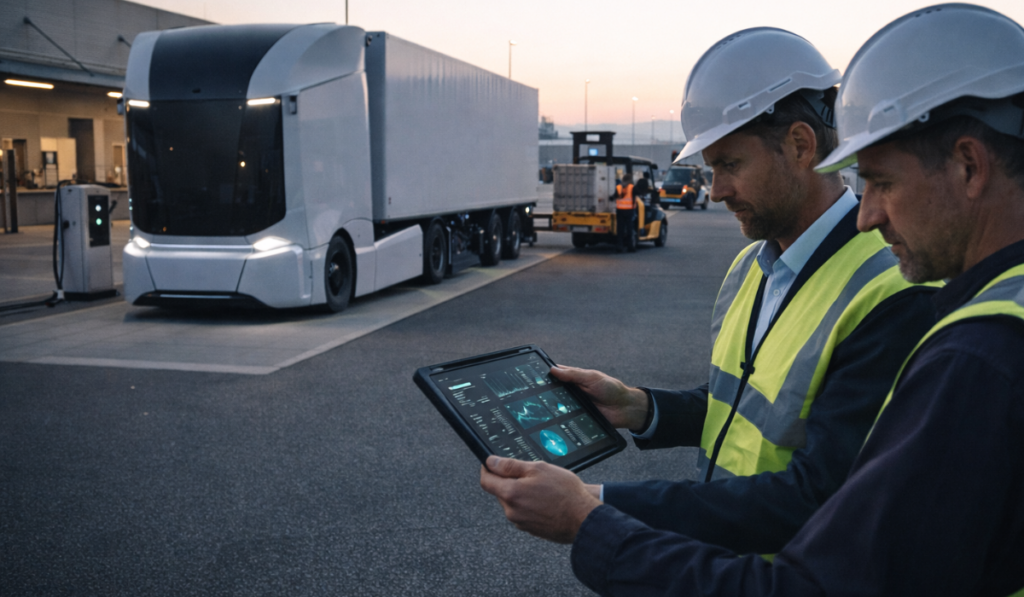
Today, the company operates approximately 200 heavy-duty electric trucks across Europe, North America and the UAE. Customers include PepsiCo, Heineken, Carlsberg Sweden and DP World — signaling real commercial traction beyond pilot hype.
Autonomous pod deployments remain limited but notable, including trials with Apotea in Sweden and GE Appliances in the United States.
This hybrid strategy — electrification today, autonomy tomorrow — may prove to be the company’s most strategic decision.
Valuation Reset, Not Retreat
Einride’s SPAC transaction values the company at a pre-money valuation of $1.35 billion, down from the earlier $1.8 billion target. In 2021’s exuberant climate, such a reset might have been perceived as weakness.
In 2025, it signals realism.
The autonomous vehicle sector has seen dramatic recalibrations since the 2020–2021 SPAC boom. Companies like Aurora Innovation went public at multibillion-dollar valuations before scaling back expectations. Others, including Kodiak Robotics, also pursued SPAC routes as public capital markets tightened.
According to data from Crunchbase News, investor appetite has shifted toward companies with visible commercial deployment rather than purely developmental roadmaps.
Einride’s ability to secure an oversubscribed PIPE in this environment suggests investors see execution — not just vision.
Leadership in Capital Discipline
Robert Falck’s leadership style has remained notably understated compared to some autonomous-tech peers.
Rather than positioning autonomy as an immediate replacement for drivers, Einride has focused on building revenue through electric fleets, charging infrastructure, and freight management software.
The PIPE includes participation from new and existing investors, including Stockholm-based EQT Ventures and a U.S.-based global asset manager — reinforcing institutional confidence.
The capital will fund technology development, international expansion and scaled autonomous deployments in North America, Europe and the Middle East.
But the real challenge lies ahead: public market scrutiny.
The Bigger Innovation Trend
Einride sits at the intersection of three macro shifts:
- Freight electrification
- Autonomous logistics
- AI-driven supply chain optimization
As sustainability mandates tighten globally and corporations commit to net-zero targets, electrified freight fleets are becoming operational imperatives rather than PR exercises.
At the same time, labor shortages in trucking across Europe and North America create structural pressure toward automation.
Governments are also investing heavily in smart logistics infrastructure, particularly in regions like the UAE, which has positioned itself as a mobility innovation hub.
The autonomous freight race is no longer about futuristic prototypes — it’s about economic viability.
Why This Founder Matters for 2026
In 2026, the companies that survive the autonomous reset will be those that built real revenue before promising autonomy at scale.
Falck’s approach — deploying electric fleets now while methodically advancing autonomy — may prove more sustainable than competitors who bet everything on rapid driverless rollout.
The $113 million PIPE is not just bridge financing. It is a vote of confidence that disciplined execution can still attract capital in a sector where hype has cooled.
If Einride can convert SPAC capital into scaled commercial operations — especially in North America and the Middle East — it could become one of the few autonomous logistics players to emerge stronger from the post-valuation-reset era.
The freight industry rarely makes headlines. But the transformation of how goods move may define the next decade of industrial innovation.
And Einride is placing a measured, electrified bet on that future.

UK-based journalist covering UAE entrepreneurship, executive branding, and leadership growth across global business ecosystems.