When Deepinder Goyal stepped down earlier this year as CEO of Zomato — now operating under parent entity Eternal — many assumed the Indian entrepreneur would pivot into investing quietly.
Instead, he has returned with something far more ambitious: a $54 million friends-and-family raise for Temple, a brain-monitoring wearable startup targeting elite performance athletes.
According to regulatory filings reviewed by TechCrunch, Temple closed the round at a post-money valuation of approximately $190 million. Goyal is leading the funding round himself, joined by investors including Steadview Capital, Peak XV Partners (formerly Sequoia India), InfoEdge Ventures, Dharana Capital, and a cohort of India’s most prominent founders.
Notably, over 30 employees participated at the same valuation — signaling internal conviction in the product’s future.
But this isn’t just another wearable startup story.
It’s a founder reinvention play.
From Food Delivery to Brain Monitoring
Goyal built Zomato into one of India’s largest consumer technology companies after co-founding it in 2008. Under his leadership, Zomato expanded aggressively, acquiring Uber Eats India in 2020 and grocery platform Blinkit (formerly Grofers) in a $568 million deal in 2022.
In January 2026, Goyal handed CEO duties to Albinder Dhindsa, head of Blinkit, marking the end of nearly two decades of operational leadership.
Temple represents the clearest articulation of what he previously described as a move toward “higher-risk exploration and experimentation.”
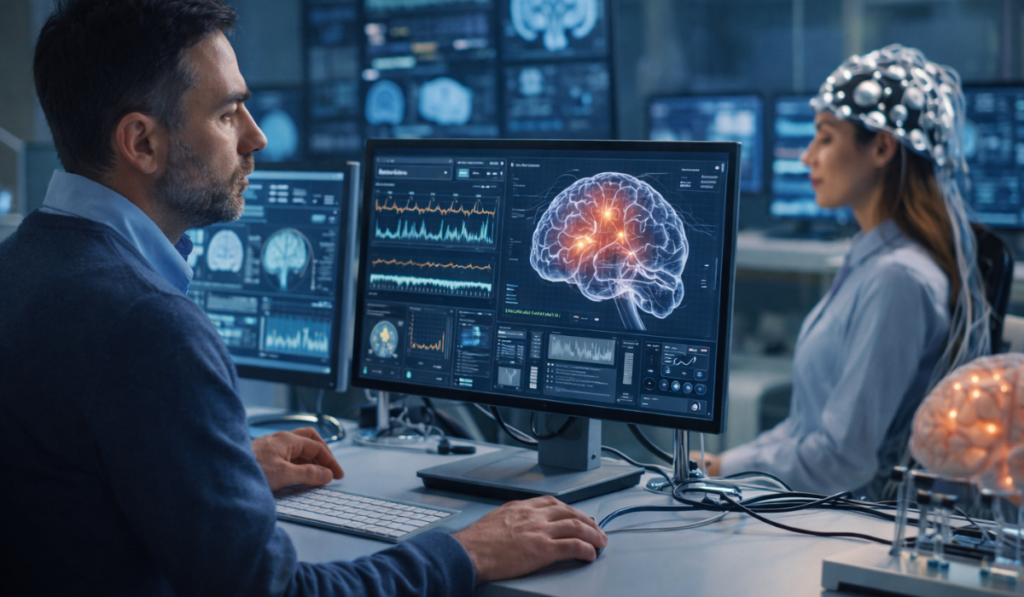
The device Temple is building is reportedly designed to sit on the wearer’s temple and continuously track cerebral blood flow — a metric not typically captured by mainstream wearables like Whoop, Oura, or Garmin.
If successful, the device could push wearables beyond heart rate and sleep tracking into neurological performance monitoring.
That’s a far more complex — and controversial — frontier.
The Brain Is the Last Performance Frontier
Elite sports performance is already saturated with biometric data. Recovery scores, HRV tracking, glucose monitoring — these are mature categories.
But cerebral blood flow monitoring ventures into brain-computer interface territory — an area increasingly explored by companies like Neuralink and other neurotechnology firms.
Temple, according to Goyal’s public comments, aims to measure neurological metrics existing devices cannot.
If validated scientifically, this could unlock:
- Enhanced cognitive recovery tracking
- Real-time fatigue detection
- Concussion or micro-impact monitoring
- Neural focus optimization
However, brain-signal measurement is notoriously difficult. Signal noise, motion interference, and calibration challenges have limited consumer-scale neuro-wearables historically.
Temple will need to demonstrate not just innovation — but reproducibility and regulatory viability.
The Founder Pivot: From Scale to Speculation
Temple is part of a broader pattern in Goyal’s recent portfolio.
In October 2025, he committed $25 million of his own capital into Continue Research, a longevity-focused venture exploring lifespan extension. He is also linked to aviation startup LAT Aerospace, which recently expanded into defense technologies.
This shift suggests a deliberate move away from hyper-growth consumer marketplaces toward frontier science and performance technology.
For founders exiting large-scale platforms, this pivot is becoming common:
- Move from operational scale
- To deep tech speculation
- Backed by personal capital
It signals a maturing founder class in India — one willing to reinvest gains into high-risk R&D sectors rather than incremental SaaS plays.
Why Temple Is a High-Risk, High-Reward Play
The wearables market remains competitive and heavily funded. According to reports cited by CB Insights, the global wearable technology market continues to expand, but differentiation has narrowed.
Temple must answer three questions:
- Can it measure cerebral blood flow accurately in real-world athletic environments?
- Will elite athletes adopt neuro-monitoring as part of training?
- Can it expand beyond niche performance markets into broader health tech?
Without clear clinical validation, the company risks becoming a speculative hardware experiment.
With validation, it could redefine performance tracking.