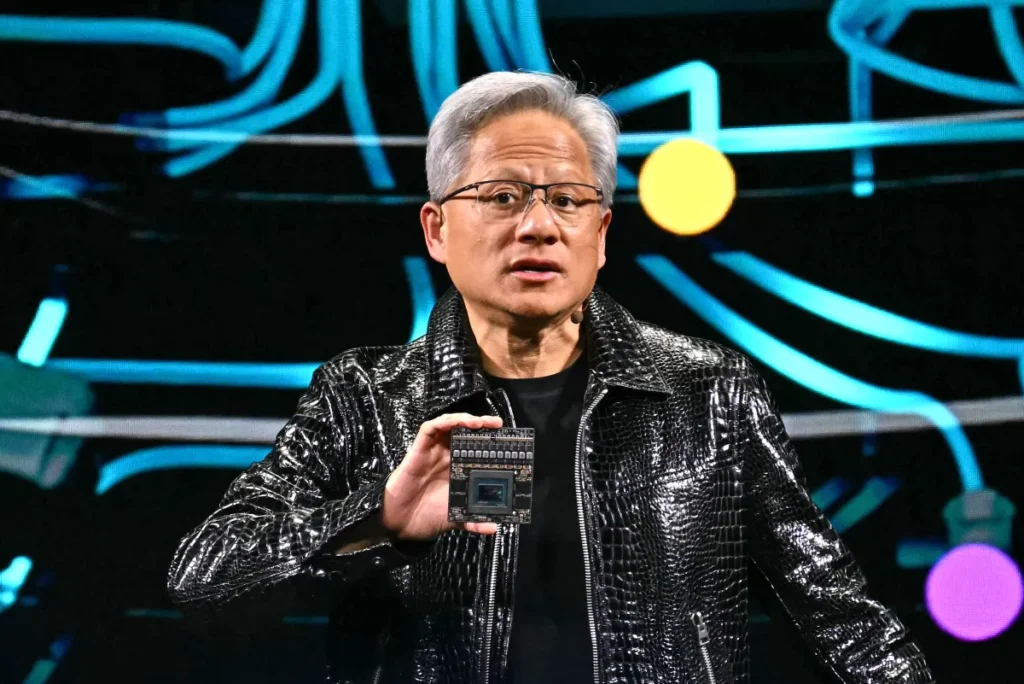
Nvidia CEO Jensen Huang has suggested that the company may be stepping back from further investments in leading artificial intelligence startups OpenAI and Anthropic, raising new questions about the evolving dynamics of the global AI industry.
Speaking at the Morgan Stanley Tech, Media and Telecom Conference in San Francisco, Huang indicated that Nvidia’s most recent investments in both companies could be its last.
According to Huang, once these AI firms go public — a possibility widely discussed by analysts — the opportunity for Nvidia to continue investing in them as private companies would effectively close.
While the explanation appears straightforward, the comments have prompted debate among industry observers who believe deeper strategic considerations may be influencing Nvidia’s decision.
Nvidia’s Expanding Role in the AI Ecosystem
Nvidia has emerged as one of the most influential companies in the artificial intelligence sector due to its dominance in high-performance graphics processing units (GPUs).
These chips power the massive computing infrastructure required by AI platforms, including those operated by OpenAI and Anthropic.
Demand for Nvidia’s AI chips has surged in recent years as companies race to build increasingly powerful large language models and generative AI tools. Products such as ChatGPT and Claude rely heavily on advanced GPU infrastructure, positioning Nvidia at the center of the AI boom.
Because of this unique position, Nvidia’s investments in AI companies have been viewed by analysts as both financial bets and strategic partnerships designed to expand the company’s broader ecosystem.
During Nvidia’s fourth-quarter earnings discussion, Huang emphasized that the company’s investments are aimed at strengthening its role within the AI ecosystem.
According to comments shared in the earnings call transcript, Nvidia focuses its investments on expanding partnerships that drive long-term adoption of its hardware and computing platforms.
Complex Financial Relationships
The financial relationships between Nvidia and major AI developers have sometimes appeared unusually circular.
For example, when Nvidia initially announced plans to invest heavily in OpenAI, observers noted that OpenAI itself was expected to spend enormous sums purchasing Nvidia chips to power its AI systems.
Professor Michael Cusumano of MIT Sloan School of Management previously described the arrangement to the Financial Times as almost self-balancing, noting that the financial flows between the companies could effectively offset one another.
Earlier reports suggested Nvidia might invest as much as $100 billion in OpenAI, although the company ultimately participated in a smaller investment round tied to OpenAI’s recent $110 billion funding raise.
Such dynamics have led some analysts to speculate about the possibility of inflated valuations or investment bubbles forming within the rapidly expanding AI sector.
Tensions Emerging in the AI Landscape
Nvidia’s relationship with Anthropic has also faced scrutiny. Shortly after Nvidia announced a major investment in the company, Anthropic CEO Dario Amodei sparked controversy during remarks at the World Economic Forum in Davos.
Amodei warned about the risks of exporting powerful AI chips to certain international markets, comparing the sale of advanced processors to potentially dangerous geopolitical actions.
Although Nvidia was not explicitly named, the comments highlighted growing ethical and political debates surrounding the global AI supply chain.
Meanwhile, the competitive landscape between AI developers has intensified. Anthropic’s Claude AI assistant recently surged in popularity in the U.S. Apple App Store rankings, briefly overtaking OpenAI’s ChatGPT following renewed public attention around the companies’ differing approaches to government partnerships and AI deployment.
These developments illustrate how alliances in the AI industry can quickly evolve into complex competitive relationships.
A Strategic Exit or a Natural Investment Cycle?
Huang’s explanation that Nvidia’s investments may end as these companies approach potential public offerings has not fully convinced some industry analysts. In the venture capital world, investors frequently continue funding late-stage private companies right up to the point of their initial public offering.
However, Nvidia’s situation may be different. The company is already generating enormous revenue by supplying the hardware that powers the AI revolution.
As demand for Nvidia chips continues to rise globally, the company may have little financial incentive to expand its equity exposure in AI startups.
Instead, maintaining strong commercial partnerships with AI developers could prove more strategically valuable than increasing ownership stakes.
For now, Nvidia remains deeply intertwined with the future of artificial intelligence infrastructure. Whether Huang’s remarks signal a long-term strategic shift or simply reflect the natural evolution of investment cycles remains uncertain.
What is clear is that Nvidia’s role as the backbone of the AI industry ensures it will remain closely connected to the fortunes of companies like OpenAI and Anthropic — regardless of whether it continues investing in them directly.

Aisha Al Mansoori is a UAE-based business and technology analyst covering startups, venture capital, AI, fintech, and innovation trends shaping the Emirates’ economy.