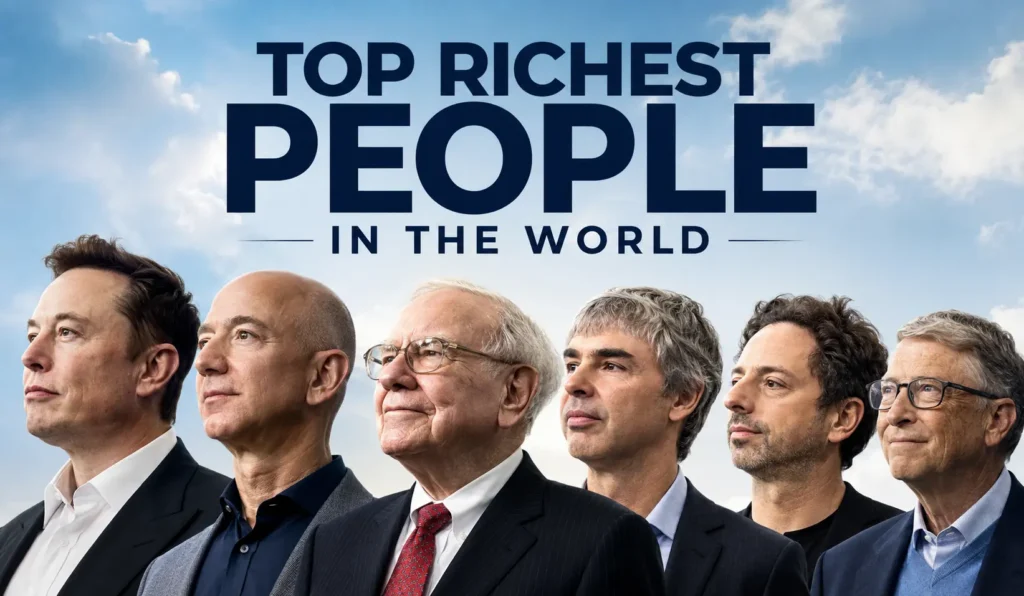
The 40th annual Forbes Billionaires List is the most dramatic wealth concentration in recorded history. 3,428 people now hold a combined $20.1 trillion, more than the GDP of the United States. Technology, AI, and luxury goods drove the biggest gains. Here is every name, every number, and what it means.

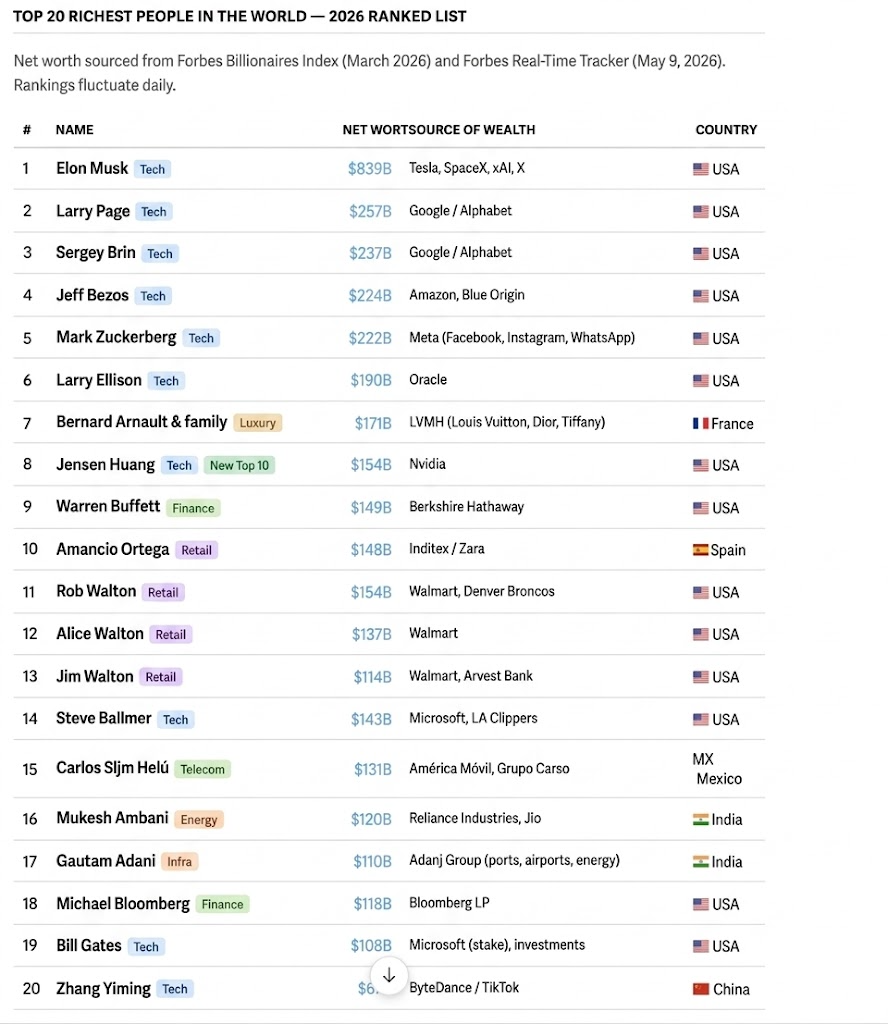
20 Richest People in the World – 2026 Ranked List
Net worth figures sourced from Forbes Billionaires Index (March 2026) and Forbes Real-Time Tracker (May 9, 2026). Rankings fluctuate daily with market movements.
Profile: #1 – Elon Musk ($839 billion)
Net worth: $839 Billion
Tesla · SpaceX · xAI · X · The Boring Company · USA
- Peak 2026: $841.2B (March)
- SpaceX valuation: ~$800B
- SpaceX stake: ~$366B of total
- Distance to $1T: $161B
No individual in history has accumulated wealth at the velocity Musk has achieved since 2020. His empire now spans five major enterprises: Tesla (electric vehicles and energy), SpaceX (launch services and Starlink internet), xAI (artificial intelligence), X (formerly Twitter), and The Boring Company. SpaceX alone carries a private valuation of approximately $800 billion, the largest private company on Earth by that metric.
Industry analysts note that $366 billion of Musk’s net worth is tied directly to his SpaceX stake. If SpaceX executes its anticipated IPO at a $1.5 trillion valuation, Musk would become the world’s first trillionaire. His May 2026 net worth of $839 billion already sits $161 billion short of that threshold. On-the-ground tracking by Forbes shows his peak net worth was $841.2 billion in March 2026, before modest Tesla stock fluctuations pulled it back slightly.
Profile: #2 – Larry Page
Net worth: $257 Billion
Google / Alphabet · USA
- Founded Google: 1998
- Left CEO role: 2019
- First time at #2: 2026
Larry Page co-founded Google with Sergey Brin in 1998 while both were PhD students at Stanford University. He co-created the PageRank algorithm, the core technology behind Google Search, and served as Google’s CEO twice: from 1997 to 2001, then again from 2011 until 2015 when he became CEO of Alphabet Inc. Following Google’s mid-November 2025 launch of the Gemini 3 model, markets re-rated Alphabet’s AI infrastructure spending, which crossed $50 billion in capital expenditure in 2025. His personal investments extend into flying car startups Kitty Hawk and Opener, but the Alphabet stake is the overwhelming driver of his $257 billion fortune.
Profile: # 3 – Sergey Brin
Net worth: $237 Billion
Google / Alphabet · USA (born USSR)
- 2025 wealth gain: +$92.3B
- Returned to Alphabet: Dec 2023
- Immigrated to USA: Age 6
Sergey Brin immigrated to the United States from the Soviet Union at age six, following his father’s path into mathematics and computer science. He met Larry Page at Stanford in 1995 and together they built Google, which launched publicly in 1998 after Brin discontinued his PhD. Brin’s 2026 net worth of $237 billion reflects a $92.3 billion increase from 2025, making him the second-biggest individual wealth gainer among the top 10. His fortune is almost entirely derived from his Alphabet equity stake, making his net worth one of the most direct proxies for Google’s market performance available to public market observers.
Profile: # 4 – Jeff Bezos
Net worth: $224 Billion
Amazon · Blue Origin · Project Prometheus · USA
- Amazon founded: 1994
- Amazon stake: ~10%
- Was #1 in 2020 at: $145B
Jeff Bezos founded Amazon in 1994 out of a garage in Seattle after leaving his role as senior vice president at investment firm D.E. Shaw. He stepped down as CEO in July 2021, transitioning to Executive Chairman while Andy Jassy took over daily operations. Bezos owns Blue Origin, his commercial space company, and in November 2025 launched Project Prometheus. He also owns The Washington Post, purchased in 2013 for $250 million. In 2020, Bezos was the richest person alive at $145 billion. By May 2026, his fortune has grown 54% to $224 billion, yet he has dropped from first to fourth, a measure of how much faster the AI-era billionaires have moved.
Profile: # 5 – Mark Zukerberg
Net worth: $222 Billion
Meta (Facebook, Instagram, WhatsApp, Reality Labs) · USA
- Meta stake: ~13%
- Daily active users: 3.2B+
- 2022 low point: ~$38B
Mark Zuckerberg’s 2026 net worth of $222 billion represents one of the most dramatic recoveries in technology sector history. In 2022, Meta’s share price fell approximately 65% as his expensive bet on the metaverse came under severe investor scrutiny; at one point, his fortune dropped below $40 billion. Zuckerberg co-founded Facebook at Harvard University in February 2004. He controls Meta through a dual-class share structure that gives him majority voting power despite owning approximately 13% of the equity. Meta’s AI investments, including the open-source Llama model series and AI assistant integrations across Facebook, Instagram, and WhatsApp.
Profile: # 6 – Larry Ellison
Net worth: $190 Billion
Oracle · Tesla (investor) · USA
- Oracle market cap: ~$400B
- CEO tenure: 1977–2014
- Owns ~98% of Lanai, Hawaii
Larry Ellison is the co-founder, executive chairman, and chief technology officer of Oracle Corporation, the enterprise database and cloud software company he built from a two-person startup in 1977 into a $400 billion market-cap giant. Oracle’s growth since has been driven by aggressive cloud adoption and AI infrastructure positioning. Ellison is a significant Tesla investor and is actively involved in AI and defense technology projects. His net worth reached $199.5 billion in March 2026 before settling to $190 billion by May. His personal holdings include an estimated 98% ownership of the Hawaiian island of Lanai purchased for approximately $300 million in 2012 along with extensive California real estate.
Profile: # 7 – Bernard Arnauld & Family
Net worth: $170 Billion
- Was #1 in: 2023–2024
- LVMH revenue 2024: €90B+
- LVMH brands: 75
Bernard Arnault was the world’s richest person as recently as 2024, the first French citizen and first non-American to hold that position in the modern era. His fall from the top spot reflects the relative underperformance of luxury goods against technology in 2025, not any structural weakness at LVMH. The conglomerate controls 75 luxury houses including Louis Vuitton, Christian Dior, Moët Hennessy, Bulgari, Tiffany & Co., TAG Heuer, Givenchy, and Sephora. LVMH revenue topped €90 billion in 2024. His five children Antoine, Delphine, Alexandre, Frédéric, and Jean each hold senior roles within the LVMH empire, and succession planning at the group is increasingly viewed by markets as a major medium-term variable for the stock.
Profile: #8 – Jensen Huang, Nvidia
Net worth: $154 Billion
- Net worth in 2020: $4.7B
- 6-year growth: ~30x
- Nvidia stake: ~3%
- Nvidia market cap peak: $3.5T
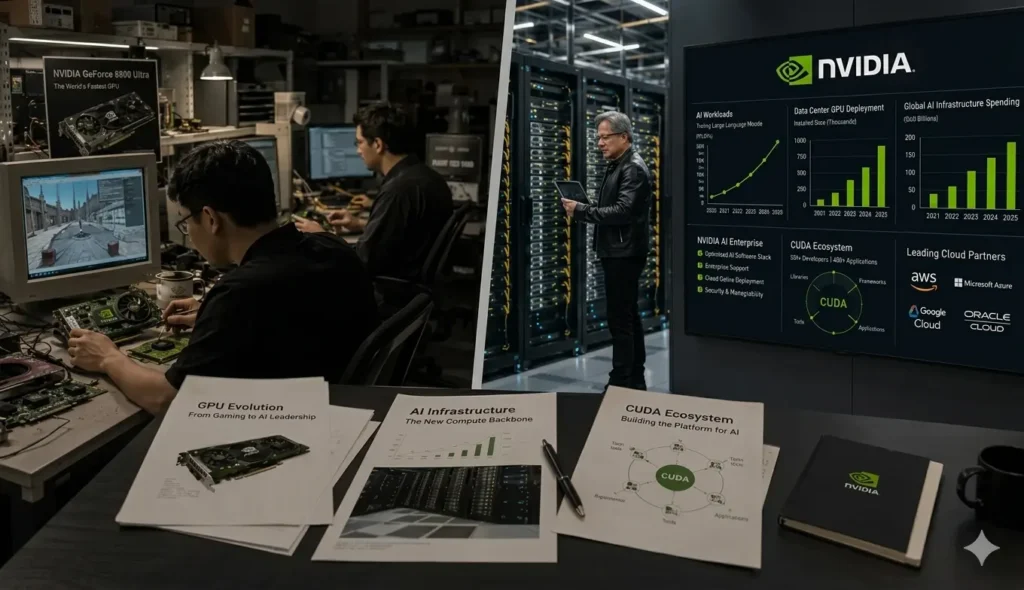
Jensen Huang’s entry into the Forbes top 10 is the defining wealth story of the AI era. In 2020, he was worth $4.7 billion, a figure that placed him well outside the top 100. By 2026, that number reached approximately $154–162 billion. Huang co-founded Nvidia in 1993 and has served as its CEO since day one, a 30-plus-year unbroken tenure at a company he grew from a three-person startup into the world’s most valuable semiconductor company, briefly crossing $3.5 trillion in market capitalization during 2025. Born in Tainan, Taiwan, Huang moved to the United States as a child and holds an undergraduate degree from Oregon State University and a master’s from Stanford.
Profile: # 9 – Warren Buffett
Net worth: $149 Billion
- Retired as CEO: Jan 1, 2026
- Berkshire market cap: $1T+
- 60-year return: 5,502,284%
- Donated: $58B+ lifetime
On January 1, 2026, after 56 years, he officially retired as Chairman and CEO of Berkshire Hathaway, handing leadership to his long-prepared successor Greg Abel. At 95, he remains Berkshire’s largest shareholder. Between 1964 and 2024, Buffett grew Berkshire’s per-share value by 5,502,284%, averaging 19.9% annually against the S&P 500’s 10.4%. Berkshire’s portfolio which includes Apple, Coca-Cola, American Express, Bank of America, and GEICO among its major holdings sits within a company now valued at over $1 trillion. Buffett has donated more than $58 billion to charitable causes, approximately 37% of his peak wealth, primarily to the Bill & Melinda Gates Foundation and his children’s foundations. At 95 years old and $149 billion in net worth, he remains the greatest argument for power.
Profile: #10 – Amancio Ortega
Net worth: $148 Billion
- Inditex stake: ~59%
- Inditex stores: 5,800+ in 96 markets
- First Zara store: 1975
Amancio Ortega is the founder of Inditex, the Spanish fashion conglomerate whose flagship brand Zara redefined the economics of global apparel retail. He launched his first clothing operation in 1963, opened the first Zara store in A Coruña, Spain, in 1975, and built the company into the world’s largest fashion retailer by revenue. Inditex now operates over 5,800 stores across 96 markets under brands including Zara, Pull&Bear, Massimo Dutti, Bershka, and Zara Home. He owns approximately 59% of Inditex and has rarely spoken publicly throughout his career For regional business leaders, his trajectory is a reminder of supply-chain dominance, executed with discipline over decades.
Profile: # 11 – Rob Walton
Net worth: $154 Billion
Walmart · Denver Broncos · USA
- Walmart revenue: $650B+
- Denver Broncos purchase: $4.65B (2022)
- Walmart chairman: 1992–2015
Rob Walton is the eldest son of Walmart founder Sam Walton and served as the company’s chairman from 1992 to 2015. Along with siblings Alice and Jim, he retains a significant Walmart equity stake reflecting decades of share appreciation in what remains the world’s largest company by revenue, generating more than $650 billion in annual sales. In 2022, Rob co-led a group that purchased the Denver Broncos NFL franchise for $4.65 billion, the highest price paid for a sports franchise at that time.
Profile: #12 – Alice Walton
Net worth: $137 Billion
Walmart · USA
- Richest woman in the world 2026
- Crystal Bridges Museum: founded by her
Alice Walton is the richest woman in the world in 2026. Unlike her brothers, she has never held an executive role at Walmart, instead pursuing a parallel career as an arts philanthropist. She founded Crystal Bridges Museum of American Art in Bentonville, Arkansas, a world-class institution housing works ranging from colonial portraiture to contemporary installation art, and which has made high-quality art publicly accessible in a region without a prior major museum tradition. She also provided $15 million in initial funding for the Northwest Arkansas Regional Airport.
Profile: # 13 – Jim Walton
Net worth: $114 Billion
Walmart · Arvest Bank · USA
- Arvest Bank assets: $27B+
- States served: AR, OK, MO, KS
Jim Walton, the youngest son of Sam Walton, has taken a more operationally active role in the family’s business interests than his siblings. He serves as chairman of Arvest Bank, a regional banking network with over $27 billion in assets that the Walton family controls across Arkansas, Oklahoma, Missouri, and Kansas. He also holds a Walmart board seat and retains his substantial equity stake in the company. His relatively low public profile has not prevented him from accumulating a fortune that would make him the wealthiest individual in the vast majority of countries on Earth.
Profile: # 14 – Steve Ballmer
Net worth: $143 Billion
Microsoft (stake) · LA Clippers · USA
- Microsoft CEO: 2000–2014
- Clippers purchased: $2B (2014)
- Microsoft market cap 2025: $3T
Steve Ballmer succeeded Bill Gates as Microsoft’s CEO in January 2000 and held the role until 2014. During his tenure, he oversaw the launch of the original Xbox. After leaving Microsoft, he purchased the LA Clippers NBA franchise in 2014 for $2 billion, the largest sum ever paid for a professional sports franchise at that time. Ballmer’s $143 billion net worth is almost entirely derived from his Microsoft equity stake held since the company’s early days. Microsoft’s share price more than tripled after he left the CEO role, and the company briefly held a $3 trillion market capitalization in 2025, reflecting its dominant cloud services position and its landmark $13 billion investment in OpenAI.
Profile: # 15 – Carlos Slim
Net worth: $131 Billion
América Móvil · Grupo Carso · Mexico
- Was #1 globally: 2010–2013
- América Móvil subscribers: 290M+
- Richest person in Latin America
Carlos Slim Helú was the world’s richest person from 2010 to 2013, topping the Forbes list three consecutive years before being overtaken by Bill Gates. His fortune is built through Grupo Carso, a conglomerate with holdings spanning telecommunications, retail, construction, banking, and healthcare across Mexico and Latin America. His most significant asset is América Móvil, the dominant mobile telecommunications provider across the region with over 290 million subscribers. Slim’s wealth model differs fundamentally from the American technology billionaires above him: it was built through the strategic acquisition and consolidation of state-owned and undervalued assets during Mexico’s privatization wave of the 1990s.
Profile: # 16 – Mukesh Ambani
Net worth: $120 Billion
Reliance Industries · Jio · India
- Jio subscribers: 450M+
- Reliance market cap: $250B+
- Largest refinery operator: single-site, globally
Mukesh Ambani is the chairman and managing director of Reliance Industries, India’s largest private-sector company. His wealth is driven by two primary assets: Reliance’s refining and petrochemical operations, which process more crude oil from a single location than any facility on Earth, and Jio, the telecom platform that upended India’s mobile market in 2016 by offering free 4G data, connecting over 450 million subscribers since launch. Reliance’s market capitalization has crossed $250 billion, making it one of Asia’s most valuable listed companies.
Profile: # 17 – Gautam Adani
Net worth: $110 Billion
Adani Group (ports, airports, energy) · India
- Port market share: ~25% of India cargo
- Renewable energy target: 50GW by 2030
- Group founded: 1988
Gautam Adani is the founder and chairman of Adani Group, which has become India’s most consequential infrastructure developer over the past decade. Starting as a commodities trading firm in 1988, the group now controls Mundra Port, India’s largest, along with seven additional major ports collectively handling approximately 25% of the country’s cargo volume. Adani Group is also India’s largest private-sector airport operator and its largest private renewable energy developer. His 2026 fortune of $110 billion reflects both operational resilience and India’s continued infrastructure.
Profile: # 18 – Michael Bloomberg
Net worth: $118 Billion
Bloomberg LP · USA
- Bloomberg terminal price: ~$27K/year
- Terminal subscribers: 320,000+
- NYC Mayor: 2002–2013
Michael Bloomberg is the founder and majority owner of Bloomberg LP. Bloomberg terminals, each subscription priced at approximately $27,000 annually are the de facto operating system of professional finance, used by over 320,000 subscribers globally and generating the substantial majority of the company’s revenue. Bloomberg LP remains privately held, with analysts estimating an enterprise value of $70 billion or more. Bloomberg served as Mayor of New York City from 2002 to 2013, ran unsuccessfully for the Democratic presidential nomination in 2020, and has donated over $14 billion to philanthropic causes including climate change, public health, and gun safety initiatives.
Profile: # 19 – Bill Gates
Net worth: $108 Billion
Microsoft (stake) · Gates Foundation · USA
- In Forbes top 10: 33 consecutive years
- Donated: $50B+ lifetime
- Left Microsoft board: 2020
Bill Gates co-founded Microsoft in 1975 and served as its CEO until 2000, during which time the company became the world’s most valuable publicly traded firm and Windows became the operating system of the modern computing age. He appeared in the Forbes top 10 for 33 consecutive years from 1992 through 2024 before dropping to rank 19 in 2025. That departure reflects deliberate philanthropic divestment: Gates has transferred more than $50 billion in Microsoft stock. At $108 billion and rank 19, Gates would still be the wealthiest person in the vast majority of countries. The fact that 18 people now have more money than him says more about the era than about Gates.
Profile: # 20 – Zhang Yiming
Net worth: $69 Billion
ByteDance / TikTok · China
- TikTok monthly users: 1.7B+
- ByteDance valuation: $250–300B
- ByteDance founded: 2012
Zhang Yiming founded ByteDance in 2012 and built its first major product, the Toutiao news aggregation app, before developing TikTok’s recommendation algorithm widely considered the most sophisticated content-matching system ever deployed at consumer scale, with approximately 1.7 billion monthly active users as of early 2026. He stepped down as ByteDance CEO in 2021, transitioning to a strategic research and innovation role. ByteDance remains privately held, with secondary market transactions and venture benchmarks suggesting a valuation of $250–300 billion. Zhang’s $69 billion net worth makes him the wealthiest Chinese national in the global top 25.
Industries that will Produce Most Billionaires in 2027
Technology accounts for seven of the top ten positions on the 2026 list. The sector’s dominance reflects the capital efficiency of software and platform businesses, marginal cost approaches zero as user count scales, generating equity value that concentrates entirely in founder stakes. Luxury and retail billionaires like Arnault, Ortega, and the Walton family built wealth over decades of physical expansion rather than platform network effects, a structurally different but equally valid path, just a slower one.
India is the fastest-growing producer of top-tier billionaires. Mukesh Ambani and Gautam Adani reflect the country’s infrastructure-driven growth story. The United States accounts for 14 of the top 20, with France, Spain, Mexico, India, and China each contributing one. China’s relative underrepresentation of only one person in the top 20, compared to its status as the world’s second-largest economy directly reflects Beijing’s 2021–2022 crackdowns on domestic tech companies, which erased hundreds of billions in Chinese billionaire wealth in under 24 months.
What’s Elon Musk’s Strategy to Stay First in the Richest People
As of May 2026, Elon Musk maintains his position as the world’s richest person with a net worth exceeding $800 billion by pivoting from a primarily auto-focused wealth model to one driven by space infrastructure, AI dominance, and a potential “trillionaire” status powered by SpaceX. His strategy centers on high-risk, high-reward, long-term technological bets across multiple industries.
Here’s why Musk is still the richest in the world:
1. The SpaceX-xAI “Three-Engine Empire”
Earlier in 2026, Musk’s wealth multiplied from Tesla, with SpaceX accounting for nearly two-thirds of his fortune.
- SpaceX IPO and Valuation: Musk is pushing for a 2026 SpaceX IPO, with projections valuing the company up to $1.5 trillion. He holds a roughly 42% stake in the aerospace firm.
- Starlink Expansion: SpaceX continues to dominate global satellite internet, serving as a primary revenue driver and growth catalyst.
- xAI and “Orbital AI”: The merger of xAI with X (formerly Twitter) creates an AI-driven “everything app,” leveraging X’s real-time data to train models that compete directly with OpenAI and Google.
2. Doubling Down on AI and Robotics
Musk has shifted focus toward artificial intelligence as the ultimate proxy for economic growth, aiming for “triple-digit growth” in his tech companies.
- Optimus Humanoid Robots: The valuation of Tesla is increasingly tied to the potential of the Optimus robot, rather than just vehicle sales, with predictions that these robots could eventually build other robots.
- Robotaxi Services: Following success in testing robotaxis without safety supervisors, AI-driven transport is seen as a key multiplier for Tesla’s stock price.
3. Aggressive “Muskonomy” Approach
- Vertical Integration & Talent: Musk enforces a “workaholic” culture, with 120-hour work weeks to ensure, for example, robotaxi technology outpaces competitors.
- Strategic Mergers: He structures deals, such as the xAI/X merger, as AI initiatives to bypass traditional social media regulatory bottlenecks, positioning them as high-growth tech entities.
- Extreme Risk Tolerance: Musk acts as a “builder of entire industries,” focusing on revolutionary technology (SpaceX, Neuralink) rather than incremental improvements, which garners higher investor valuation premiums.
4. Constant Influence and Capitalization
- Securing High Compensation: Despite controversy, shareholder approval of massive compensation packages (linked to market cap milestones) ensures his wealth grows alongside company valuation.
- Market Influence: Musk uses his platform, X, to shape investor perception, maintaining high demand for Tesla and SpaceX stock.
As of May 2026, analysts estimate a 75-78% chance of Musk becoming the world’s first trillionaire by 2027, provided his SpaceX and AI ventures continue their trajectory.
3 Crucial Takeaways
- Elon Musk’s $839 billion fortune is nearly four times what Jeff Bezos held at his 2020 peak, a concentration of individual wealth with no historical precedent.
- For the first time in the index’s history, Nvidia’s Jensen Huang broke into the top 10, confirming that AI infrastructure is now the primary engine of global wealth creation.
- The combined $20.1 trillion held by 3,428 billionaires dwarfs the $2.9 trillion held by the bottom 50% of the world’s population, a governance challenge, not just a statistic.
Elon Musk’s fortune grew by approximately $194 billion in 2025 alone, the single largest one-year wealth gain in the history of the Forbes index, driven primarily by SpaceX’s $800 billion private valuation and Tesla’s post-election recovery.
FAQs – Frequently Asked Question
Elon Musk remains the world’s richest person with a net worth estimated between $660 billion and $790 billion, fueled by surges in Tesla and SpaceX valuations.
There are a record 3,428 billionaires in the world in 2026, with a combined net worth of approximately $20.1 trillion.
Alice Walton currently holds the title of the world’s richest woman, following shifts in the fortunes of the Koch and Bettencourt Meyers families.
Analysts suggest Elon Musk is on track to become the first trillionaire as early as late 2026 or 2027, depending on the performance of xAI and a potential SpaceX IPO.
The NVIDIA CEO entered the top 10 because NVIDIA became the first company to hit a $5 trillion market cap during the massive AI infrastructure boom.
Mukesh Ambani is the richest person in India ($103.4B), followed by Gautam Adani ($67B) and Savitri Jindal ($38.6B).
Forbes calculates net worth by valuing individual assets, including stakes in public/private companies, real estate, and art, and subtracting estimated debts.
Gates fell out of the top 10 (ranking around 18th or 19th) largely due to his massive philanthropic donations to the Gates Foundation and the diversification of his holdings away from high-growth tech stocks.

Dwayne Paschke is a seasoned content strategist and AI automation specialist with over nine years of experience at the intersection of journalism and digital innovation. A versatile force in the media landscape, Dwayne has built a reputation as an expert content writer and investigative journalist, contributing high-impact pieces to various reputable news websites.