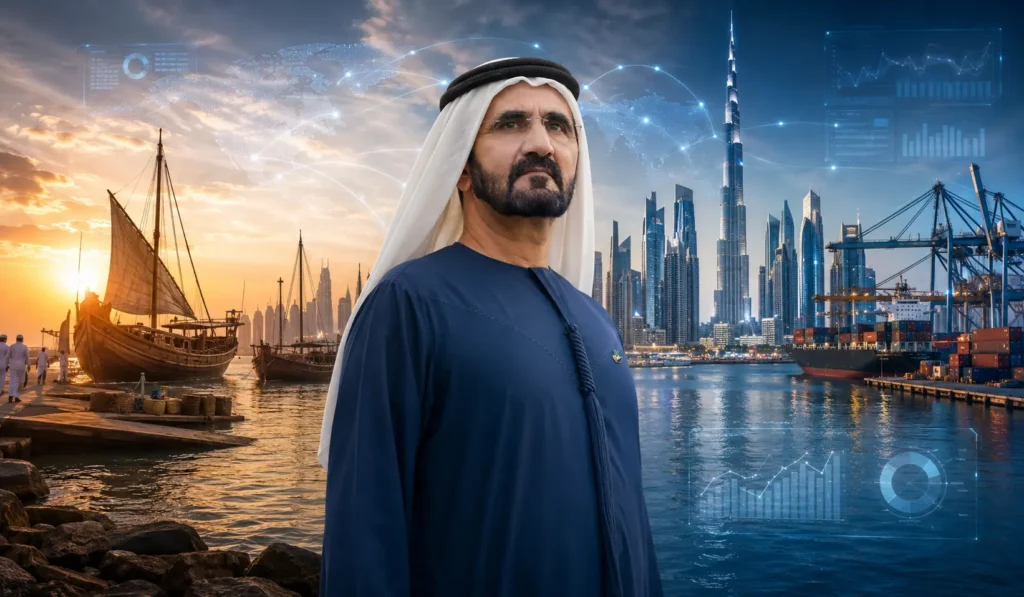
Sheikh Mohammed bin Rashid Al Maktoum, the Vice President and Prime Minister of the United Arab Emirates (UAE) and Ruler of Dubai, has directed one of the most rapid urban and economic developments in modern history. His leadership has turned a regional port into a global financial, tourism, and logistics hub. Understanding his methods is essential for global business leaders, policymakers, and investors looking to understand the “Dubai Model” of growth. This article examines his leadership philosophy, the strategies used to modernize the UAE government, and the long-term economic visions that continue to shape the region.
For investors, this trend of rapid, vision-led development is worth watching.
The Historical Shift from a Trade Port to a Global Hub
Fifty years ago, Dubai was a small coastal town with an economy based on fishing, pearling, and traditional sea trade. It lacked advanced infrastructure, skyscrapers, and the international recognition it holds today. While many neighbouring regions relied heavily on vast oil reserves, Dubai’s leadership recognized early that sustainable growth required economic diversification.
When Sheikh Mohammed assumed governmental responsibilities, he acted as both a political leader and an economic strategist. He pursued a path of rapid development that moved the emirate away from oil dependency. Under his guidance, the city transformed into a major financial centre hosting millions of tourists, investors, and residents from over 200 nations.
This transformation was achieved through bold projects such as the Jebel Ali Port, which is now one of the largest and busiest ports in the world. He also established free trade zones to attract international companies and expanded the tourism industry through landmark projects like the Palm Jumeirah and the Dubai Mall. Businesses should pay close attention to how these infrastructure investments continue to drive market stability.
Related Story: UAE Leadership Meeting Highlights National Development Priorities and Government Coordination
Core Leadership Traits and the Transformational Style
Sheikh Mohammed is frequently categorized as a transformational leader. This leadership style focuses on creating a clear vision, putting personal concerns aside to achieve national goals, and inspiring followers to exceed their own expectations. His leadership is characterized by several specific traits that have defined the UAE’s progress:
- Vision with Specific Objectives: He does not just create vague goals; he articulates specific strategies to achieve them. This clarity allows government entities to align their efforts toward a single destination.
- Willingness to Take Risks: Many of Dubai’s most famous projects, such as building towers in the sea or developing a tourism industry in a desert, were initially seen as impossible. He views calculated risks as necessary for transformative change.
- Self-Confidence and Persistence: He maintains a strong belief in the path he has set for the UAE, which instills confidence in the residents and the market.
- Connection with Followers: His leadership involves an empathetic approach and a genuine concern for the well-being of the people. He is known to be approachable, which allows him to receive direct feedback on policy issues.
He believes that a true leader does not derive power from a position, but from ethics, knowledge, and the love of the people. He often uses the analogy of the “gazelle and the lion” to describe the need for constant movement and speed in a competitive world, stating that whether you are a lion or a gazelle, you must run faster than others to survive.
Also Read: UAE Space Investment Trends and the Strategic Leadership of H.E. Dr. Ahmad Belhoul Al Falasi
The Dubai Model for Government Services
One of the most significant contributions of Sheikh Mohammed’s rule is the “Dubai Model for Government Services”. This model, coordinated by the Dubai Model Centre, focuses on two key strategic objectives: customer-centricity and service efficiency.
The government’s job, according to Sheikh Mohammed, is to achieve happiness for its people. He views the government as a service provider that should compete with, and eventually surpass, the private sector in quality. He has stated that government centers should welcome customers more professionally than hotels and manage processes better than banks.
The Dubai Model follows a five-phase annual improvement cycle:
- Current State Assessment: Understanding the actual needs and expectations of the customers.
- Planning Service Improvement: Setting priorities and identifying potential areas for change.
- Implementation: Overseeing the change with a focus on risk management and flexibility.
- Monitoring and Follow-up: Reporting on the implementation and dealing with recommendations.
- Continuous Learning: Assessing results and celebrating success to motivate further improvement.
To ensure these standards are met, the government uses multiple levels of monitoring, including electronic performance indicators and “mystery shopping” to test service levels firsthand. This commitment to efficiency could shape the market in the coming months as more services move to digital platforms.
Major Infrastructure Projects as Economic Drivers
Sheikh Mohammed has used large-scale infrastructure projects not just as functional buildings, but as symbols of national ambition and branding tools.
The Burj Khalifa, the tallest building in the world, was built to be a national accomplishment and a historic milestone. While the building itself provides direct economic value, its larger purpose was to enhance the global image of Dubai and the UAE. This saved millions of dollars in branding costs by positioning the UAE as a global hub where the “best minds come together”.
The Palm Islands The Palm Islands are another example of his refusal to accept conventional limits. When experts recommended building the islands in a standard way, Sheikh Mohammed insisted they be shaped like a palm tree to signify the heritage and creativity of the Dubai people. Visible from space, they serve as a symbol of the capacity to deliver on “impossible” dreams.
These projects demonstrate his belief that the word “impossible” is only used by those who fear to dream big. By receiving millions of visitors annually, these landmarks have proven that developing a massive tourism industry in the desert was feasible.
Future Strategic Visions From 2021 to 2071
Sheikh Mohammed’s leadership is defined by long-term planning rather than short-term reactions. He launched UAE Vision 2021 with the goal of making the UAE one of the best countries in the world. This vision focused on several pillars, including a first-rate education system, world-class healthcare, a competitive knowledge economy, and a safe, just society.
Following the success of earlier plans, he launched the UAE Centennial 2071. This is a five-decade plan designed to prepare future generations for rapid global changes. The pillars of Centennial 2071 include:
- Future-focused Government: Establishing a government that anticipates future variables and focuses on social happiness.
- Excellent Education: Prioritizing advanced science, technology, space science, and engineering to discover and nurture individual talents.
- Diversified Knowledge Economy: Increasing the productivity of the national economy and supporting national companies to compete globally.
- Happy and Cohesive Society: Promoting a tolerant, secure, and ethical society where women participate fully in all sectors.
This long-term planning provides a stable roadmap for government work and fortifies the country’s reputation on the global stage.
Empowerment of Women and Society
A central part of Sheikh Mohammed’s leadership is the empowerment of all members of society. He has stated that the UAE has moved beyond “empowering women” to “empowering society through women”. In the UAE, women occupy leadership positions and play critical roles in the economy, military, and government services like education and health.
Furthermore, he has prioritized Emiratisation, which involves activating and empowering UAE citizens in the workplace. This is achieved through major initiatives aimed at employing thousands of Emiratis and ensuring they have the skills to lead in the private and public sectors.
He also places a high value on the “Spirit of the Union,” advising other leaders to “unite hearts before uniting efforts.” This philosophy emphasizes that no union or organization can thrive if it is based solely on material interests; it must have a shared spirit and vision.
Views on Management, Time, and Innovation
Sheikh Mohammed’s approach to management is highly practical and focused on results. He believes that time is a flowing river that cannot be stepped in twice, and therefore every minute must be invested in accomplishments and happiness. He views “investing” time as more important than simply “managing” it, often shortening three-hour meetings to thirty minutes to maintain focus.
Regarding innovation, he believes it should not just come from the top but from all levels of an organization. He encourages a culture where creativity is rewarded and where employees feel empowered to contribute ideas.
How does he view mistakes? He is often more concerned with a lack of effort than with honest errors. He believes that an exaggerated fear of making mistakes can paralyze an organization and stop innovation. By allowing his teams the freedom to try new things, he fosters a more creative and responsive government environment.
Personal Disciplines and Role Models
Sheikh Mohammed’s leadership is also influenced by his personal interests, particularly poetry and horse riding. He views horse riding, poetry, and leadership as a “triad” that interacts to make a person a better leader. Horse riding, specifically endurance racing, teaches planning, patience, and control. Poetry provides a depth of vision, allowing a leader to see what others might fail to notice.
He attributes much of his success to his role models: the Prophet Mohammed, Sheikh Zayed (the founder of the UAE), and his father, Sheikh Rashid. From Sheikh Zayed and Sheikh Rashid, he learned that a leader should be like a “father to his people.” He accompanied them on journeys that served as intensive courses in life and government management.
He also emphasizes the importance of physical health, stating that a “sound leader is in a sound body”. He advises all people to make time for exercise as the best investment for their future and happiness.
Related Article: President Sheikh Mohamed Launches National Education Charter to Shape UAE’s Learning Future
Challenges and Critiques
While his achievements are widely recognized, research also highlights specific challenges and characteristics of his leadership style. Some analysts note that he often prefers to work alone or with a very close team, which can sometimes limit the breadth of brainstorming for national policies. His methods are described as “evidence-based” and “practical,” but his strong personal direction means that the success of the vision is heavily tied to his own leadership.
Additionally, coordinating a diverse network of government entities to ensure a seamless “customer experience” remains an operational complexity. The Dubai Model Centre constantly adjusts its level of involvement to balance central guidance with the independence of various agencies.
Despite these challenges, his ability to manage crises and his bold execution of large-scale projects have placed him among the leading figures in global economic development.
Final Verdict
The leadership of Sheikh Mohammed bin Rashid Al Maktoum has transformed Dubai from a local trade port into a global metropolis in just a few decades. By redefining the role of government as a “happiness provider” and treating citizens as customers, he has created a unique model for public service. His commitment to “number one” status, his refusal to accept the word “impossible,” and his focus on long-term visions like Centennial 2071 provide a blueprint for how a nation can navigate the complexities of the 21st century. For global businesses and investors, the UAE remains a critical market where the link between leadership vision and economic reality is exceptionally strong.
FAQs – Frequently Asked Questions
He is the Vice President and Prime Minister of the United Arab Emirates and the Ruler of Dubai.
It is a framework that treats government services like a business, focusing on “customer-centricity” and efficiency.
These were not just construction projects; they were symbols of national ambition and tools for global branding.
It was a strategic plan to make the UAE one of the best countries in the world by its 50th anniversary. It focused on education, healthcare, the economy, and social justice.
It is a long-term plan extending five decades into the future. It aims to prepare the UAE for the next century by focusing on a future-focused government and excellent education.
He believes “impossible” is a word used by people who fear to dream or who do not want to work.
Sheikh Mohammed is a strong advocate for the role of women. He believes that women are essential to empowering society and the economy.
He encourages innovation and accepts that mistakes will happen during the creative process.

Dwayne Paschke is a seasoned content strategist and AI automation specialist with over nine years of experience at the intersection of journalism and digital innovation. A versatile force in the media landscape, Dwayne has built a reputation as an expert content writer and investigative journalist, contributing high-impact pieces to various reputable news websites.