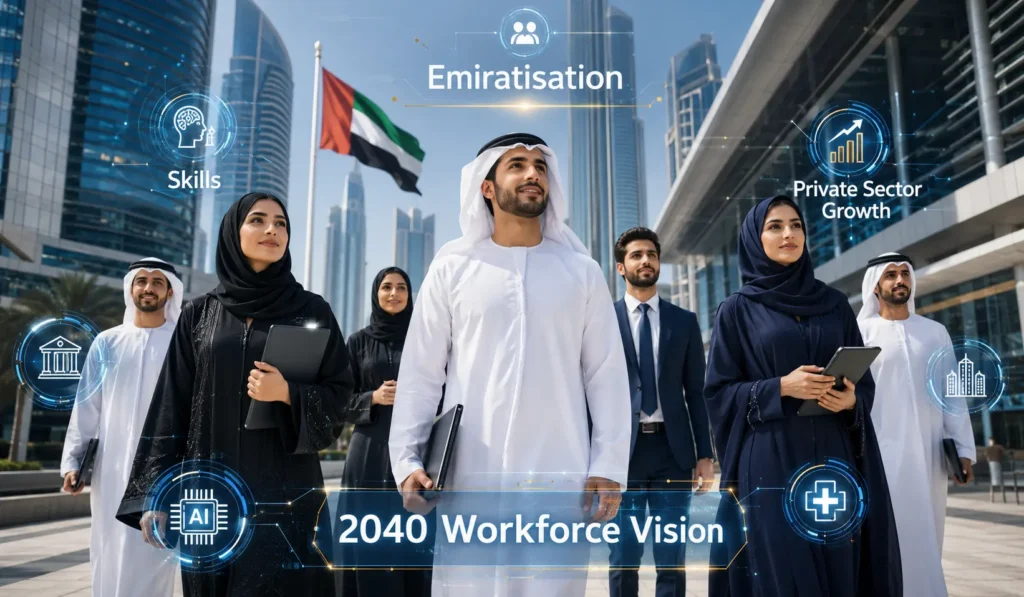
The United Arab Emirates has recently announced a transformative extension and overhaul of the Nafis programme, a federal initiative designed to fundamentally reshape the nation’s private sector workforce. Originally launched in 2021 as a five-year plan, the programme has now been extended until 2040, signaling a long-term government commitment to integrating Emirati talent into the heart of the national economy. This move is not merely an extension of existing subsidies but represents a strategic shift from quantitative hiring targets to a focus on competency, high-value sectors, and family stability. For investors and business leaders, this trend is worth watching as it dictates the future of human capital in the region.
Nafis Programme Marks a Major Shift in UAE Labour Policy
The Nafis programme, which means “to compete” in Arabic, was established in September 2021 as a cornerstone of the “Projects of the 50″—a series of developmental initiatives marking the UAE’s 50th anniversary. The primary goal was to increase the competitiveness of Emirati human resources and empower them to occupy 75,000 jobs in the private sector over its first five years. To back this ambition, the UAE government allocated a massive budget of AED 24 billion.
As of early 2026, the programme has significantly outperformed its initial projections. More than 176,000 Emiratis have benefited from the initiative, with over 152,000 currently employed across approximately 32,000 private sector establishments. One of the most striking demographic trends is the participation of women, who account for 74% of all beneficiaries. This high level of engagement demonstrates a shifting cultural paradigm where Emirati nationals are increasingly viewing the private sector as a viable and rewarding career path.
Each Phase of Nafis Has Strengthened UAE Labour Strategy
To understand the current trajectory of Nafis, it is essential to look at the timeline of its development:
- September 2021: Launch of the Nafis programme under the “Projects of the 50” with an initial five-year mandate.
- March 2022: Launch of Phase 2, which introduced specialized training, the National Healthcare Programme, and vocational counseling.
- June 2023: Implementation of stricter compliance measures, including fines of AED 6,000 per month for companies failing to meet their 2% annual Emiratisation increase targets.
- April 2026: Announcement of the extension to 2040 and a major package of new benefits focused on family support and standardized salary thresholds.
- September 2026: Scheduled commencement of the revised framework for new beneficiaries, with a three-year transition period for existing ones.
Businesses should pay close attention to these changes, as they represent a more structured and equitable approach to workforce development.
2026 Policy Changes Redefine Financial Security for Emiratis
The April 2026 updates introduced by the Emirati Talent Competitiveness Council (ETCC) represent the most significant reform since the programme’s inception. These changes are designed to align with the Year of Family 2026, placing social stability at the center of economic policy.
Removal of Child Allowance Caps
One of the most impactful reforms is the removal of the cap on the Child Allowance Scheme. Previously, support was limited to four children per family. Under the new rules, eligible Emiratis in the private sector will receive financial support for all children without an upper limit. This change is intended to promote long-term social stability and alleviate financial pressures on larger households.
Also Read: Sarah Al Amiri and Her Strategy for the UAE Education and Space Technology
Standardized Salary Thresholds
To simplify the system and ensure fair access, the minimum salary threshold for eligibility across all Nafis schemes has been standardized at AED 6,000 per month. This standardization helps in maintaining equitable support across various sectors and qualification levels.
Enhanced Salary Support Packages
The revised framework provides tiered monthly support based on educational attainment, ensuring that higher qualifications are rewarded while still providing a robust safety net for all. The maximum monthly support levels are:
- Bachelor’s Degree Holders: Up to AED 6,000.
- Diploma Holders: Up to AED 5,000.
- Secondary School Graduates: Up to AED 4,000.
- Below High School: Up to AED 4,000 for married individuals with dependents, or AED 3,000 for single individuals.
Furthermore, the programme has been expanded to include children of Emirati mothers and the wives of Emirati men working in the private sector, providing up to AED 3,000 per month in additional support.
Emiratisation Policy Now Focuses on Quality Over Quantity
As the programme enters its next phase, the focus is shifting away from simply increasing the number of employees toward quality and competency. This strategy aims to build a sustainable pipeline of talent for sectors that are critical to the UAE’s future economy.
Key priority sectors for Nafis 2.0 include:
- Banking and Finance: Strengthening the national presence in the financial services industry.
- Artificial Intelligence (AI) and Technology: Preparing the workforce for the digital transformation.
- Real Estate: Integrating nationals into one of the UAE’s most dynamic economic drivers.
- Healthcare: Continuing to develop a robust pool of local medical professionals through specialized training.
This focus on strategic roles ensures that Emiratis are not just filling quotas but are contributing to high-value areas that drive innovation and productivity.
Businesses Must Adjust to a New Emiratisation-Driven Economy
The extension of Nafis to 2040 provides much-needed certainty and security for both employers and employees. For businesses, it offers a clear regulatory roadmap and financial incentives that reduce the costs associated with hiring and training local talent. For employees, it provides a safety net and clear career progression opportunities outside of the traditional government sector.
Employer Responsibilities and Pension Contributions
A significant change coming in September 2026 involves pension contributions. While the “Subscription” scheme will continue to support Emiratis, employers will assume full responsibility for their share of pension contributions from this date. This move is intended to reinforce private sector accountability and ensure the long-term sustainability of the Emiratisation ecosystem.
Integration Challenges
Despite the successes, the integration of Emirati talent into a private sector historically dominated by expatriates presents challenges. Issues such as skill gaps for specific technical roles and limited awareness of programme benefits among smaller firms remain hurdles that the ETCC is working to address through upskilling initiatives and perception-change campaigns.
Also Read: Parents Alarmed as UAE Children Turn to AI for Everything
Government-Led Emiratisation Is Reshaping Employment Systems
The UAE’s approach to Emiratisation through Nafis is a unique model of public-private partnership. By acting as a facilitator rather than just a regulator, the government is creating a balanced environment where economic growth and social welfare are intertwined.
The programme also includes a robust system of rewards and penalties. The “Nafis Award” celebrates excellence among companies and individuals, while strict fines are imposed for non-compliance or fraudulent practices, such as “ghost Emiratisation”. In 2022 alone, over 400 companies were penalized for showcasing false job placements, and the government recovered millions in wrongly disbursed benefits.
Nafis Expansion Signals a Decade of Workforce Transformation Ahead
Looking ahead, the UAE aims for Emiratis to occupy 10% of all private sector jobs by the end of 2026. The long-term extension to 2040 suggests that the government views the private sector as the primary engine for future employment.
This could shape the market in the coming months as companies scramble to meet their annual targets and adapt to the new September 2026 framework. We can expect to see:
- Increased Outreach at Schools: Efforts to shift career preferences toward the private sector will start at the educational level.
- AI-Enabled Monitoring: The government is introducing AI tools to measure the quality of Emiratisation and detect compliance issues more effectively.
- Growth in Free Zones: With more than 14,000 Emiratis already in free zones, these areas will become critical hubs for talent development as they adjust to the new AED 6,000 minimum salary standards
FAQs – Frequently Asked Questions
Nafis is a federal initiative designed to increase the competitiveness of Emirati nationals and encourage them to occupy high-quality roles in the private sector through financial incentives and training.
The programme, which was initially launched in 2021 for five years, has now been extended until 2040 to provide long-term stability for the labor market.
Starting in September 2026, eligible Emirati parents in the private sector will receive child allowance payments for all their children without any limit on the total number of children.
A standardized minimum salary threshold of AED 6,000 per month has been set across all eligible support categories.
No. In addition to salary support, Nafis offers professional training, career guidance, international certifications, and specialized programs like the National Healthcare Programme.
Wives of Emirati men and children of Emirati mothers working in the private sector can receive up to AED 3,000 monthly, provided they meet specific criteria regarding salary, education, and family status.
Companies with 50 or more employees must increase their Emiratisation by 2% annually. Failure to do so results in a fine of AED 6,000 for every Emirati employee not hired within their designated quota.
The programme includes an Unemployment Benefit Scheme, providing up to AED 7,000 per month for six months to eligible nationals who lose their private sector jobs for reasons beyond their control.

Dwayne Paschke is a seasoned content strategist and AI automation specialist with over nine years of experience at the intersection of journalism and digital innovation. A versatile force in the media landscape, Dwayne has built a reputation as an expert content writer and investigative journalist, contributing high-impact pieces to various reputable news websites.