The economies of the United Arab Emirates (UAE) and Saudi Arabia are currently undergoing a massive transformation. In 2026, these nations rely more than ever on a vast migrant workforce to build futuristic cities and maintain global tourism hubs. For investors and business leaders, the sustainability of this labor model is a critical factor for long-term growth. This trend suggests that the way these countries manage their workforce could shape the regional market for decades.
International Labor Day in the UAE Industrial Sector
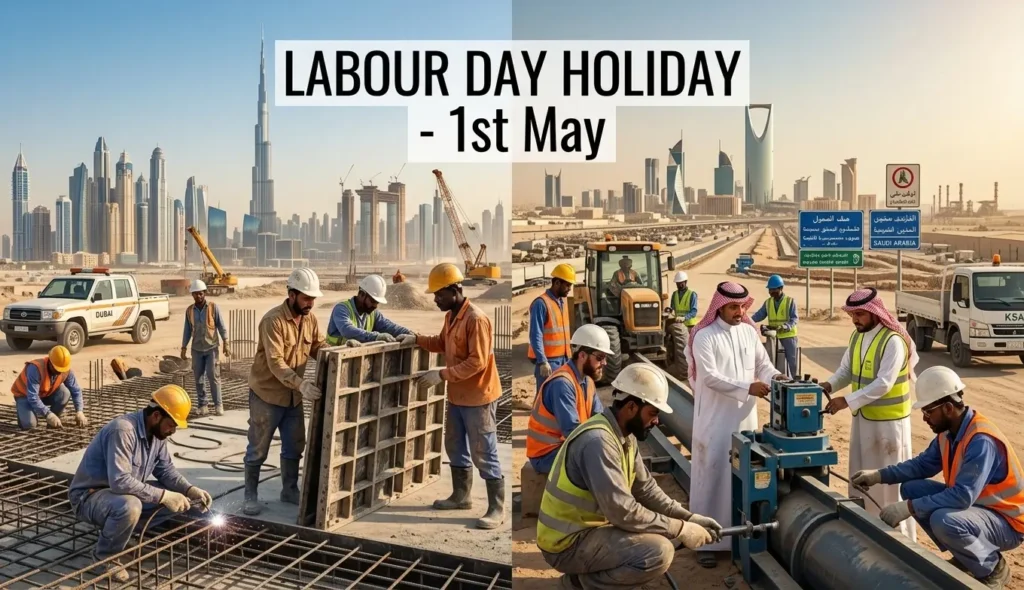
International Labor Day, observed every year on May 1, has become a major event in the UAE’s industrial calendar. In 2026, the government and private organizations use this day to laud the efforts of more than two million blue-collar workers. These workers are often referred to by officials as the “real heroes” who built landmarks like the Burj Khalifa and the Museum of the Future.
Celebrations typically take place in industrial zones like Al Quoz in Dubai, where thousands of workers receive gifts, food parcels, and attend entertainment events. Officials from the Dubai Police, Dubai Municipality, and the Ministry of Human Resources and Emiratisation (MoHRE) often use these platforms to express gratitude. Businesses should pay close attention to these events as they represent the government’s attempt to promote a “culture of excellence” in labor practices.
However, while Labor Day serves as a public relations milestone, it also highlights the gap between official celebrations and daily realities. For many workers, the day is a brief moment of visibility in a system that often renders them invisible. The UAE leadership emphasizes that workers remain in their “hearts and minds,” yet the industrial sector continues to face challenges regarding wage enforcement and living standards.
Migrant Labor Demographics and the Gulf Economy in 2026
The UAE has seen remarkable population growth, increasing by 395% since 1990 to reach over 9.4 million people by the early 2020s. Approximately 93.9% of the population consists of expatriates from around 200 countries. In Dubai specifically, foreign nationals comprise roughly 91.3% of the resident population. This demographic structure is almost unique globally, with only Qatar showing similar ratios.
The industrial and private sectors are almost entirely operated by this foreign workforce. Expatriates make up 96% of the private sector workforce in Dubai. In certain occupations, such as craft and related trades, the percentage of migrant labor reaches nearly 100%. Most of these workers hail from India, Pakistan, Bangladesh, Nepal, and the Philippines.
The reliance on this workforce is absolute. Without them, the hospitality, construction, and service sectors would effectively cease to function. In 2026, as 92 million passengers pass through Dubai International Airport (DXB), they are served by a labor force that is largely in “transit,” often remaining in the country only as long as their visa sponsorship lasts. For investors, this reliance on a temporary workforce creates underlying economic fragility that requires careful monitoring.
Social Realities of Labor in Dubai and Saudi Arabia
The treatment of labor in the Gulf is often described as a “dual reality”. On one hand, there is a polished image of luxury and modern infrastructure shown by influencers. On the other hand, investigative reports highlight a “hidden side” of overcrowded labor camps and harsh conditions.
In Dubai, workers are often transported in sealed buses at dawn from remote camps to construction sites, ensuring they remain out of the sight of high-spending tourists. This has been described by some analysts as a form of “economic separation” where the people building the city are allowed to exist only as mechanical components, not as social beings.
In Saudi Arabia, the treatment of labor is currently under intense global scrutiny due to the “giga-projects” of Vision 2030. Workers on projects like NEOM and the Red Sea Project have reported being pressured to meet unrealistic deadlines in extreme heat. Some workers have described their supervisors as uncaring, with one manager reportedly telling a worker, “Die first, and I’ll pay you later,” when asked about overdue wages.
Despite these reports, many workers express a sense of resilience. They often hide their hardships from families back home to avoid causing them stress. Some workers in Dubai even report a high sense of safety in public spaces and appreciation for the strong rule of law, which they find superior to their home countries.
Migrant Worker Earnings in Dubai and Saudi Arabia
The earning potential for migrant workers in the Gulf varies significantly by sector and nationality. While wages in the UAE and Saudi Arabia are generally higher than in South Asia or Africa, they are often low relative to the cost of living in these host countries.
Salary Data for Dubai:
- Hospitality Sector: A skilled server typically earns between $300 and $500 per month.
- Construction Sector: Average wages have historically been around $5 to $7 per day for laborers.
- Low-Wage Category: Approximately 65% of non-Emiratis earn AED 4,999 or less per month.
- High-Wage Category: Only a very small percentage of expatriates, mostly from developed Western nations, occupy the high-wage bracket of AED 50,000 or more.
Salary Data for Saudi Arabia:
- Minimum Wage: There is a mandated minimum wage of SAR 4,000 for Saudi nationals in the private sector, but no such minimum exists for expatriate workers.
- Unskilled Labor: Many laborers on giga-projects are promised around SAR 1,000 to SAR 1,200 ($267-$320) but sometimes receive as little as SAR 600 to SAR 800 ($160-$213) after unexplained deductions.
- Referral Wages: Some origin countries, like India and Nepal, set “referral wages” (e.g., SAR 1,500 for Indians), but these are often bypassed through contract substitution.
A business calculation reveals the stark reality of the “Dubai Dream.” A server would need to work for three months without spending a cent just to afford one high-end meal they serve to a customer. Businesses should pay close attention to these wage disparities, as they are a primary driver of worker dissatisfaction and talent drain to other regions.
Living Conditions in Dubai Labor Camps and Saudi Giga-Projects
Living conditions remain a major point of contention in 2026. In Dubai, workers are often housed in massive complexes like Sonapur, which houses 5,000 people per building. While UAE law mandates specific standards—such as 3 square meters of space per person—overcrowding is common.
Key issues in Dubai labor accommodations include:
- Overcrowding: Rooms designed for four people often hold 15 to 20 men.
- Hygiene: Shared bathrooms are sometimes used by 16 people, leading to long queues and cleanliness issues.
- Hidden Costs: Workers sometimes have to pay for their own cooking facilities or transport if company-provided services fail.
In Saudi Arabia, the situation at giga-project sites like NEOM is mixed. Some workers report that new accommodations are better than traditional labor camps, featuring air conditioning, fridges, and well-maintained rooms for four to six people. However, workers also complain about the quality of food in mess halls that serve tens of thousands, describing it as insufficient for recovering from physically strenuous tasks in the desert heat.
The disparity in housing can be extreme. While the ultra-wealthy in Dubai debate which type of marble to choose for their penthouses, tens of thousands of workers sleep in concrete blocks that some observers claim are less than what would be used for livestock in other countries.
Interesting Article: UAE Frontline Heroes – How a National Mandate Transformed Corporate Responsibility into a Strategic Economy
Holiday Policies and Work Schedules in Dubai and Saudi Arabia
Work Schedules in Dubai (UAE)
In Dubai and the broader UAE, the standard workweek for the private sector includes at least one paid rest day per week, as specified in the employment contract. While the employer determines the specific rest day—which is frequently Sunday—they have the flexibility to designate any other day of the week.
Other key scheduling regulations include:
- Ramadan Hours: During the holy month of Ramadan, daily working hours are reduced by two hours for all employees, regardless of religion, without any reduction in salary.
- Friday Prayer: Companies must provide a break for employees to attend Friday (Jumu’ah) prayers; some organizations adopt a half-day schedule or offer flexible hours on Fridays.
- Midday Break: To protect workers from extreme heat, the UAE implements a mandatory midday break from June 15 to September 15, banning work in open spaces under direct sunlight from 12:30 PM to 3:00 PM.
- DIFC Nuance: In the Dubai International Financial Centre (DIFC), leave and work calculations are often based on working days rather than calendar days.
Work Schedules in Saudi Arabia (KSA)
The workweek in Saudi Arabia traditionally runs from Sunday to Thursday, with Friday and Saturday serving as the weekend. Friday is considered the primary day of rest and prayer in accordance with Islamic tradition.
Standard practices include:
- Working Hours: Employees typically work between 40 and 48 hours per week, generally consisting of eight hours per day.
- Ramadan Reductions: For Muslim workers, the workday is reduced to six hours during Ramadan to accommodate fasting.
- Break Times: Many businesses operate from 8:00 AM to 6:00 PM but include a significant midday break, particularly during the hot summer months.
Holiday Policies in Dubai (UAE)
UAE employees are entitled to full pay on official public holidays as defined by the Ministry of Human Resources and Emiratisation (MOHRE). If an employee is required to work on a public holiday, the employer must provide normal wages plus a supplement of at least 50% of the basic wage, or grant a day off in lieu.
The 2025 public holiday schedule includes:
- Fixed Dates: New Year’s Day (January 1), Commemoration Day (December 1), and National Day (December 2–3).
- Movable (Hijri) Dates: Eid al-Fitr, Arafat Day, Eid al-Adha, Islamic New Year, and the Prophet Muhammad’s Birthday.
Holiday Policies in Saudi Arabia (KSA)
Saudi Arabia’s holiday policy is heavily influenced by the Hijri (Islamic) calendar, meaning many dates shift by 10 to 12 days each year relative to the Gregorian calendar.
Key holidays include:
- Religious Holidays: Eid al-Fitr (marking the end of Ramadan) and Eid al-Adha (marking the Hajj pilgrimage) are the most significant, typically resulting in three to five days of closure for businesses and government offices.
- National Holidays: These are fixed on the Gregorian calendar: Saudi National Day (September 23) and Saudi Founding Day (February 22).
- Holiday Compensation: Employees required to work during these periods are usually compensated with extra pay or a day off at a later date.
- Public vs. Private Sector: Government workers often receive extended holiday breaks compared to those in the private sector, particularly during the Eid festivals.
Intresting News: What the New Manila Representative Office Offers to Dubai Investors
Will Migrant Workers Ever Be Free of the Kafala System?
The Kafala (sponsorship) system continues to govern the residency and employment of migrant workers in both countries. Under this system, a worker’s legal status is tied to an employer (the kafeel). Historically, this has allowed employers to confiscate passports and prevent workers from changing jobs.
Reforms in the UAE:
- Labor Law No. 33 of 2021: This law aimed to protect workers from discrimination and illegal recruitment fees.
- Wage Protection System (WPS): Launched to ensure salaries are paid through bank transfers. In 2026, about 47% of workers report receiving salaries through banks, though cash payments and delays persist.
- Job Mobility: Recent changes technically allow workers to change employers after their contract ends, but in practice, many still face threats of “absconding” charges if they attempt to leave an abusive boss.
Reforms in Saudi Arabia:
- Labor Reform Initiative (LRI) of 2021: Claimed to facilitate worker mobility and exit from the country.
- Nationalization (Nitaqat): A quota system that forces companies to hire Saudi nationals. This has sometimes created a “perverse incentive” to hire migrants off-the-record or deny them residency permits to save costs.
Despite these reforms, enforcement remains weak. In Dubai, there are estimated to be only about 100 to 400 labor inspectors for a workforce of millions. This could shape the market in the coming months as international pressure for better enforcement continues to grow.
Extreme Temperatures and the Growing Health Crisis Among Gulf Workers
Climate change is no longer a distant threat but a daily operational reality in 2026. Summer temperatures in the region frequently reach 50°C (122°F). This has led to the emergence of “wet bulb temperatures,” a threshold where the human body can no longer cool itself through sweat.
Saudi Arabia and the UAE both implement midday work bans during the summer months (typically from 12:30 PM to 3:00 PM). However, scientific studies indicate these bans are inadequate. The highest heat intensity for workers often occurs between 9:00 AM and 12:00 PM, outside the ban hours.
Health risks associated with heat include:
- Organ Failure: Chronic kidney disease and organ failure are increasingly reported among returnee workers.
- Sudden Deaths: Healthy young men who collapse at night are often recorded as dying of “natural heart failure” to avoid insurance costs and investigations.
- Operational Risks: In Dubai, maintaining an indoor temperature of 72°F when it is 122°F outside is becoming so expensive that it threatens the profitability of the hospitality sector.
Recruitment Fees and Wage Theft in the Gulf
The migration cycle for many workers begins with debt. Even though it is illegal under both UAE and Saudi laws for employers to charge recruitment fees, the practice remains rampant.
Workers often pay between $600 and $4,500 to recruitment agents in their home countries. To afford these fees, they sell family land or borrow money at interest rates as high as 42%. This creates a situation of debt bondage, where workers spend their first year of employment simply paying off their entry costs.
Wage theft is another pervasive challenge. In 2026, 43% of workers in the UAE report not receiving their salary in full and on time. In Saudi Arabia, workers on giga-projects often report that their overtime benefits only begin after 10 hours of work, despite the law mandating an 8-hour workday. Some workers have reported having their phones smashed or being beaten for posting videos of their grievances on social media.
Also Read: Dh250 Million Pledged to UAE’s Mother of the Nation Endowment to Strengthen Orphan Care
What the Future Holds for Millions of Workers in the Gulf?
Dubai no longer has a monopoly on growth in the Gulf. Saudi Arabia, with an $800 billion budget for Vision 2030, is aggressively siphoning talent from the UAE. Mega-projects like NEOM offer salaries 30% to 50% higher than those currently found in Dubai.
Future Outlook:
- Talent Drain: As skilled service workers leave for Riyadh or Doha, Dubai’s “five-star” brand risks being operated by inexperienced staff.
- Visual Saturation: Modern travelers are becoming numb to glass towers and are seeking “authentic” experiences in nature, which the Gulf’s artificial environments struggle to provide.
- Residency Pathways: Competitors are beginning to offer pathways to long-term residency or equity ownership. If Dubai fails to match these offers, it may lose its most valuable resource: its people.
History suggests that any structure built on the suffering of the majority tends to carry the seeds of its own destruction. For the Gulf to remain a global powerhouse, it must move beyond gold-plated infrastructure and restore dignity to its silent workforce. For investors, this trend is worth watching closely.
FAQs — Frequently Asked Questions
It is a sponsorship framework that ties a migrant worker’s legal residency and work visa to a specific employer. This gives the employer significant control over the worker’s ability to change jobs or leave the country.
In the luxury hospitality sector, workers typically earn between $300 and $500 per month. In the construction sector, wages have historically averaged $5 to $7 per day.
While it is illegal for employers to charge recruitment fees, most workers still pay agents in their home countries between $600 and $4,500. This often leads to debt bondage.
Some giga-projects in Saudi Arabia report better standards, but in many parts of Dubai, workers still live in overcrowded rooms with 15 to 20 people and shared facilities.
Labor Day (May 1) is marked by government events in industrial areas where workers are thanked for their service and given food parcels and gifts.
The primary risk is extreme heat stress, which can lead to heatstroke, chronic kidney disease, and in some cases, unexplained sudden deaths at night.
It is an electronic salary transfer system designed to ensure that workers are paid on time and in full via bank transfers. While it has improved transparency, some workers still report delays.
Saudi Arabia is offering significantly higher salaries (30-50% more) to attract skilled talent for its massive Vision 2030 projects like NEOM.

Dwayne Paschke is a seasoned content strategist and AI automation specialist with over nine years of experience at the intersection of journalism and digital innovation. A versatile force in the media landscape, Dwayne has built a reputation as an expert content writer and investigative journalist, contributing high-impact pieces to various reputable news websites.