The retail sector in Dubai currently stands at a critical crossroads between record-breaking growth and unprecedented geopolitical challenges. For decades, the city has positioned itself as the world’s leading destination for luxury shopping and “retail tourism,” a strategy that successfully attracted over 111 million visitors to a single location—the Dubai Mall—in 2024. However, as of May 2026, the “Mall Economy” that fuels roughly 24.1% of Dubai’s GDP is facing a period of intense volatility.
This topic matters right now because the stability of Dubai’s economic model is being tested by regional conflicts and supply chain disruptions. Investors and businesses are closely watching how the city balances its ambitious expansion plans with the reality of a 45% to 50% drop in visitor traffic at major shopping hubs in early 2026. Understanding the evolution of this sector provides essential insights into how modern cities can sustain growth when faced with global instability.
The Shocking History Behind Dubai’s Mall Dominance
Dubai’s transformation into a global retail powerhouse began in earnest in the late 1990s and accelerated through the 2000s. The vision was to move the economy away from oil dependency and toward a diversified hub for aviation, tourism, and commerce. A pivotal moment occurred in November 2008 when the Dubai Mall opened its doors. This launch happened during the height of the global financial crisis, a time when real estate prices in the city had dropped by 64%.
Despite the global downturn, Dubai chose to build massive infrastructure, including a $20 billion “retail city” covering 13 million square feet. When bankruptcy loomed in 2009, an emergency bailout of $20 billion from Abu Dhabi provided the necessary liquidity to sustain these projects. This established a pattern of “borrowing from the future” to fund high-prestige developments that would eventually attract a global audience.
By 2014, the retail sector was growing at a staggering rate, with the Dubai Mall and Mall of the Emirates attracting 117 million visitors combined in a single year. Retailers began to view these malls not just as shopping centers, but as “town centers” and social hubs. This shift was supported by government initiatives, including a Dh50 billion stimulus package and visa relaxations that made the city more accessible to international shoppers. For investors, this trend of converting retail space into social infrastructure was a key driver of long-term value.
How Dubai Built One of the World’s Biggest Retail Markets?
- 2008: The Dubai Mall opens amidst the global financial crash; real estate values plummet.
- 2009: Abu Dhabi provides a $20 billion bailout to stabilize Dubai’s debt-heavy economy.
- 2014: Emaar Malls Group launches an IPO, raising between $2 billion and $2.5 billion.
- 2021: The UAE retail market reaches a value of $56.6 billion.
- 2023: Dubai welcomes 14.5 million tourists; the economy expands by 4.6% in the first nine months.
- 2024: Dubai Mall hits a record 111 million visitors, surpassing the visitor counts of major cities like New York.
- November 2025: Emaar and Majid Al Futtaim announce multi-billion dollar expansions, including “The District” and a Dh5 billion upgrade to Mall of the Emirates.
- March 2026: Geopolitical crisis leads to drone strikes and a blockade of the Strait of Hormuz.
- April 2026: Visitor traffic at major malls drops by nearly 50%; luxury sales fall by 60%.
Why Dubai’s Mall Model Is Both Profitable and Fragile?
The “Mall Economy” is a strategic pillar of the UAE’s broader economic framework. As of late 2025, malls were considered “economic flywheels” that anchored real estate and hospitality while creating over 250,000 jobs. In 2022, Dubai’s GDP reached $507.53 billion, with a growth rate of 7.4%. The wholesale and retail sector alone accounted for 25.9% of the GDP by the third quarter of the following year.
Data from 2024 shows that 99% of visitors to Dubai visited the Dubai Mall at least once. The mall’s revenue generation is tied directly to high footfall; in 2014, visitor sales recorded a 26% rise. However, the cost of maintaining this infrastructure is immense. To keep 13 million square feet of retail space cooled in 120-degree desert heat, air conditioning systems must run 24/7, consuming energy levels comparable to a small city.
The current crisis in 2026 has revealed the fragility of this high-volume model. When the visitor flow stops, the fixed operating costs do not disappear. Reports indicate that Italian luxury brands in Dubai saw local sales fall by 35% to 40% compared to pre-war levels. Businesses should pay close attention to these changes in consumer flow, as high operating costs can quickly lead to losses if capacity is not met.
Interesting Article: UAE’s 2030 Vision for 6G and AI Leadership
Trade Route Disruptions Are Affecting Dubai’s Shopping Industry
Dubai’s retail success is heavily dependent on geopolitical stability and open trade routes. The March 2026 crisis has significantly disrupted this stability. Iran’s blockade of the Strait of Hormuz has forced cargo to be rerouted through ports in Oman and Saudi Arabia. This rerouting has added over 10 days to delivery times.
The financial impact on logistics is severe. International courier DHL and other logistics firms have reported surcharges for land-based detours. For example, a furniture exporter from Milan reported paying over 30,000 euros in extra fees to deliver goods to the UAE. These disruptions affect the availability of high-end fashion, electronics, and luxury goods, which are the lifeblood of Dubai’s malls.
Furthermore, the disappearance of key consumer groups—specifically tourists from Russia, China, and India—has left a massive revenue gap. These three nationalities traditionally saw Dubai as a safe haven and a premier shopping destination. The sudden silence of the runways at Dubai International Airport (DXB) directly correlates with the empty corridors of the city’s largest malls.
Digital Intelligence Is Transforming the Mall Experience in Dubai
Dubai malls are engineered to maximize “emotional spending” through sophisticated architectural and technological techniques. One prominent strategy is the Gruen effect, an architectural layout designed to disorient visitors. By removing windows and maintaining constant, perfect lighting, malls cause visitors to lose their sense of time and space. This disorientation often leads to impulsive purchases, as the brain’s logical spending controls are bypassed.
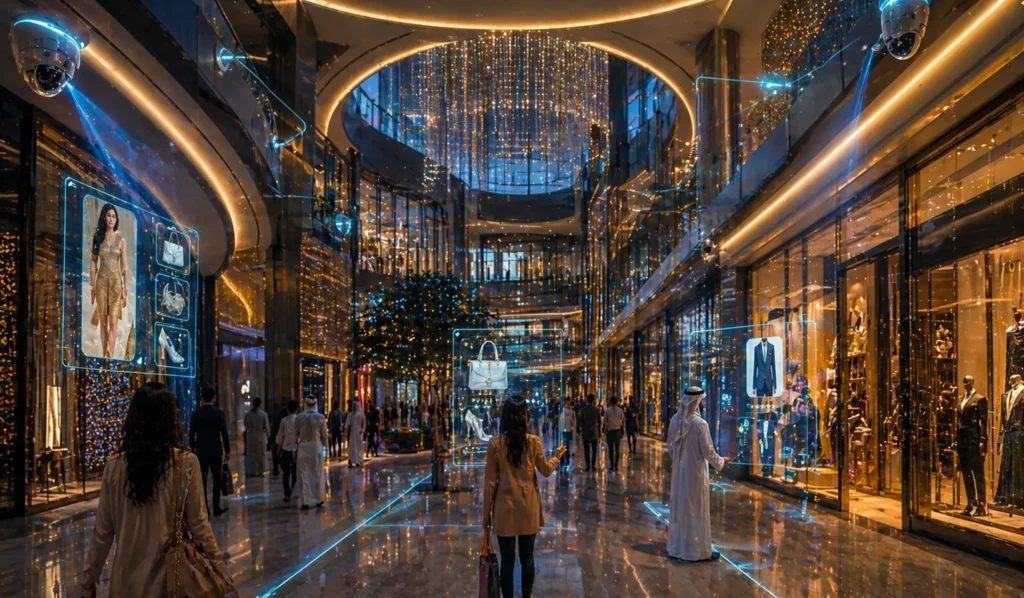
In 2026, this psychological engineering is augmented by the Isotana AI system. A network of 1,300 AI-powered cameras analyzes shopper emotions, facial expressions, and even walking paces in real-time. If a customer gazes at a specific item, such as a pair of shoes, for 30 seconds, the system can trigger a targeted promotion directly to their smartphone.
While these technologies create a “frictionless” experience, they have also raised concerns about privacy and the dehumanization of the retail environment. In the newly developed Chinatown area of the Dubai Mall, human interaction has been largely replaced by AI scanners and automated kiosks. This could shape the market in the coming months as consumers may begin to prioritize privacy and personalized service over mass-market efficiency.
Free Zones and Low Taxes Continue to Attract Global Retail Investment
The UAE government has been instrumental in fostering the retail boom through vision-led policymaking. The alignment with “UAE Vision 2021” and “Dubai Plan 2021” ensured that infrastructure was built ahead of demand, creating world-class leisure and business facilities.
Key policies include:
- Free Zones: Areas like the Dubai Multi Commodities Centre (DMCC) allow international businesses to operate with tax incentives and 100% ownership.
- Golden Visa Program: This policy has encouraged short-term visitors to become long-term residents. While this stabilizes the population, it has also shifted consumer behavior from impulsive “tourist spending” to more planned, responsible consumption.
- Tax Structure: Dubai remains attractive due to the absence of traditional property taxes, although it has implemented a 5% Value Added Tax (VAT) and various municipality fees (5% of annual rent for tenants).
- Import Duties: A 5% customs duty applies to most goods, while excise taxes reach 50% for carbonated drinks and 100% for tobacco and energy drinks.
Commission-Based Workers Are Facing Significant Income Declines in 2026
The recent downturn has had a cascading effect on the workforce within the retail sector. Major brands like Nike, Apple, and Gap face a difficult choice: continue paying high rents based on 5-to-10-year leases or face severe penalties for breaking contracts.
The impact on employees is even more direct:
- Commission-Based Staff: Many sales associates have seen their income drop by 60% as foot traffic evaporated in early 2026.
- Residency Links: Because employment is tied to residency, staff members who are laid off often have only 30 days to leave the country.
- The “Silent Exodus”: Thousands of managers and retail workers are reportedly leaving the city as the “dream of an upscale life” becomes unaffordable.
- Migrant Labor: Under the Kafala system, low-wage workers such as cleaners, security guards, and taxi drivers have no social safety net. Taxi drivers, in particular, are struggling to pay vehicle rental fees as the flow of passengers from the mall has dwindled.
The Growth Effect Between Retail and Property Is Under Pressure
The proximity to major malls has historically been the primary driver of property values in Dubai. Areas like Downtown Dubai, Dubai Marina, and Palm Jumeirah command the highest rents because of their accessibility to these “retail meccas”.
Research indicates that residential units closer to the Dubai Mall appreciate more rapidly than those further away. For example, a 2-bedroom apartment in Downtown Dubai can cost between AED 120,000 and AED 250,000 per year. However, the 2026 crisis has slowed this “ripple effect”. As the mall’s allure fades due to security concerns, the premium associated with living nearby is being questioned by rational investors.
Related Article: City Centre Deira Photos – Remains the Main Source of Dubai’s Retail Economy
Dubai’s Growth Model Faces Debate Over Long-Term Sustainability
The core challenge for Dubai in 2026 is the risk of concentration. The city has tied its economic fate to a single variable: the global perception of its safety. When drone explosions occurred near iconic structures like the Burj Al Arab, that perception was shattered, leading to a rapid capital flight.
Sustainability also remains a major point of contention. While developers showcase “LEED Platinum” certifications and water recycling systems from companies like General Electric, the basic model remains energy-intensive. Critics argue that you cannot use technology to fix a “flawed economic philosophy” built on excess and international crowds. The cost of maintaining an artificial environment in a water-scarce region may eventually exceed what both nature and finance can bear.
Final Verdict
Dubai’s retail market is entering a clear phase of transformation driven by changing consumer behavior, technological integration, and economic pressure. While large malls continue to play a central role, the future will favor more personalized, community-focused, and digitally enabled shopping experiences. The rise of hyper-personalization and “phygital” retail models shows that physical stores are evolving into experience-driven spaces rather than pure sales points. At the same time, shifting luxury preferences highlight a move toward long-term value over impulsive spending. Overall, the market is adapting toward efficiency, sustainability, and customer-centric innovation, shaping a more balanced and resilient retail ecosystem in Dubai.
FAQs – Frequently Asked Questions
Dubai’s high cost of living is driven by a combination of high housing demand in prime locations, the cost of imported goods, and various fees such as municipality taxes and service charges for property maintenance.
The crisis has led to a 45% to 50% drop in visitor traffic and a 60% decline in sales during key periods like Ramadan. Geopolitical instability has deterred international tourists and caused significant logistics delays.
The Mall Economy refers to the strategic use of shopping malls as the central pillar of Dubai’s visitor economy, contributing roughly 24% to the city’s economic growth and anchoring the real estate and hospitality sectors.
Unlike in other parts of the world, Dubai malls have largely “ducked” the e-commerce wave by transforming into “third places” for socializing and entertainment. They use a “showrooming” model where the physical and digital shopping experiences integrate seamlessly.
As more visitors become long-term residents through the Golden Visa, their behavior shifts from impulsive tourist spending to planned, responsible consumption focused on practical needs.
AI systems like Isotana use 1,300 cameras to monitor shopper emotions and movements, allowing for real-time targeted promotions and automated, staff-free retail environments.
The blockade of the Strait of Hormuz has forced retailers to reroute cargo through Oman and Saudi Arabia, adding 10+ days to delivery times and thousands of dollars in extra shipping fees.
There is significant debate on this; while technology is used for energy efficiency, the high cost of cooling massive spaces in the desert heat and the reliance on international aviation make the model vulnerable to geopolitical and environmental shifts.

Dwayne Paschke is a seasoned content strategist and AI automation specialist with over nine years of experience at the intersection of journalism and digital innovation. A versatile force in the media landscape, Dwayne has built a reputation as an expert content writer and investigative journalist, contributing high-impact pieces to various reputable news websites.