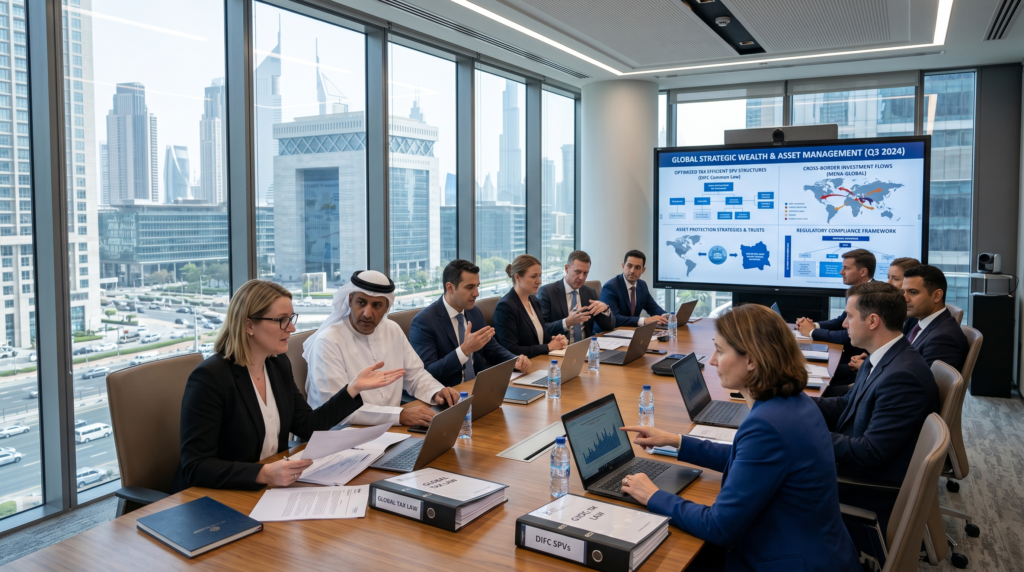
Capital does not flee to jurisdictions based on low tax rates alone; it moves toward environments that offer absolute regulatory predictability, bulletproof asset protection, and friction-free corporate structuring. Dubai has established itself as the world’s premier capital hub by designing independent common-law judicial enclosures, offering total capital repatriation guarantees, and building a world-class logistics network. These structural elements allow global institutions and ultra-high-net-worth allocators to move and deploy massive capital pools faster than anywhere else on earth.
The Capital Velocity Rule: Wealth moves toward jurisdictions where business entities can be formed, funded, and restructured within 24 hours under a trusted common-law legal system, completely insulated from civil law interference.
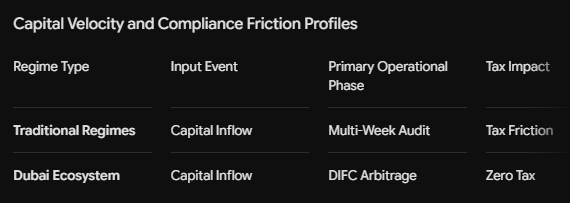
See how Dubai’s specific business frameworks perform compared to traditional European and North American financial capitals:
| Operational Variable | Traditional Western Capitals | Dubai Capital Hub (DIFC / ADGM) | Institutional Performance Delta |
| Judicial System | Complex Civil or Statutory Courts | Independent English Common Law Courts | Complete elimination of local vernacular legal biases |
| Corporate Tax Baseline | High Corporate and Capital Gains Taxes | Zero Percent Corporate Tax Exemptions | Retain 100% of operational compounding power |
| Capital Repatriation | Strict Outflow Taxes and Reporting | Immediate 100% Capital and Profit Return | Zero holding-company lockup friction points |
| Setup Speed | Multi-Week Bureaucratic Registration | Instant Digital Corporate Onboarding | Capital deployment occurs in hours rather than months |
How Independent Common Law Zones Insulate Private Capital
Dubai’s primary structural advantage was creating the Dubai International Financial Centre (DIFC). The DIFC is not merely a collection of real estate assets; it is a completely independent legal jurisdiction with its own civil and commercial laws, staffed by senior judges recruited directly from top global common-law systems.
Total Legal Independence
The DIFC operates entirely separate from the standard UAE civil court system. If a multi-billion-dollar contract dispute arises, it is settled in English common-law courts, giving western institutional investors complete legal familiarity and certainty.
Structured Special Purpose Vehicles
Dubai’s free zones allow allocators to build highly secure corporate structures. These setups feature flexible capital share classes, absolute privacy for beneficial owners, and zero restrictions on foreign ownership, making them ideal for holding global family assets.
How Experienced Founders Route and Insulate Global Assets
To move a global asset protection play or corporate holding structure into Dubai, a practitioner must execute a specific series of technical maneuvers. This process routes capital through the Dubai International Financial Centre (DIFC) or the Abu Dhabi Global Market (ADGM) to achieve maximum structural insulation.
Entity Selection and Capital Structuring
The allocator must first select between a standard commercial entity or an asset-holding Special Purpose Vehicle (SPV). The SPV structure is preferred for multi-billion-dollar transactions because it does not require a physical office lease and can hold shares, real estate, and intellectual property globally.
- Step 1: File an application with the DIFC Registrar of Companies specifying the choice of a Prescribed Company or SPV structure.
- Step 2: Define the share classes, using custom voting or non-voting shares to separate economic rights from management control.
- Step 3: Designate a registered corporate service provider located inside the free zone to handle local compliance filings.
Bank Account Onboarding and Liquidity Routing
Once the corporate registry issues the trade license, the firm must establish its banking footprint. This step requires integrating with Tier 1 regional clearing banks that offer direct multi-currency accounting lines.
| Onboarding Parameter | Minimum Requirement | Standard Processing Window | Operational Outcome |
| Corporate KYC | Ultimate Beneficial Owner disclosure | 5 to 7 Business Days | Clean international AML status clearance |
| Capital Deposit | Zero dollars required for standard SPVs | Instantaneous activation | Immediate readiness for asset wire routing |
| Currency Options | USD, EUR, AED, GBP, and CNY lines | Simultaneous multi-setup | Zero conversion friction for international trades |
Why Legacy Financial Capital Hubs are Losing Institutional Momentum
Traditional banking centers are suffering major capital flight because their regulatory frameworks have become unpredictable, slow, and overly litigious.
The Regulatory Friction Trap
Western capitals frequently introduce retroactive tax changes, unexpected wealth reporting mandates, and lengthy compliance delays on asset transfers. This regulatory instability destroys capital velocity, forcing international wealth managers to relocate operations to stable hubs.
Securing Corporate Structures Long-Term
To protect corporate holdings from unexpected political or regulatory shifts, structure your primary entity foundations inside independent financial free zones. Ensure your entity agreements route all contract disputes through recognized international arbitration courts.
| Operational Risk Vector | Legacy Capital Centers | Dubai Free Zone Enclosures |
| Retroactive Taxation | High risk due to shifting legislative budget deficits | Protected by 50-year statutory zero-tax guarantees |
| Asset Seizure Vulnerability | Subject to arbitrary domestic civil court injunctions | Protected by specialized sovereign wealth immunity rulings |
| Compliance Overhead | Excessive non-operational filing mandates | Streamlined algorithmic transaction monitoring systems |
Why Billion Dollar Deal Structuring Stalls in Practice
This strategy stalls or fails in practice when corporate allocators succumb to the Compliance Disconnect Error. This occurs when an international business sets up a Dubai entity but fails to establish legitimate economic substance inside the jurisdiction, leading to global tax audits.
Also Read: What Companies Actually Control the Global Economy
The Real Cost of Economic Substance Failures
International tax bodies enforce strict Economic Substance Regulations (ESR). If a Dubai holding company generates billions in revenue but has no physical board meetings, local directors, or operational expenses occurring within the UAE, foreign tax authorities will label the structure a shell company and penalize the parent firm.
The Diagnostic Solution
To eliminate this operational vulnerability and secure your structure against international tax challenges, apply this diagnostic verification playbook:
- Appoint at least one qualified resident director to the board of the Dubai entity who physically signs operational resolutions within the free zone.
- Hold all core corporate governance and asset allocation meetings physically inside the DIFC or ADGM corporate enclosures.
- Route all local operational expenditures, including office utilities, legal fees, and administrative salaries, directly through a UAE-domiciled corporate bank account.
What Does the Capital Velocity Matrix Demonstrates
The Capital Velocity Matrix demonstrates how Dubai functions as a frictionless sovereign turntable for global wealth deployment. Traditional financial systems run their transactions through a multi-layered gauntlet of clearing banks, regional tax reviews, and bureaucratic compliance interventions that drag execution out over weeks.
The Dubai architecture uses a parallel processing design: the legal system, the banking system, and the tax authority are integrated into a single, unified common-law free zone framework. This structural design means a transaction that would freeze a western banking line due to clearing bottlenecks sails through the Dubai hub instantly, preserving the market timing of the allocator.
Why do the world’s largest private equity funds prefer the DIFC over traditional offshore tax havens for structuring cross-border deals?
Also Read: How Sheikh Mohammed bin Rashid Al Maktoum Built an Empire As A Dubai Ruler
Unlike traditional offshore tax havens that carry a high risk of international blacklisting and reputational scrutiny, the DIFC provides a top-tier regulatory framework managed by the DFSA. This allows global funds to achieve optimal tax efficiency while remaining fully compliant with global banking standards, ensuring frictionless capital entry into any global market.
The Sovereign Institutional Credibility Factor
The world’s largest private equity funds prefer the DIFC because it combines a zero-percent tax environment with the highest levels of global regulatory credibility. Unlike traditional offshore tax havens that face constant scrutiny, blacklisting, and reputational risks from international financial watchdogs, the DIFC maintains a world-class regulatory framework managed by the DFSA. This balance allows institutional allocators to optimize their global tax exposures while remaining fully compliant with international banking standards, ensuring smooth capital entry into any global market.
The Final Verdict
Dubai’s rise to dominance is the direct result of designing a highly predictable, friction-free business environment tailored specifically for major capital allocators. Winners use Dubai’s common-law jurisdictions to scale international deals rapidly, while losers remain stuck in slow, high-tax western bureaucratic systems. To position your business operations for maximum capital efficiency, execute this three-step action plan within the next 24 hours:
- Initiate an operational audit of your international corporate holding structures to identify entities currently exposed to western capital gains or withholding taxes.
- Form a target Special Purpose Vehicle within an independent common-law free zone like the DIFC to serve as your central hub for global asset allocation.
- Open a dedicated corporate multi-currency banking facility with a primary Dubai institution to bypass restrictive western international wire clearing delays.
FAQs – Frequently Asked Questions
The DIFC courts operate in English under common law, while regular UAE courts use a civil law framework conducted in Arabic.
Dubai uses explicit legislative guarantees that lock in a 0% corporate tax rate for up to 50 years to ensure predictable fiscal insulation.
3: What is the minimum capital required to establish a holding company in Dubai?
Major financial free zones require no fixed minimum share capital for Special Purpose Vehicles or asset-holding companies.
The 10-year residency requires no local sponsor, allowing dealmakers to establish permanent regional hubs and commit long-term capital.
Yes, companies established within Dubai’s free zones enjoy complete 100% foreign ownership rights across all operational sectors.
Sitting at the intersection of Europe, Asia, and Africa places Dubai within an eight-hour flight of two-thirds of the world’s population.
Annual independent audits are mandatory, but the reports remain completely confidential and are never accessible on public registries.
Dubai deploys advanced electronic screening and automated KYC protocols to ensure strict compliance without stalling capital transfers.

Dwayne Paschke is a seasoned content strategist and AI automation specialist with over nine years of experience at the intersection of journalism and digital innovation. A versatile force in the media landscape, Dwayne has built a reputation as an expert content writer and investigative journalist, contributing high-impact pieces to various reputable news websites.