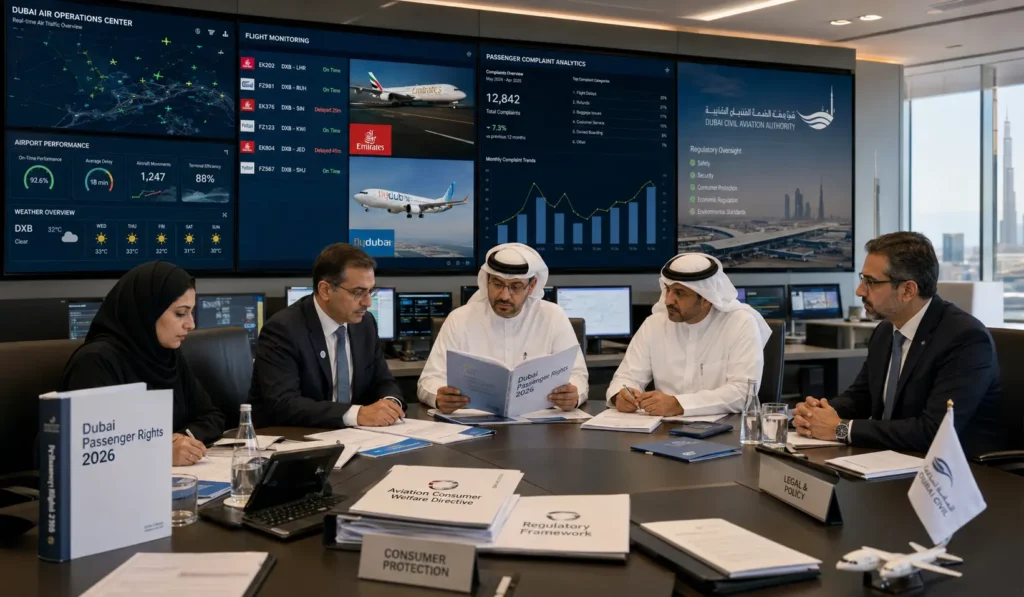
The aviation landscape in the Middle East has undergone a fundamental shift with the introduction of a major legal framework designed to protect air travellers. On April 28, 2026, the Dubai Civil Aviation Authority (DCAA) officially launched the Aviation Consumer Welfare Directive of the Emirate of Dubai. This landmark 17-page document represents the first time in Dubai’s history that passenger rights have been codified into a legally binding rulebook.
This directive arrives at a critical moment for Dubai International Airport (DXB), which continues to function as the world’s busiest international hub. In 2025, DXB handled a record 95.2 million passengers, a significant portion of whom were transit travellers connecting between continents. For millions of passengers flying with Emirates, flydubai, and scores of international carriers, these new rules provide an enforceable safety net that did not previously exist in such a structured format.
Businesses should pay close attention to these changes as they provide a clear regulatory reference for both the rights of travellers and the obligations of airlines and travel agents. The DCAA now serves as a formal mediator, ensuring that the relationship between passengers and service providers remains balanced and aligned with international best practices.
Aviation Consumer Welfare Directive
The directive is comprehensive in its reach, applying to every airline operating commercial flights from Dubai International Airport (DXB) and Al Maktoum International Airport (DWC). This includes Dubai’s national carriers, Emirates and flydubai, as well as their subsidiaries and codeshare partners. Furthermore, all foreign airlines, such as British Airways, Qantas, and Singapore Airlines, must comply with these standards when operating from Dubai.
The regulation also extends to all licensed travel agents operating within the Emirate of Dubai. This means that if a passenger purchases a ticket through a Dubai-based agent, that agent is legally bound to follow the directive’s requirements regarding transparency and assistance during disruptions.
The primary goal of the DCAA is to foster an advanced regulatory environment that strengthens customer confidence in the sector. For investors, this trend is worth watching as it elevates the quality of service and accountability across the entire aviation ecosystem. By creating a level playing field, Dubai aims to protect its reputation as a premier global aviation hub even during times of regional volatility.
Ticket Costing Transparency and Accurate Information
One of the most immediate changes for passengers is the requirement for full transparency during the booking process. Airlines and travel agents are now legally required to provide clear, accurate, and timely information at the point of sale. This must include the total price of the ticket with all taxes and additional fees included, eliminating the frustration of hidden charges appearing at the final checkout stage.
The directive also mandates that passengers be informed of all terms and conditions related to ticket amendments, cancellations, and refunds in plain language. This ensures that travellers fully understand their financial risks before committing to a purchase.
Another crucial requirement is the disclosure of the actual operating carrier. In the world of aviation, “codesharing” is common, where a passenger buys a ticket from one airline but actually flies on an aircraft operated by another. The DCAA now requires that this be made clear so that passengers know exactly who is flying them, which is particularly relevant for those connecting between major international carriers and regional partners.
The Legalized Rights During Postponed Flight
The postponed flights are among the most major disruptions in air travel, and the new directive provides specific, enforceable rights for affected passengers. Airlines are now obligated to communicate proactively with travellers about the nature, reason, and expected duration of any delay.
If a delay exceeds specific thresholds defined by the DCAA’s Passenger Welfare Programme, the airline must provide a “duty of care”. These thresholds typically range between three and eight hours, depending on the distance of the flight.
Key Entitlements During Long Delays Contains:
- Meals and refreshments proportionate to the waiting time.
- Access to communications, such as phone calls or emails, to notify family or business contacts.
- Hotel accommodation if an overnight stay becomes necessary, including transport between the airport and the hotel.
If a flight is delayed, the airline must offer the passenger a choice between alternative travel arrangements on the next available flight, re-routing via another carrier if a commercial relationship exists, or a full refund/voucher for the unused portion of the ticket.
The Mandatory 14-Days Refunds for Flight Cancellation
In the event of a flight cancellation, the Dubai directive introduces a standard that goes beyond many existing international regulations. Airlines are now mandated to process cash refunds for cancelled flights within a strict 14-day deadline. This provides passengers with faster access to their funds if they choose not to accept alternative travel arrangements.
For business travellers, the directive includes a practical tool: the “service disruption certificate”. Airlines are now required to issue these official documents to passengers upon request. These certificates serve as formal proof of the disruption, which can be submitted to employers to justify missed meetings or to insurance companies to support travel insurance claims.
This could shape the market in the coming months as passengers begin to realize they no longer have to wait weeks or months for their money to be returned. The clarity of these rules is intended to reduce the legal grey zones that travellers often encounter when flights are grounded.
Also Read: Family Visa Renewal Fees for Daughter Over 18 UAE
Protection Against Denied Boarding
Airlines sometimes overbook flights, leading to situations where passengers with confirmed tickets are “bumped” from their flight. The new DCAA directive establishes a clear protocol for how airlines must handle these situations.
Before any passenger is involuntarily denied boarding, the airline must first call for volunteers who are willing to surrender their seats in exchange for compensation. This compensation is a matter of negotiation between the passenger and the airline.
If not enough volunteers come forward and a passenger is involuntarily denied boarding, the airline must provide immediate care and assistance. This includes offering alternative travel to the final destination or a return flight to the original point of departure, alongside meals and accommodation where applicable.
Recent Regulations for Lost and Damaged Baggage
Mishandled baggage is a significant source of travel stress, and the directive aims to make the resolution process more transparent. Airlines are now bound by strict regulations to provide clear communication when baggage is lost, delayed, or damaged.
When a passenger reports a baggage issue, the airline must promptly acknowledge the problem and provide a formal claim reference number. For delayed baggage, airlines are required to provide passengers with interim essential items or compensation to cover them.
While baggage claims are also governed by the international Montreal Convention, the DCAA directive adds a local enforcement layer. This means the DCAA can mediate if an airline disputes a baggage claim, ensuring that passengers are treated fairly and receive the compensation they are owed under international law.
Priority for Particular Needs and Vulnerable Passengers
A noteworthy feature of the new framework is its emphasis on protecting vulnerable travellers. The directive specifically mandates that airlines must give due attention and priority to people of determination (passengers with disabilities), elderly travellers, and unaccompanied minors.
This priority applies at all stages of the travel journey, particularly during disruptions. Airlines are expected to provide adequate assistance without discrimination, ensuring that those who need the most help are not left behind during flight delays or cancellations. For families and those travelling with elderly relatives, this provides a critical level of legal assurance when flying through Dubai’s airports.
The DCAA Online Complaints and Feedback Portal
To make these new rights enforceable, the DCAA has launched a dedicated digital portal. This service allows passengers to file complaints directly with the authority and track the status of their cases in real time.
The portal, located on the official DCAA website (dcaa.gov.ae), is free to use. Passengers can create an account using their passport details (for visitors) or Emirates ID (for UAE residents).
You Can File a Complaint This Way:
- Visiting dcaa.gov.ae and navigating to the feedback or passenger protection section.
- Submitting details regarding the flight, the nature of the issue (delay, cancellation, baggage, etc.), and any supporting documents like receipts or photos.
- Tracking the case as the DCAA acts as a neutral mediator between the passenger and the airline or travel agent.
The DCAA has significant enforcement powers to ensure compliance. If an airline or agent fails to resolve a legitimate complaint, the authority can issue fines or, in cases of repeat offences, even suspend the airline’s permit to operate in Dubai.
What is Not Covered By the Directive
While the Aviation Consumer Welfare Directive is extensive, there are specific exclusions that passengers should be aware of. The DCAA complaints portal is designed for “core” travel services and cannot be used for disputes involving non-core services.
Exclusions Are:
- Ancillary services such as seat selection, lounge access, chauffeur services, or loyalty program disputes.
- Matters currently in court or those that have already been adjudicated by a tribunal.
- Criminal conduct or personal injury, which fall under the jurisdiction of law enforcement and specific international treaties.
- Force Majeure events, which are disruptions beyond an airline’s control, such as extreme weather, natural disasters, or government-imposed restrictions.
In cases of force majeure, while airlines may not be liable for financial compensation, they are still required to provide a “duty of assistance,” including facilitating alternative travel and providing care to stranded passengers.
Related Story: Archer Aviation Strengthens UAE Expansion Ahead of Q1 Earnings
Crucial Relevance for the Global Aviation Market
The timing of this directive is significant. Regional challenges, including airspace closures, have recently caused disruptions at major Gulf hubs. By codifying these protections into law, Dubai is sending a clear message to the global travel industry that it remains a reliable and transparent transit point.
For corporate travel managers and multinational employers, the directive provides a clearer recourse when transiting staff through Dubai. Companies can now more accurately model travel risks and ensure their employees’ rights are protected under a formal regulatory framework.
The move also aligns Dubai with other major passenger-rights regimes, such as the European Union’s EU261 and the United Kingdom’s UK261. While the Dubai directive does not currently specify fixed cash compensation amounts in the same way as EU261, its mandatory mediation and 14-day refund rules make it a powerful tool for consumer protection.
FAQs – Frequently Asked Questions
Yes. The directive applies to every airline flying out of Dubai International Airport (DXB) and Al Maktoum International Airport (DWC), no matter if they are Dubai-based or foreign carriers.
Definitely. The directive mandates a strict 14-day deadline for cash refunds if a passenger chooses not to take an alternative flight after a cancellation.
If a delay exceeds the thresholds set by the DCAA (usually between 3 to 8 hours), the airline is legally required to provide you with meals, refreshments, and access to communication.
Under the new rules, you can request a “service disruption certificate” from the airline. This is an official document that’s proof of the cancellation for employers or insurance companies.
You should document the situation and then file a formal complaint through the DCAA’s online portal at dcaa.gov.ae. The DCAA will act as a mediator to resolve the issue.
Yes. The directive covers all licensed travel agents operating in Dubai. Agents must provide accurate pricing, disclose the operating carrier, and assist you during disruptions.
Airlines are generally not liable for financial compensation in “Force Majeure” situations, which are events beyond their control like severe weather or natural disasters.
Absolutely not. The DCAA portal is specifically for core service issues like delays, baggage, and denied boarding. It doesn’t cover services like staff conduct, seat selection, or loyalty programs.

Dwayne Paschke is a seasoned content strategist and AI automation specialist with over nine years of experience at the intersection of journalism and digital innovation. A versatile force in the media landscape, Dwayne has built a reputation as an expert content writer and investigative journalist, contributing high-impact pieces to various reputable news websites.