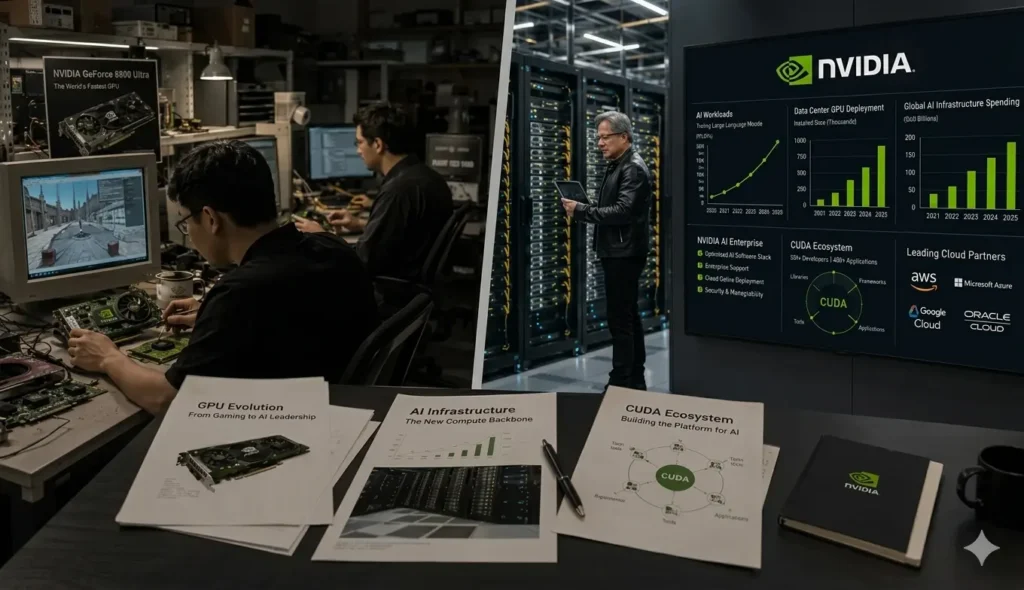
In May 1999, the tech world was transfixed by the impending dot-com bubble and the struggle for personal computer dominance. In that noise, NVIDIA released the GeForce 256, a chip marketed with the relatively niche claim of being the world’s first “Graphics Processing Unit” (GPU). Its primary promise was to offload geometry transformation and lighting from the central processor, allowing for more fluid movement in consumer video games. No industry analyst at the time could have predicted that this specific device category would, within two decades, transcend the realm of entertainment to become the most strategically critical semiconductor class in the global technology economy.
The ascent of NVIDIA is not merely a story of corporate growth; it is a story of a technological metamorphosis. It represents a rare moment where an architectural decision made for one purpose, rendering pixels, aligned perfectly with the mathematical requirements of a burgeoning scientific frontier: artificial intelligence.
Why AI Chose the GPU – Is it Isomorphic Alignment?
The foundation of NVIDIA’s dominance lies in the Parallel Processing Hypothesis. Traditional Central Processing Units (CPUs) are designed for sequential logic, excelling at complex, one-after-another tasks. However, rendering a 3D scene requires performing the same mathematical operations, matrix multiplications and dot products, across millions of pixels simultaneously.
By a stroke of mathematical fate, training a deep neural network requires an almost identical class of operations across billions of parameters in parallel. The computational patterns are structurally isomorphic. This alignment was demonstrated in 2012 when the AlexNet model, trained on consumer-grade NVIDIA GTX 580 cards, publicly proved that GPUs could offer a 10–70× speedup over traditional CPUs. Within 18 months of that demonstration, virtually every major AI research institution globally had reoriented its computational strategy around GPU clusters.
From Fixed Pipelines to CUDA as Architectural Pivot
The transition from a gaming peripheral to an AI substrate was not instantaneous. It required a series of pivotal design decisions that enabled GPUs to execute arbitrary programs. In the early 1990s, graphics hardware operated through fixed-function pipelines, which were entirely inflexible and hard-coded at fabrication.
The turning point arrived in 2006 with the G80 architecture, which introduced a unified pool of shader processors. More importantly, it saw the launch of CUDA (Compute Unified Device Architecture). CUDA was a revolutionary programming model that allowed developers to write general-purpose programs for the GPU using a C-like language. It transformed the GPU from a graphics-only tool into a general-purpose processor capable of handling massive numerical simulations. By the time the Volta architecture debuted in 2017, NVIDIA had introduced Tensor Cores, dedicated hardware units designed specifically for the matrix math of deep learning, achieving performance levels roughly 8× higher than conventional cores.
Why Hardware Rivals Struggle
NVIDIA’s true dominance is not anchored solely in silicon; it is secured by its software ecosystem. The depth of the CUDA platform functions as a structural advantage that persists independently of any specific hardware generation.
By integrating CUDA into the world’s most prominent AI frameworks, such as PyTorch and TensorFlow, NVIDIA ensured that the entire world of AI development was built on its foundations. By 2024, the CUDA developer community numbered in the millions globally. While competitors like AMD (with its ROCm platform) and Intel (with Gaudi) have attempted to challenge this, they remain substantially behind in both performance optimization and ecosystem depth. Switching away from NVIDIA today involves not just buying new chips, but rewriting decades of optimized code, a cost that most enterprises are unwilling to bear.
The New Gold Rush: Hyperscale CapeX
We are currently witnessing an infrastructure investment of a magnitude rarely seen in history. The four major cloud hyperscalers, Microsoft, Meta, Google, and Amazon, have collectively committed hundreds of billions of dollars to GPU infrastructure. In 2025 alone, the estimated AI infrastructure capital expenditure for these giants is expected to exceed $245 billion.
Microsoft alone has disclosed over $80 billion in CapeX commitments for FY2025, with AI infrastructure as the primary driver. Meta has plans to deploy roughly 350,000 H100-equivalent GPUs by the end of 2024. This surge in demand pushed NVIDIA to a market capitalization exceeding $3 trillion in 2024, as it commands between 80% and 90% of the training accelerator market.
Also Read: SpaceX Net Worth 2026 and How It Became a Space Empire
Sovereign Silicon and the Geopolitical Chessboard
NVIDIA’s growth has moved beyond the balance sheets of Silicon Valley and into the heart of geopolitical strategy. Since October 2022, the U.S. government has implemented sweeping export controls to bar high-performance AI chips, like the A100 and H100, from being exported to certain regions, specifically China. This has sparked a “silicon arms race,” with China accelerating domestic development of chips like Huawei’s Ascend 910B to bypass these restrictions.
Furthermore, nations in the Middle East are leveraging their sovereign wealth to secure a place in this new era. The United Arab Emirates (UAE) has aggressively pivoted from oil to AI, positioning itself as a “tech bridge” to the Global South. Bolstered by elite deliveries of NVIDIA’s next-generation Blackwell Ultra GPUs, the UAE is building data centers in partnership with American tech giants to provide AI infrastructure to underserved markets in Africa and beyond.
Similarly, Saudi Arabia’s Public Investment Fund (PIF), which manages assets exceeding $925 billion, has transformed into an “essential engine” for economic diversification. The PIF has shown a high-risk, aggressive investment strategy, funneling billions into techno-focused funds and seeding domestic industries like defense and military technology through subsidiaries like SAMI.
The “Big Three” and Corporate Governance
While NVIDIA and the hyperscalers dominate the headlines, a “quiet power” influences their direction from the shadows. A trio of asset management giants, BlackRock, Vanguard, and State Street, collectively known as the “Big Three,” manage over $24 trillion in assets. They now control over 20 percent of the total market capitalization in the U.S. and are the largest shareholders in 88 percent of S&P 500 companies.
Their influence is a double-edged sword. As “permanent owners” who rarely sell their shares, they provide long-term capital stability and often push for ESG (Environmental, Social, and Governance) principles. However, their dominance creates “accountability gaps,” where a small cluster of non-elected experts can steer corporate strategies, executive pay, and industry standards across the entire global economy, a phenomenon sometimes referred to as “shadow governance”.
The Sustainability Wall: Power, Energy, and Carbon
The final, and perhaps most daunting, challenge to NVIDIA’s growth story is the physics of power. GPU Thermal Design Power (TDP) has risen from 300W in 2017 to a staggering 1,000W for the latest Blackwell B200 generation, a 3.3× increase in just eight years.
A single DGX H100 server draws roughly 10.2 kW of power, and a full rack can exceed 100 kW. Training a frontier language model like GPT-3 is estimated to consume ~1,287 MWh of energy, emitting over 550 tonnes of CO2. As AI compute demand scales, the environmental and energy footprint of these “AI factories” is forcing a total rethink of data center design, moving from air cooling to advanced liquid and immersion cooling systems.
Final Verdict
As we look toward 2030, the architectural trajectory of the GPU is shifting again. NVIDIA’s Blackwell architecture has moved toward a multi-chip module design, combining two GPU dies to achieve sizes that would be physically impractical on a single silicon substrate. Meanwhile, emerging architectures like photonic computing, which uses light for matrix multiplication, and in-memory computing are promising even greater efficiencies for inference.
The story of the GPU is ultimately about the relationship between hardware and algorithm. Algorithmic demand has reshaped hardware design, and hardware affordances have, in turn, shaped what software is possible. Whether NVIDIA can maintain its sovereign status in this ecosystem will depend on its ability to navigate escalating energy demands, geopolitical fracturing, and the inevitable shift toward custom silicon from the very hyperscalers that currently fuel its record-breaking growth.
Related Article: Nvidia Signals Strategic Shift as Jensen Huang Hints at Pullback From OpenAI and Anthropic Investments
FAQs – Frequently Asked Questions
It was an accidental “isomorphism.” GPUs were built for parallel pixel rendering in games, which involves the same matrix multiplication required for training AI neural networks. CPUs process tasks sequentially, making them far slower for deep learning.
CUDA is NVIDIA’s proprietary software platform that allows developers to use the GPU for general-purpose math. It has become a “soft moat” because millions of AI developers have spent decades optimizing their code for it, making it extremely difficult to switch to competitors.
The numbers are historic. In 2025, just the four major cloud hyperscalers are expected to spend over $245 billion on AI infrastructure. Microsoft’s individual CapeX commitment for that year is upwards of $80 billion.
Yes. A single top-tier NVIDIA Blackwell GPU now draws 1,000 Watts. The energy consumed by training a single large model can equal the annual consumption of thousands of households, leading to a massive surge in demand for liquid cooling and power grid upgrades.
BlackRock, Vanguard, and State Street are the world’s largest asset managers. They own roughly 25% of the voting shares in most major U.S. corporations, giving them “hidden power” to influence boardroom decisions and long-term strategic goals without public oversight.
By barring the export of elite chips like the H100 to China, the U.S. has created a tiered system of intelligence. This has forced China to accelerate its own domestic chip production (like Huawei’s Ascend) while causing a supply chain bottleneck for the rest of the world.
The shift to multi-chip modules. Because we have reached the physical limit of how large a single silicon chip can be, NVIDIA is now fusing two dies together in the Blackwell architecture to bypass traditional manufacturing constraints.

Dwayne Paschke is a seasoned content strategist and AI automation specialist with over nine years of experience at the intersection of journalism and digital innovation. A versatile force in the media landscape, Dwayne has built a reputation as an expert content writer and investigative journalist, contributing high-impact pieces to various reputable news websites.