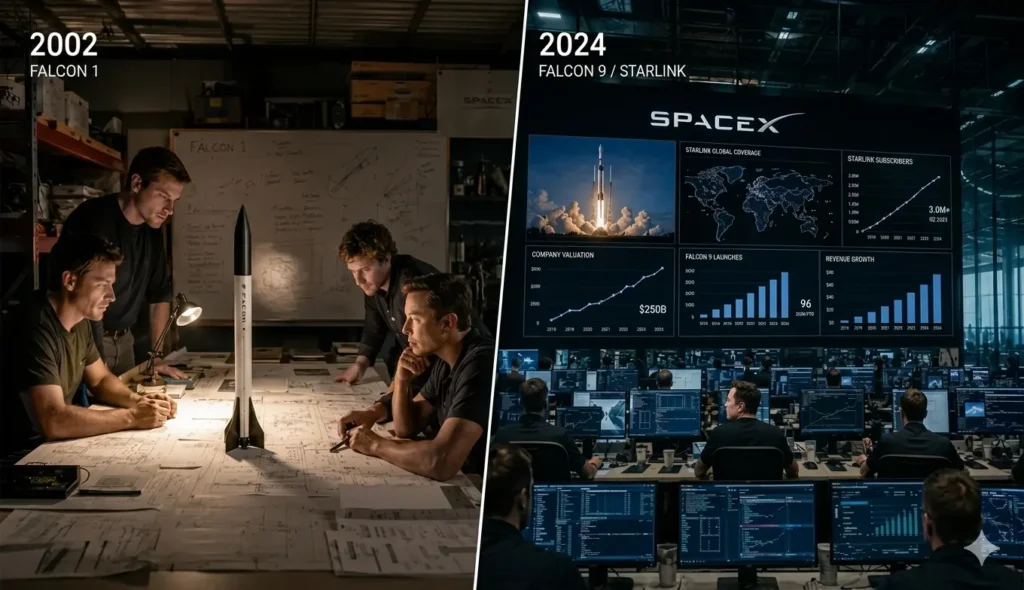
SpaceX was entirely out of funding and facing immediate bankruptcy between 2006 and 2008. The company’s first three rocket launches failed. By the summer of 2008, they only had enough money and capital remaining for one final Falcon 1 launch; if it failed, the company would have dissolved.
Three consecutive launch failures had consumed almost all of Elon Musk’s available capital. He had already poured his PayPal fortune into the company. Engineers were working without salary guarantees. The fourth launch of Falcon 1, a slender, black rocket that represented years of work, was either going to save the company or end it.
Fortunately, it worked. Falcon 1 reached orbit. NASA noticed. A $1.6 billion contract followed shortly after. What began as one man’s eccentric conviction that humanity needed to become multiplanetary became, in the years that followed, the most valuable private company in the history of the world.
In 2026, SpaceX’s net worth, expressed through private secondary market valuations and a confidential IPO filing submitted to the SEC in April 2026, sits somewhere between $1.75 trillion and $2 trillion. That number deserves unpacking. Not just because it is extraordinary, but because of how it got there, and what that trajectory reveals about the nature of long-horizon company building.
SpaceX Valuation Timeline
To ground this valuation in reality, it helps to look at the structural arc of SpaceX’s financial trajectory over the years:
| Year | Milestone / Financial Event | Implied Valuation |
| 2002 | Founded by Elon Musk with ~$100 million in PayPal proceeds. | Initial Capital |
| 2008 | Near-bankruptcy; Falcon 1 success and NASA contract save the company. | Survival Phase |
| 2015 | First successful Falcon 9 first-stage landing—reusability is realized. | Infrastructure Proof |
| June 2024 | Secondary market share transaction. | $210 Billion |
| Dec 2024 | Secondary sale raising $1.25 billion. | $350 Billion |
| July 2025 | Private share sale at $212 per share. | $400 Billion |
| Dec 2025 | Insider tender offer at $421 per share; becomes top private company. | $800 Billion |
| Feb 2026 | SpaceX acquires xAI (Elon Musk’s AI startup) in an all-stock deal. | Strategic Expansion |
| Apr 2026 | Confidential S-1 IPO filing submitted to the SEC. | $1.75 Trillion |
| May 2026 | Bloomberg reports SpaceX raised its public IPO target. | $2.0+ Trillion |
For context, SpaceX generated approximately $15–$18 billion in revenue in 2025, with 2026 projections pointing significantly higher. At a $1.75 trillion valuation, the company trades at roughly 95–100x trailing revenue. While that multiple would be staggering for almost any other business, analysts argue it is anchored by a uniquely powerful economic engine.
How SpaceX Actually Makes Money
Understanding the valuation requires looking at the business architecture, which operates across three distinct and increasingly powerful revenue streams.
Launch Services
SpaceX’s Falcon 9 rocket changed the economics of space access permanently. Before SpaceX, the cost to launch one kilogram to low Earth orbit was approximately $15,600. SpaceX’s reusable Falcon 9 has brought that cost to under $1,000 per kilogram, a reduction of more than 93%.
This wasn’t a gradual improvement; it was an engineered disruption. By designing the Falcon 9’s first stage to land itself and fly again, SpaceX collapsed the economics that had protected legacy incumbents like United Launch Alliance (a Boeing-Lockheed joint venture) for decades.
As of May 2026, Falcon 9 rockets have landed and reflown more than 630 times. The commercial and government launch market is now effectively SpaceX’s to command. In April 2025, SpaceX secured a $5.9 billion Pentagon contract for 28 national security launch missions through 2029. With a standard Falcon 9 launch priced at $74 million and a cadence of 1–3 launches per week, the baseline revenue compounds rapidly.
Starlink’s Exponential Story
If launch services built SpaceX’s credibility, Starlink is building its future wealth.
Starlink is a low Earth orbit satellite internet constellation providing broadband connectivity globally. As of early 2026, Starlink has surpassed 10 million active subscribers worldwide. ARK Invest, which holds SpaceX as its largest venture position, projects Starlink’s 2026 revenue alone will exceed $20 billion.
The global satellite connectivity opportunity is estimated at roughly $160 billion annually at scale. Starlink is adding customers faster than any telecom network in history because it outperforms competitors dramatically on technical specs, delivering speeds up to 215 Mbps compared to legacy satellite options that average 20 Mbps. Furthermore, its military counterpart, Starshield, has become central to U.S. defense infrastructure via highly lucrative classified contracts.
Orbital AI Infrastructure Has Been The Wildcard
This is where valuation math becomes genuinely interesting, and disruptive.
In February 2026, SpaceX acquired xAI, Elon Musk’s artificial intelligence company, in an all-stock deal. The goal is to develop space-based AI data centers. The logic is unorthodox but highly strategic: ARK Invest’s analysis suggests that at sub-$100 launch costs (the ultimate target for Starship, SpaceX’s next-generation mega-rocket), orbital data centers could deliver compute roughly 25% cheaper than ground-based alternatives. Space placement completely bypasses terrestrial power grid constraints, permitting friction, and massive land acquisition costs.
Musk has stated a long-term goal of deploying 100 gigawatts of AI computing capacity from orbit annually. While the timeline is debated, this narrative is a massive valuation driver for public market investors looking for pure AI upside.
Also Read: 15 Philosophical Questions that Shape Great Leaders
The IPO That Could Rewrite Records
SpaceX filed a confidential S-1 with the SEC on April 1, 2026. A June 2026 Nasdaq listing is the reported target, under the ticker SPCE.
If completed at a $1.75 trillion valuation, it will be the largest IPO in history, surpassing Saudi Aramco’s 2019 record by a wide margin. The heavyweight underwriting syndicate includes Morgan Stanley (left-lead), Goldman Sachs, JPMorgan Chase, Bank of America, and Citigroup.
Governance Note: The S-1 discloses super-voting Class B shares carrying 10 votes per share. This structure ensures that Musk and key insiders retain absolute voting control post-IPO, meaning Musk cannot be removed as CEO without the consent of the Class B holders he controls. This governance model will likely face heavy scrutiny from large institutional fund managers.
SpaceX vs. The Legacy Giants
The starkest way to understand SpaceX’s market dominance is to compare its valuation to mature aerospace defense giants:
- Boeing: Founded in 1916, Boeing generates roughly $66.5 billion in annual revenue more than four times SpaceX’s 2025 figures. Yet, Boeing’s market capitalization sits at approximately $155 billion.
- Lockheed Martin: Carries a $141 billion market cap with roughly $71 billion in annual revenue.
- SpaceX: With smaller current revenue, its implied valuation is 10 to 13 times larger than Boeing or Lockheed Martin.
The public markets are aggressively pricing trajectory and operational efficiency over current mature earnings. Boeing and Lockheed operate mature, capital-intensive legacy models plagued by supply chain and operational bottlenecks. SpaceX operates as a high-growth tech platform that vertically integrated its manufacturing, slashed its core product cost by 93%, and built a global telecom network from scratch in under six years.
What Most Analysis Gets Wrong
Most financial coverage fixates heavily on the eye-popping headline numbers. The truly compelling aspect of SpaceX is structural.
The company has achieved a rare feat in corporate history: it simultaneously disrupted an asset-heavy existing market (launch services), created an entirely new multi-billion dollar consumer market (Starlink), and is now front-running a highly speculative frontier market (orbital AI computing).
The risks, however, are just as real as the upside:
- Starship Dependency: If Starship’s fully reusable architecture fails to meet its aggressive cost-per-launch targets, the financial thesis for orbital AI data centers weakens significantly.
- Regulatory Hurdles: Increased geopolitical and regulatory friction could slow Starlink’s international subscriber growth.
- Public Market Valuation Pressures: Pricing a company at $1.75 trillion out of the gate leaves zero margin for execution errors. Public markets can be ruthlessly punishing if growth targets miss by even a small percentage.
Final Verdict
In 2008, SpaceX was one bad engine burn away from total oblivion. In 2026, it is executing a public offering that will rewrite Wall Street record books.
This trajectory was not an accident of luck, nor is it purely a cult of personality. It is the logical result of first-principles engineering meeting aggressive cost-reduction in an industry that had insulated itself from capitalistic competition for half a century.
Whether the $2 trillion valuation thrives under the intense scrutiny of the public quarterly earnings cycle remains to be seen. But the raw physical infrastructure—the launch pads, the 10-million-strong global subscriber base, the cross-planetary defense contracts, and the sheer launch cadence is operational, highly profitable, and accelerating.
That part isn’t speculation. That’s just the numbers.
FAQs – Frequently Asked Questions
Based on its confidential S-1 filing and recent private transactions, SpaceX’s valuation sits between $1.75 trillion and $2 trillion.
SpaceX brought in an estimated $15–$18 billion in 2025. Driven by Starlink’s explosive subscriber growth, 2026 revenue projections are on track to exceed $20 billion.
Following its confidential filing in April 2026, reports indicate the company is targeting a public Nasdaq listing in June 2026 under the ticker symbol SPCE.
Not directly, as it remains private until the upcoming IPO. Currently, retail investors seek indirect exposure via venture fund structures or specialized ETFs that carry private equity allocations (such as DXYZ or XOVR).
SpaceX acquired xAI in February 2026 to pioneer space-based AI data centers. The initiative seeks to utilize Starship’s massive payload capacity to put computational power into orbit, cooling servers naturally in space and bypassing terrestrial energy grid limits.
Unquestionably. The culture modeled by its leadership prioritizes cross-disciplinary engineering knowledge over bureaucratic experience.

Dwayne Paschke is a seasoned content strategist and AI automation specialist with over nine years of experience at the intersection of journalism and digital innovation. A versatile force in the media landscape, Dwayne has built a reputation as an expert content writer and investigative journalist, contributing high-impact pieces to various reputable news websites.