The post Yousuf Hamad Al Shaibani’s Leadership in Dubai’s Digital Security and Space Sectors appeared first on Disruptors Digest.
]]>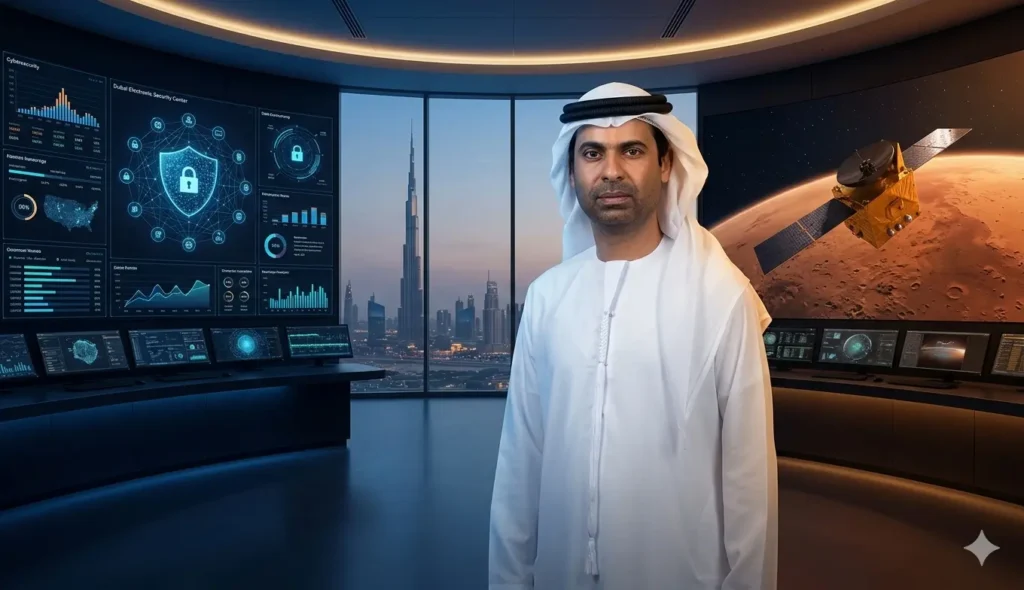
Over the past two decades, the United Arab Emirates (UAE) has evolved from a regional business hub into a global center for technology, digital transformation, cybersecurity, and space innovation. At the center of this change are two critical sectors: cybersecurity and space exploration. His Excellency Yousuf Hamad Al Shaibani serves currently as Chief Executive Officer (CEO) of the Dubai Electronic Security Center (DESC) accordingly to Global Government Cloud Platform, Vice Chairman of Mohammed Bin Rashid Space Centre (MBRSC), and Board Member of UAE Space Agency.
The UAE’s entry into the global space race requires strategic management of complex projects like the Emirates Mars Mission. Understanding the career and strategic decisions of Al Shaibani provides insight into how the UAE balances its digital safety with scientific progress.
Yousuf Hamad Al Shaibani’s Professional Background and Education
The foundation of Al Shaibani’s leadership lies in a strong technical education and over 25 years of experience in the government sector. He graduated from Etisalat University College in 1995. The institution later became part of Khalifa University following the UAE’s higher education restructuring.
To gain international expertise, he moved to the United Kingdom for postgraduate studies. In 1997, he earned a Master’s Degree in Microelectronics Systems Design from Central England University, which is now known as Birmingham City University. This specific focus on microelectronics provided him with the technical knowledge necessary to lead organizations that rely on advanced hardware and software systems.
Al Shaibani is recognized as a founding member of the Dubai Electronic Security Center. His long-term association with the organization, starting from its establishment, allowed him to shape its growth from the ground up. Before becoming the Director General, he held several senior positions and served as a member of the organization’s board of directors.
Related Article: H.E. Dr. Mohamed Al Kuwaiti – UAE Cybersecurity Strategy and His Leadership
Strategic Leadership at the Dubai Electronic Security Center (DESC)
Under the direction of Al Shaibani, DESC has become the primary authority for protecting Dubai’s information and telecommunications networks. His role as Director General and CEO involves overseeing the “cyber readiness” of the city. This is a critical task as Dubai integrates more services into its digital infrastructure through the Digital Dubai department.
Key achievements under his leadership at DESC include:
- Innovation in Cyber Readiness: His development team has created innovative platforms and software designed to detect and prevent digital threats.
- Government Integration: DESC works closely with other government entities to ensure that Dubai’s digital transformation is secure and sustainable.
- Policy Development: As a board member, Al Shaibani has contributed to the strategic policies that govern how data is handled and protected in the emirate.
Advancing the UAE Space Sector through MBRSC
In addition to his security roles, Al Shaibani serves as the Director General of the Mohammed Bin Rashid Space Centre (MBRSC). His involvement in the space sector is extensive. His leadership at MBRSC has been defined by high-profile missions that have placed the UAE on the international stage of scientific exploration.
Significant milestones in the UAE space sector led by Al Shaibani include:
- The Emirates Mars Mission (Hope Probe): Al Shaibani played a key role in the launch of this mission, which successfully reached Mars to study its atmosphere.
- Astronaut Program: He was instrumental in the mission that sent the first Emirati astronaut to space, a move that inspired a new generation of scientists in the region.
- Satellite Technology: Under his guidance, MBRSC has focused on Earth observation and remote sensing technologies, which provide vital data for urban planning and environmental monitoring.
These projects demonstrate a strategic decision to move the UAE economy beyond oil and toward a knowledge-based system driven by science and technology.
National Boards and Councils
Al Shaibani’s influence extends beyond individual centers to national-level policymaking. He holds seats on several influential boards that coordinate the UAE’s technological strategy. These roles ensure that the local successes in Dubai are aligned with national goals.
His current board memberships include:
- UAE Cyber Security Council: This body coordinates cybersecurity efforts across all seven emirates to ensure a unified defense against digital threats.
- UAE Space Agency: Serving on this board allows Al Shaibani to contribute to the overarching national space strategy, including the management of the National Space Fund.
- MBRSC and DESC Boards: He continues to serve on the boards of the organizations he leads, providing continuity and long-term vision.
By holding these positions, Al Shaibani acts as a bridge between operational execution at the centers and strategic planning at the federal level.
The Impact on Dubai’s Economic and Digital Strategy
The dual focus on security and space has a direct impact on the UAE’s economy. Through Digital Dubai and MBRSC, Al Shaibani oversees projects that create high-value jobs and attract international investment in the tech sector. The space sector, in particular, has seen the emergence of a “Space Economy” involving private startups and international collaborations.
For example, the MBRSC manages initiatives such as:
- Space Data Center: A hub for processing and sharing space-related data with international partners.
- National Space Academy: A program designed to train the next generation of Emirati engineers and scientists.
- Startup Support: Large events like Cybertech Global UAE-Dubai provide platforms for startups to interact with government leaders like Al Shaibani to find growth opportunities.
These efforts ensure that Dubai remains a leader in the global “smart city” movement, where technology is used to improve the quality of life for all residents.
Also Read: Zach Perret – Architect Behind Plaid
Key Career Events – Timeline
The following timeline highlights the professional progression of Yousuf Hamad Al Shaibani:
- 1995: Graduated from Etisalat University College (KUSTAR) in Sharjah.
- 1997: Earned a Master’s Degree in Microelectronics Systems Design from Central England University (UK).
- Founding Years: Served as a founding member of both DESC and MBRSC, helping to establish the core infrastructure for Dubai’s cybersecurity and space exploration.
- 2018: Represented DESC at major international events like HITBSecConf2018 in Dubai to discuss regional security challenges.
- 2021-2022: Oversaw the successful progress of the Emirates Mars Mission and participated in global summits like Cybertech Global to promote the UAE’s digital security.
- Present: Continues to lead DESC and MBRSC while serving on the boards of the UAE Space Agency and the UAE Cyber Security Council.
Related Article: UAE Cyber Pulse Initiative – National Cybersecurity Strategy
Future of Emirati Technology and Security
Looking ahead, the work of Al Shaibani suggests that the UAE will continue to prioritize technological independence. The development of local software and satellite technology reduces reliance on foreign systems and builds local expertise. The focus on “cyber readiness” will likely expand as artificial intelligence (AI) and the Internet of Things (IoT) become more common in Dubai’s infrastructure.
In the space sector, the UAE is moving toward more complex exploration and “Space Economy” projects, including the potential for long-term space research and commercial space activities.
Editorial Note
This article has been prepared using information published by official UAE government organizations, institutional biographies, public announcements, and reputable news sources. Leadership positions and organizational responsibilities are subject to change; readers are encouraged to consult official government websites for the latest updates.
Frequently Asked Questions – FAQs
He is the Director General of the Dubai Electronic Security Center (DESC) and the Director General of the Mohammed Bin Rashid Space Centre (MBRSC). He also serves on the boards of the UAE Space Agency and the UAE Cyber Security Council.
He graduated from Etisalat University College (now Khalifa University) in 1995 and received a Master’s Degree in Microelectronics Systems Design from Central England University (now Birmingham City University) in the UK in 1997.
DESC was established to strengthen Dubai’s cybersecurity infrastructure, protect its digital networks, and ensure the city’s readiness against electronic threats.
As a founding member and Director General of MBRSC, he played a key role in the Emirates Mars Mission and the program that sent the first Emirati astronaut into space.
DESC is part of the Digital Dubai department, which aims to digitize all aspects of life in the city. Al Shaibani’s leadership ensures that this digital transition is secure and protected from cyberattacks.
It refers to the commercial and economic activities related to space exploration, including the National Space Fund, space research conferences, and supporting startups in the space sector.
He has over 25 years of experience serving in the government sector and has been with DESC since its establishment.

Dwayne Paschke is a seasoned content strategist and AI automation specialist with over nine years of experience at the intersection of journalism and digital innovation. A versatile force in the media landscape, Dwayne has built a reputation as an expert content writer and investigative journalist, contributing high-impact pieces to various reputable news websites.
The post Yousuf Hamad Al Shaibani’s Leadership in Dubai’s Digital Security and Space Sectors appeared first on Disruptors Digest.
]]>The post Origen Secures $50 Million from Bluefive Capital for AI Expansion appeared first on Disruptors Digest.
]]>
Abu Dhabi-based artificial intelligence firm Origen has secured a $50 million deliberate investment from BlueFive Capital, a Gulf-rooted global investment platform that has been quietly and methodically building one of the region’s most forward-looking technology portfolios. The announcement is significant not because of the dollar figure, though $50 million in a single strategic round is not small by any measure, but because of what it signals about where serious capital is flowing, what kind of AI companies are winning institutional confidence, and what the UAE’s technology ambitions are beginning to look like when they move from government vision documents into actual funded operations.
$50 Million That Changes the Conversation
Before breaking down what Origen plans to do with this capital, it is worth understanding what this investment represents beyond the headline number.
Most technology funding rounds in the artificial intelligence space over the past three years have followed a predictable script. A company with a compelling research angle, a handful of impressive pilot projects, and an articulate founder who can explain neural networks at a cocktail party secures funding based on potential. The pitch is almost always the same: the technology is revolutionary, the market is enormous, and the applications are limitless.
Origen is not pitching limitlessness. It is pitching precision.
Founded in 2025 and headquartered in Abu Dhabi, Origen has positioned itself from day one as an implementation-first AI company — a phrase that sounds almost aggressively boring until you understand what it means in practice. It means the company’s primary obsession is not developing AI systems that perform brilliantly in controlled laboratory conditions. It means building systems that perform reliably, consistently, and safely in environments where the question “what happens if this fails?” has answers that range from expensive to genuinely dangerous.
That positioning is exactly why BlueFive Capital’s $50 million investment landed the way it did. This is not speculative funding chasing the next large language model headline. It is calculated capital being placed behind a company that has identified and is actively closing one of the most persistent and least glamorous gaps in the artificial intelligence industry — the gap between what AI can theoretically do and what it reliably does in production environments under real-world conditions.
Where Origen Is Deploying the Capital and Why Each Decision Matters
Origen has been transparent about its capital allocation strategy, and the sectors it has identified as priority deployment areas reveal a great deal about how the company thinks about AI’s immediate commercial and social value.
Government and Public Services
The relationship between artificial intelligence and government operations is one of the most consequential and least efficiently managed intersections in the modern technology landscape. Public service delivery systems in most countries — including some of the world’s wealthiest — operate on infrastructure, workflows, and data management practices that were designed for a pre-digital era and have been patched, updated, and improvised around ever since.
Origen is deploying AI systems specifically designed to address this structural inefficiency. The goal is not to replace human decision-making in government — a conversation that generates far more heat than light — but to automate the processual, repetitive, high-volume administrative functions that currently consume enormous amounts of human time and institutional budget while delivering outcomes that are slow, inconsistent, and frequently frustrating for the citizens on the receiving end.
In practical terms, this means AI-powered document processing systems that handle applications, verifications, and routing in minutes rather than weeks. It means predictive resource allocation tools that help government agencies deploy personnel and services where demand is highest before the demand surge creates a backlog. It means communication systems that handle routine citizen inquiries at scale without sacrificing accuracy or eroding trust.
The potential efficiency gains in this sector are not marginal. They are structural — the kind of improvements that compound over time and fundamentally change what a public service system can deliver per dollar of investment.
Smart Infrastructure and Connected Living Environments
The phrase “smart home” has been so thoroughly colonized by marketing language that it has nearly lost its meaning. Most people’s experience of smart home technology involves a voice assistant that occasionally mishears commands, a thermostat that requires a computer science degree to reprogram, and a security system that sends false alerts at three in the morning.
Origen’s work in this sector is aimed at something considerably more ambitious. The company is developing integrated AI ecosystems for residential and commercial built environments, systems where the various components of a building’s infrastructure communicate with each other, learn from usage patterns, and make real-time optimization decisions across energy consumption, security, access management, environmental comfort, and maintenance scheduling simultaneously.
The differentiating factor in Origen’s approach is integration depth. The challenge with most smart infrastructure deployments is not that individual components fail to work. It is that they work in isolation, creating siloed data environments that cannot be synthesised into genuinely intelligent building management. Origen’s architecture is designed from the ground up for cross-system communication, producing AI-driven infrastructure that behaves like a coherent system rather than a collection of independent devices that happen to share a Wi-Fi network.
Advanced Manufacturing and Industrial Operations
Manufacturing environments are, in many respects, the perfect testing ground for production-grade AI. They are data-rich, process-intensive, and highly sensitive to variability. A one percent improvement in production efficiency in a large manufacturing operation can translate to millions of dollars in annual savings. A single undetected equipment fault can trigger a cascade of failures whose cost dwarfs the investment required to prevent it.
Origen’s AI systems for industrial applications focus on three core capabilities: predictive maintenance that identifies equipment degradation before it becomes failure; production optimization that continuously analyzes throughput, quality metrics, and resource consumption to identify efficiency opportunities in real time; and quality assurance systems that catch defects at the point of production rather than at the point of customer delivery.
These are not pilot-project aspirations. They are proven AI application categories where the technology has demonstrated measurable, repeatable ROI in mature industrial deployments globally. Origen’s entry into this space with dedicated capital behind it positions the company to capture a significant share of the Gulf region’s advanced manufacturing AI market as the sector continues its technology adoption acceleration.
How Origen Bridges the Gap Between AI Research and Real Results
Here is something the AI industry rarely admits openly: most AI research never leaves the lab.
Not because the science is flawed. But because building a system that dazzles in a controlled environment and building one that performs under genuine operational pressure are two completely different challenges, and most companies are only equipped for the first.
Origen was built specifically for the second.
Founded in 2025, the company operates as an implementation-first AI firm, meaning its definition of success is not a benchmark score or a polished demo. It is a live system, running in a real environment, delivering measurable outcomes when failure is not an option.
The model is straightforward:
- Take advanced AI concepts and evaluate them for real-world viability
- Adapt them for unpredictable, constraint-heavy operational environments
- Integrate them into existing infrastructure without rebuilding everything from scratch
- Stay accountable for performance long after the system goes live
That last point is where most AI companies quietly disappear. Origen’s entire identity is built around not disappearing.
BlueFive Capital’s Innovative Logic
BlueFive Capital made this investment – this point requires understanding how this firm thinks about capital deployment. Using the capital is considerably more sophisticated than a simple bet on AI as a hot sector.
BlueFive Capital, founded in 2024 and operating from Abu Dhabi, manages a diversified portfolio spanning private equity, infrastructure, real estate, and financial services. Its technology investment thesis is not driven by trend-chasing. It is driven by a disciplined analysis of where technological capability intersects with structural economic need in markets that are actively and financially committed to transformation.
The UAE, and Abu Dhabi specifically, represents one of the most concentrated examples of exactly this intersection anywhere in the world right now. The emirate is not simply expressing an aspiration to become a technology hub through policy language and conference appearances. It is backing that aspiration with regulatory frameworks, institutional infrastructure, and substantial public and private capital in ways that create genuine, durable commercial opportunity for AI companies operating in the region.
By investing in Origen, BlueFive Capital is not merely taking a position in an individual company. It is taking a position in the build-out of a regional AI capability that has clear government alignment, strong institutional support, and a growing pipeline of deployment opportunities across exactly the sectors where Origen is already focused.
That is not a speculative bet. That is a calculated positioning in a market where the conditions for success have been deliberately and systematically constructed.
Why Origen and BlueFive Capital Deal Fits Perfectly for Abu Dhabi’s AI Ecosystem
The Origen-BlueFive deal does not exist in a vacuum. It is one data point in a much larger pattern of deliberate ecosystem construction that Abu Dhabi has been executing with remarkable consistency over the past several years.
The emirate has assembled a combination of advantages that few global cities can match for AI company development. The Abu Dhabi Global Market financial centre provides a world-class regulatory environment for technology businesses. The Masdar City innovation district offers purpose-built infrastructure for technology companies at various stages of growth. Government entities including Mubadala, ADQ, and G42 have demonstrated both the appetite and the institutional capacity to partner with AI companies on large-scale deployment contracts that provide the revenue stability early-stage companies need to execute without distraction.
Origen sits squarely within the strategic priorities that Abu Dhabi has identified as central to its long-term economic diversification. The company’s focus on sectors where AI can deliver measurable operational improvement government, infrastructure, and manufacturing maps precisely onto the emirate’s ambition to build a technology-enabled economy that is genuinely productive and globally competitive, not simply well-branded.
This alignment is not coincidental. It reflects a deliberate strategic choice by Origen’s leadership to build a company whose value proposition is as compelling to institutional partners and government clients as it is to private investors, a dual-market positioning that significantly de-risks the growth trajectory.
What this Investment Signals for the Broader AI Era
Step back from the specifics of this deal and a pattern becomes visible that has significant implications for how artificial intelligence develops commercially in the Middle East and globally.
The first signal is about investor maturity. The era of funding AI companies primarily on the basis of research credentials and theoretical capability is giving way, not everywhere and not uniformly, but meaningfully, to a preference for companies that can demonstrate production-grade systems, real deployment experience, and measurable client outcomes. BlueFive Capital’s investment in Origen is an expression of this maturation.
The second signal is about regional ambition. The Gulf region’s technology investment narrative has evolved substantially from the story of wealthy states importing technology from the West and Asia. The emergence of companies like Origen, built in Abu Dhabi, funded by Gulf capital, targeting Gulf-priority sectors, represents something qualitatively different: the early formation of an indigenous AI industry with the potential to export capability rather than simply import it.
The third signal is about execution. All of the strategic alignment, institutional support, and investment capital in the world produces nothing without companies that can actually build, deploy, and sustain AI systems that perform under pressure. Origen has staked its entire identity on being exactly that kind of company. The $50 million it has just secured is the clearest possible statement that at least one serious, experienced, globally connected investor believes the company can deliver on that identity.
Final Verdict
The Origen-BlueFive Capital investment is a story about one company and one funding round. But it is also a story about a region taking AI seriously in a way that goes beyond rhetoric, a capital market evolving toward rewarding execution over narrative, and an emerging AI ecosystem whose most important chapter is still being written.
Origen has the capital, the strategic positioning, and the institutional alignment to make a significant impact on how artificial intelligence is built and deployed across the Gulf region. The sectors it is targeting are the right ones. The timing is right. The backing is credible.
Everything about how Origen has positioned itself suggests it understands this. BlueFive Capital, by committing $50 million, has made clear that it believes Origen can deliver. The real story of this investment will be told not in the press release but in the deployments, the client outcomes, and the precedents that follow over the next three to five years.
The region is watching. The industry is watching. And the clock, as it always does, has already started.
FAQs – Frequently Asked Questions
Origen is an Abu Dhabi-based AI company founded in 2025. It builds and deploys production-grade AI systems across government, smart infrastructure, and advanced manufacturing.
BlueFive Capital is a Gulf-rooted global investment platform founded in 2024. It backed Origen because its implementation-first model aligns directly with the UAE’s Vision 2031 economic goals.
The capital goes toward product development, expanding engineering teams, scaling deployments, and strengthening operational infrastructure. Every dollar is directed at execution, not experimentation.
Origen is focused on government and public services, smart infrastructure, and advanced manufacturing, three sectors where AI failure carries a real and measurable cost.
Abu Dhabi has been building an AI-ready ecosystem through ADGM, innovation initiatives, and global tech partnerships. Origen is exactly the kind of homegrown company that strategy was designed to produce.
Most regional AI firms adopt and resell technology built elsewhere. Origen builds original systems designed specifically for Gulf environments, with full accountability for performance after deployment.
Yes. With Microsoft’s $1.5 billion G42 commitment, NVIDIA’s regional infrastructure push, and the world’s first national AI university operating in Abu Dhabi, the UAE has moved from ambition to execution.
It signals genuine market maturation; Gulf capital is shifting from funding AI narratives to backing companies with real deployments, verified outcomes, and sustainable operational models.
Dwayne Paschke is a seasoned content strategist and AI automation specialist with over nine years of experience at the intersection of journalism and digital innovation. A versatile force in the media landscape, Dwayne has built a reputation as an expert content writer and investigative journalist, contributing high-impact pieces to various reputable news websites.
The post Origen Secures $50 Million from Bluefive Capital for AI Expansion appeared first on Disruptors Digest.
]]>